A car accident injury lawyer can help minimize your liability and maximize compensation after a crash
Wisconsin is known as the Badger State because early miners who settled the region would live in their mines during the cold Wisconsin winters and other people would call them “badgers” because they would burrow underground like the animals. We don’t think anyone is living in underground mines in Wisconsin anymore, and in fact, the state is blanketed by 5 interstate highways, 3 auxiliary interstates, and over 100,000 miles of public roadway.
There were more than 4.2 million licensed drivers in Wisconsin in 2016, so it’s inevitable that there are going to be car accidents — where there are cars, there are crashes. Fortunately, the vast majority of car crashes result in no injury or minor injuries. Statistically, you’re likely to be involved in a handful of car crashes in your lifetime, but most people recover and move forward following an accident.
However, if you’re involved in a serious car accident, it’s important to know how Wisconsin law treats liability, Wisconsin at-fault insurance laws, and what to do to recover compensation for your injuries.
Wisconsin car accident statistics
There were 513 fatal crashes in Wisconsin reported in 2015. By 2020, that number increased to 540.
It might not seem like a huge jump, but each of those 540 people had a family, friends, and a life before their crash.
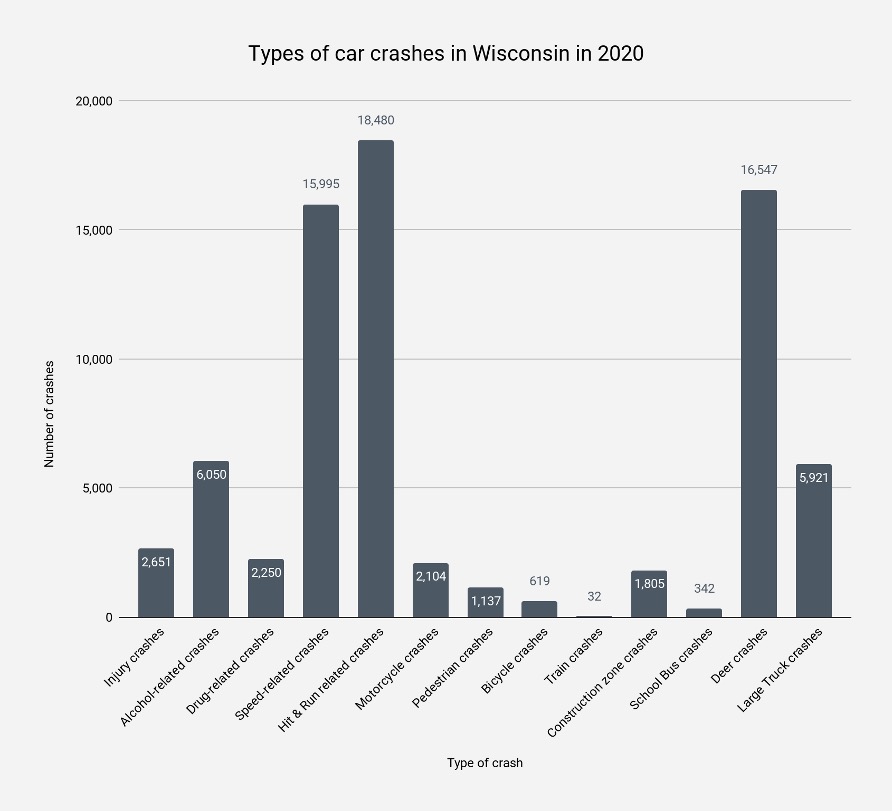
Wisconsin had 115,694 crashes in 2020.
Consider these statistics reported by the Wisconsin Department of Transportation:

Wisconsin is an at-fault state
If you’re involved in a car accident, there are usually 4 paths to recovering damages, or the costs associated with your injury.
In a traditional fault-based system (which is what Wisconsin uses), the person who caused your accident is responsible for paying for expenses related to the accident. If you’re in an accident, you may take any of the following actions to recover compensation:
- File a claim with your own insurance company. If the other driver is at fault, your insurance will likely pursue a subrogation claim against the at-fault driver’s policy.
- File a third-party claim directly with the at-fault driver’s insurance carrier.
- Settle privately with the other driver (i.e. “out of pocket,” instead of using insurance).
- File a personal injury lawsuit.
Because Wisconsin is an at-fault state, the most important aspect to recovering damages is going to be determining who was liable for the accident.
In most situations, a plaintiff would first claim damages from the at-fault party’s insurance policy. If the amount covered by insurance is lower than the amount of the plaintiff’s expenses, the plaintiff could then file a lawsuit for the remaining damages.
Modified comparative fault (51% rule) in Wisconsin
Each state follows 1 of 4 methods for determining how much is awarded in damages if a plaintiff (the injured person) shares a portion of fault for the accident. In Wisconsin, if the plaintiff is 51% or more liable for the accident, they cannot recover any damages.
If a plaintiff is partially responsible for the accident, their damage award would be reduced by the amount for which they are at fault.
Here’s a hypothetical example of Wisconsin’s modified comparative fault rule in action:
Automobile driver Abbey is driving west on Main Street in Madison. Trucker Toby is about to turn right onto West Main from South Bassett Street. However, he misjudges Abbey’s speed as she approaches from his left and he pulls out just as she is traveling through the intersection. Toby hits the passenger side of Abbey’s car and she suffers injuries from the impact.
However, witnesses reported seeing Abbey lean over just before passing through the intersection in order to pick up something from the floor of the passenger side of her car. Even though Toby caused the accident, Abbey could have avoided it if she’d been paying closer attention to the road—at least that’s what Toby’s defense lawyers might assert.
The cost for Abbey’s injuries exceeded the amount covered under Toby’s insurance policy, so she filed a lawsuit for the remaining amount. The court awarded her $50,000 in damages but determined that she was 20% liable for the crash. Therefore, her damage award is reduced by 20% to $40,000.
How to establish negligence for a car accident claim
If you need to file a lawsuit, there are 5 elements that must exist in order to make a valid claim:
- Duty. You must show that the defendant owed you a duty. We all have a duty to someone, and that changes based on circumstances. You don’t have to know someone or have a relationship with them in order to owe them a duty. Every driver has a duty not to cause harm to any other road user, whether it’s other motorists, pedestrians, or bicyclists. Therefore, the fact that the other person was sharing the road with you can be enough to establish a duty.
- Breach. The second element to a personal injury claim is proving that the defendant breached their duty. In a car accident situation, this means the driver was negligent through action or inaction. They might have been following road rules and driving cautiously, but still made an error (like misjudging speed, for example) that was negligent.
- Causation. Once it’s proven that the defendant acted negligently, did that negligence cause the accident? A driver might have rolled through a stop sign, but if that wasn’t the cause of the accident, then they might not be legally negligent in a way that resulted in your injuries.
- Injury. In order to have a valid claim, you must have suffered an injury. If you were in a minor accident like a slow-speed rear-ender, you might be annoyed and frustrated but otherwise unharmed. You can’t claim damages unless you suffered an actual injury, financial costs or property loss.
- Damages. As discussed above, damages are the money you can recover for your losses. Economic damages are the value you can claim for objective expenses, and non-economic losses could be for subjective claims and are based on the severity of your injuries.
Wisconsin car accident laws
Aside from determining liability and insurance payments, there are other Wisconsin laws that will become important if you’re involved in a car accident.
Wisconsin car accident statute of limitations
A statute of limitations is the amount of time you have in which to file a lawsuit. If you intend to file a lawsuit for injuries related to a car accident, you must do so within 3 years of the date of the accident. If you don’t file a lawsuit within that time, the court can decline to take the case.
If you intend to file a wrongful death lawsuit (even if it’s from a car accident), you must do so within 2 years of the date of the victim’s death.
However, if you are going to make an insurance claim, that needs to happen much sooner. Most insurance companies will only process claims that are made within a few days or weeks (depending on the insurer’s policy) after the accident. You should contact your insurance company immediately after an accident in order to be sure you can be covered.
Reporting a Wisconsin car accident
Each state has its own reporting requirements for accidents. In Wisconsin, the driver of a vehicle involved in an accident that results in any injury or death, damage of $200 or more to state- or government-owned property, or damage of $1,000 or more to a state- or government-owned vehicle must immediately report the accident to the police department.
In other words, you have a duty to report an accident to the police for any accident unless it’s a very, very minor collision. This duty extends to passengers, too. If the driver is not able to report the accident right away, a passenger then has the duty to do so.
The bottom line:
If you’re in an accident, call for a police report from the scene.
Wisconsin car insurance laws
You’re required to have car insurance in Wisconsin (and every other state).
There are some rare cases when a driver could opt for other financial security like personal funds or a certificate of self-insurance, but this is unusual.
These are the legal requirements for car insurance in Wisconsin:
| Type of coverage | Minimum amount | What it covers |
|---|---|---|
| Liability coverage for 1 person | $25,000 | Bodily injury or death of 1 person in an accident caused by the owner of the insured vehicle. This includes medical expenses, property damage, and other costs up to the limit of your coverage. |
| Liability coverage for more than 1 person | $50,000 | Total bodily injury or death for an accident caused by the owner of the insured vehicle |
| Liability coverage for property damage | $10,000 | Property damage per accident caused by the owner of the insured vehicle |
| Uninsured motorist | $25,000/person, $50,000/accident | Bodily injury of a driver or their passengers if injured in an accident with an uninsured driver or in a hit-and run. |
The required liability coverage does not include your own injuries or damage to your car. It’s good to have collision or comprehensive insurance coverage for that reason. These are not required, but they are helpful if the other party’s insurance does not cover the full extent of your damage.
Wisconsin laws for the scene of an accident
Wisconsin state law requires a driver to:
- Stop at the scene of the accident. If your car is in traffic, you may move it to a safe place out of traffic, but still near the scene.
- Provide assistance to anyone who was injured, or call for emergency assistance.
- Call the police to report the accident.
- Provide your contact information and vehicle registration to the police and the other involved drivers.
10 most common causes of car accidents
- Distracted driving. Distracted driving is a serious problem. People depend on cell phones for maps, podcasts, music, traffic reports, and other functions, but you should never, ever handle your phone or any electronic device while driving. Distractions can also include eating, passenger behavior, personal grooming, or any other behavior that takes your mind, eyes or hands off driving.
- Drunk driving. You’re not allowed to drive if your blood alcohol content (BAC) is 0.08% or higher. Being under the influence of alcohol, drugs, or some medications can severely affect your driving and raises your risk of causing an accident.
- Aggressive driving. You’ve likely heard of “road rage,” which is when a person becomes so angry at another person that they might bully or physically harm someone on purpose because they’re annoyed. But there are other kinds of aggressive driving that don’t necessarily involve anger at a specific individual. Some drivers might be impatient and speed or swerve around cyclists or cars they think are going too slowly, make unsafe lane changes, or behave recklessly in some other way that could result in an accident.
- Speeding. Sometimes speeding is aggressive, and sometimes it is carelessness. You might speed because you’re in a hurry or running late, but you shouldn’t. Speeding doesn’t get you to your destination any faster if you crash or get a ticket. And when you speed, you have less time to react to a traffic situation in front of you and stop if necessary.
- Reckless driving. Similar to aggressive driving, reckless driving is any kind of action behind the wheel that’s unsafe. It might be speeding, weaving, dodging other cars, failure to stop at lights or stop signs, or any other number of reckless driving practices that break road rules or are unsafe.
- Inexperienced drivers. Your teenager might be the most responsible kid around, and they might care a lot about following road rules, driving at the correct speed, heeding stop lights and signs, and doing everything “right.” But younger drivers are inexperienced. That lack of experience could cause even the most careful driver to misjudge the speed of an oncoming car, poorly execute a turn, or make another mistake that results in an accident. And, some teenagers are more likely to take risks than an older driver would. Statistically, younger male drivers are most likely to make risky driving decisions.
- Tailgating. Tailgating is when a driver follows too closely behind the driver in front of them. Some tailgating is aggressive, but sometimes it happens because someone isn’t paying attention or simply doesn’t see the practice as dangerous. When traveling 55 mph, you should leave 16 car lengths (which is about 243 feet) between your vehicle and the car in front of you. Tailgating is dangerous because when you’re too close to another vehicle, you don’t have enough time to stop if you need to do so quickly. No car can stop on a dime, even if you react quickly. And, even if you stop fast enough, there’s no guarantee that the driver behind you will be able to do so. As a result, tailgating can result in chain-reaction accidents.
- Weather conditions. Wisconsin is no stranger to severe weather — ice, snow, wind, and other conditions are a regular part of life in the Upper Midwest. When the weather is extreme, it’s best to stay off the roads when you can. But when that’s not practical or realistic, exercise caution and drive slowly.
- Failure to obey traffic laws. Traffic laws are more than just stopping at red lights. Following the speed limit, staying in your lane, passing bicyclists safely, and yielding to pedestrians are just a few of the many necessary aspects to driving responsibly. Be familiar with the traffic laws in your local area and state, and obey them at all times to reduce your risk of a collision.
- Failure to stop at a red light or stop sign. Although stopping for stop signs and traffic lights are part of following traffic rules, they’re also among the ones drivers break most often. Even if you think you’re driving through a “quiet” intersection, you must stop completely at stop signs and lights.
What to do after a car accident in Wisconsin
- STOP. Pull your car off the road and out of traffic if no one is seriously injured. Never attempt to move a seriously injured person.
- Call 911. Whether there’s an injured person or not, the police report will also be filed with the DMV and satisfies your reporting requirement. It can also be a valuable piece of evidence.Even if you know or think you’re at fault, a police report can still help you. For instance, a plaintiff could try to claim that they were more injured than they actually were or that their car sustained more damage, but the police report will set forth the facts of the accident exactly as they’re assessed at the scene.It’s important to cooperate with police officers, though you don’t need to make a statement of fault. You’re not required to make a statement about how the accident happened (and it’s probably best if you don’t), but you can and should provide factual information like your name, address, vehicle registration, and those types of answers when asked.
- Seek medical attention. Even if you don’t feel injured, visit a doctor or hospital anyway as soon as possible following a collision. Some car accident injuries like whiplash and head injuries could have symptoms that don’t appear for days or weeks after the accident. If you don’t have an immediate medical assessment of your condition, it can be difficult to prove that a later injury is related to the accident.
- Obtain witness information. A well-meaning bystander might wait to make sure help has arrived or to see if everyone is okay and then leave the scene, figuring there’s no reason to stick around. But if anyone at the scene observed the accident — or the period leading up to it — they might have important, relevant information that can help with your case. Write down each person’s name, phone number, email address, and mailing address if possible.You might also check to see if any surveillance cameras captured the crash on video. Many businesses and residences are equipped with cameras these days. If the accident happened somewhere that’s close to a business or home, you might be able to recover that footage. But be quick as most businesses will delete camera footage within a short time if they don’t think there’s a reason to save it. If you think there might be worthwhile information there, notify the business right away so the footage from that time period can be saved.
- Take photos. Yes, a police report is important, but you’ve heard that a photo is worth a thousand words. If you’re not injured and are able to do so safely, take photos of the scene. Take pictures of the weather, any traffic signs or signals, the vehicles involved, other property damage, road markings, and anything else that might tell a story about how the accident happened and its aftermath. Don’t take photos of another person’s injuries, though, as this is an invasion of privacy (you may photograph your own injuries if you choose).
- Call your insurance company. It’s important to report the accident immediately to your auto insurance company, even if you decide later not to file an insurance claim.
- Contact a personal injury lawyer. Particularly if your accident led to serious injuries, requires ongoing medical treatments, or if you have lost time from work to recover, you might be entitled to a large sum of money. Insurance companies (even your own) will pay out the minimum amount of money that they think you’ll accept — and once you do, you can’t change your mind if you realize it’s not enough to cover your expenses. But your lawyer’s job is to work with financial, medical and actuarial professionals to make sure you’re getting exactly the amount you need so you’re not left with a loss for an accident that wasn’t your fault.
Additional resources
Refer to this list of free printable documents that are designed to help organize your needs after a car accident. Documents include:
- What To Do After a Wisconsin Car Accident
- Bicycle Accidents and Injuries in Wisconsin
- Financial Compensation After a Wisconsin Pedestrian Injury
- Hit-and-Run Crash Injuries, Penalties, and Lawsuits in Wisconsin
- How to Claim an Auto Insurance Payout After a Wisconsin Accident
- The Problem of Distracted Driving in Wisconsin
- Understanding Wisconsin Drunk Driving Laws & Civil Lawsuits
- Understanding Wisconsin Plane Crash & Aviation Injury Lawsuits
- What To Do If You’re Injured in a Wisconsin Bus Accident
- Wisconsin Boating Accidents Can Result in Serious Injuries
- Wisconsin Railroad Accident Injury Lawsuits and Compensation
Did you know that car accident law varies by state?











Hurt in a car crash? You may find these resources helpful


Need a lawyer?

What does an injury lawyer do?
A personal injury lawyer helps individuals who have sustained injuries in accidents to recover financial compensation. These funds are often needed to pay for medical treatment, make up for lost wages and provide compensation for injuries suffered. Sometimes a case that seems simple at first may become more complicated. In these cases, consider hiring an experienced personal injury lawyer. Read more
Common car accidents