
It’s hard to determine fault in a head-on collision. Here’s how to start.
A head-on collision (also called a “frontal” crash) is when cars driving in opposite directions crash front to front. Any car accident can cause injury, but statistics show that head-on crashes are even more likely to result in serious harm or fatality to the driver or passengers in either vehicle.
The Insurance Institute for Highway Safety reported a 58% fatality rate for vehicle occupants in frontal impact crashes in 2017. A head-on crash is more likely in a rural area, and 13% of all rural fatal crashes are head-ons. In urban areas, fewer than 7% of fatal crashes are head-ons.
The chart below looks at the number of fatal head-on collisions as they relate to the total number of fatal crashes from 2015-2020, as reported by the US Department of Transportation, National Highway Traffic Safety Administration.
| Fatal head-on collisions in the United States (2015-2020) | ||
|---|---|---|
| Year | Number | Percent of total fatal crashes |
| 2015 | 3,278 | 10.2% |
| 2016 | 3,511 | 10.2% |
| 2017 | 3,471 | 10.1% |
| 2018 | 3,651 | 10.8% |
| 2019 | 3,613 | 10.9% |
| 2020 | 3,631 | 10.2% |
| Source: U.S. Department of Transportation, National Highway Traffic Safety Administration | ||
Causes of head-on collisions
Sometimes an accident is just that—an accident. It could happen for a mechanical reason like brake failure or a power steering outage.
But usually, a head-on accident is caused when one driver is on the wrong side of the road. Often, it’s because of drunk or distracted driving (like driving while texting), unsafe passing, drowsy driving, or some other kind of confusion behind the wheel like an elderly person who accidentally enters a highway in the wrong direction.
There are other reasons why a driver might swerve into the opposite lane, like if they’re avoiding an animal, debris in the road, or an icy patch.
Establishing fault in a head-on collision
That’s the first question that your insurance company will want answered.
The impact of a crash might send each car in a different direction, which means it could be hard to know immediately how the crash occurred. Your personal injury attorney can retain the services of an engineer or accident reconstruction specialist who’ll determine the cause of the accident and who was at fault.
If you were injured or lost a family member in a head-on collision, the at-fault driver’s insurance company should pay your claim. But the first step is that you need to establish that the other driver was at fault.
Unfortunately, whether it’s an insurance claim or if it becomes a personal injury lawsuit, the burden of proof is on the plaintiff (the injured person or survivors) to establish what they’re owed by the defendant (the at-fault driver).
Here’s what to look for:
- Duty of care. Every driver has a legal obligation to avoid harming others. That includes being alert, sober, rested, and paying attention to the road. If a driver is under the influence of alcohol or drugs (which includes any prescription or over-the-counter medication that could cause impairment), they’re not exercising a duty of care.
- Negligence. A driver is negligent if their conduct was outside of what’s expected of a reasonable person. This might be driving the wrong way on a one-way street, entering a highway using an off-ramp, or driving with excessive speed.
- Cause. This element will be fairly straightforward in a car accident. For any injury claim, the plaintiff must prove that their injuries were directly caused by the defendant’s actions. For example, you wouldn’t have sustained a head injury but for the defendant’s swerving into your lane and causing the accident.
Fault systems by state
States handle fault differently. The court will determine the liability of both parties in a head-on car accident. If the other driver was intoxicated and swerved into your lane, the court might determine that he was 95% at fault. However, it could also determine that if you had reacted seconds sooner and swerved out of the way, the accident might not have happened. If that’s the finding, the court would apportion you 5% of liability.
What happens from that point depends on the state where the case is handled.
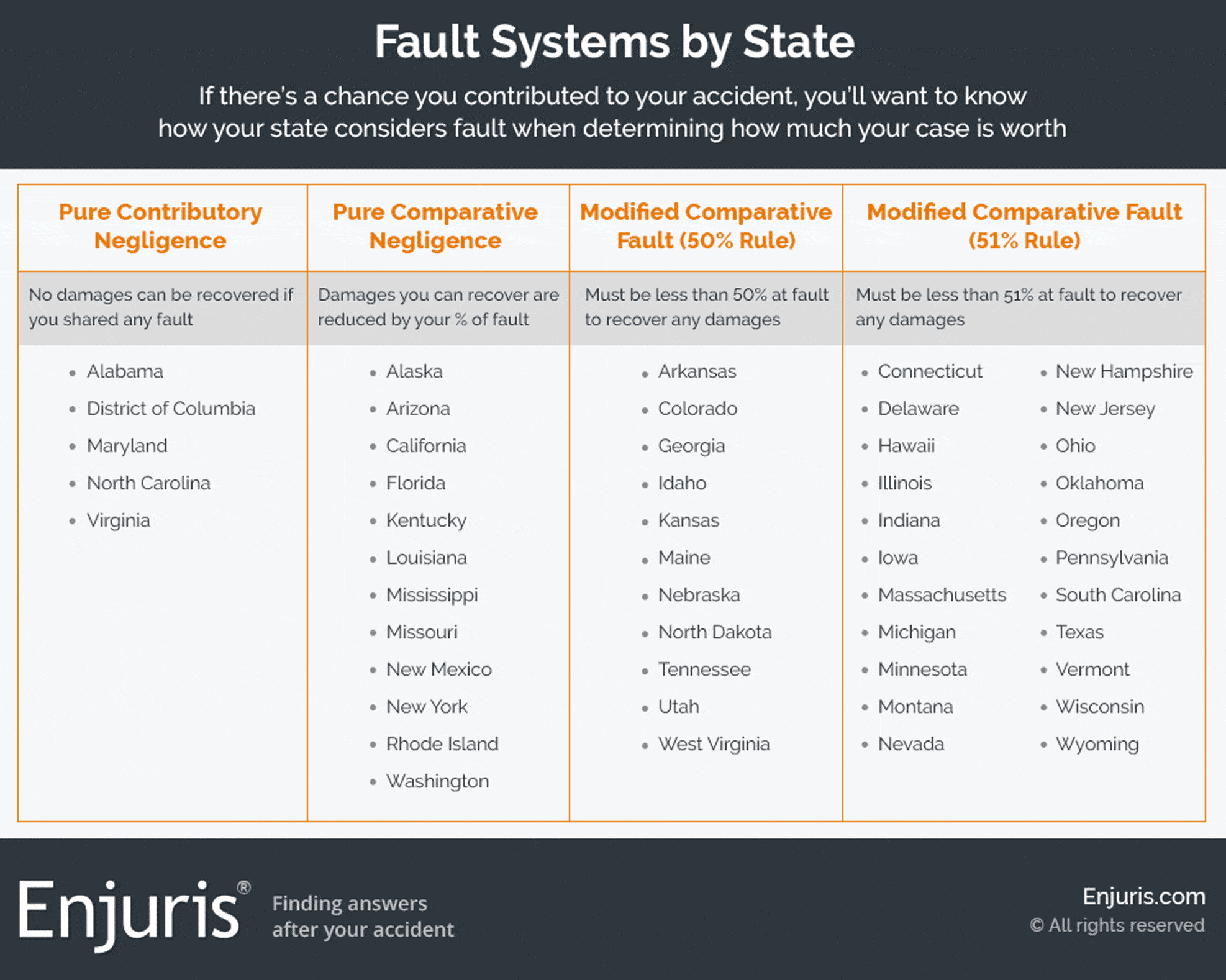
Fault Systems by State
View Full Size Get the Code Use this graphic on your site
Use this infographic on your site
We encourage people to use our infographics, with proper attribution. Just copy and paste the code below to use this infographic on your site. If you need help, let us know!
<a href="https://www.enjuris.com/personal-injury-law/shared-fault-rules/" target="blank"><img src="https://www.enjuris.com/wp-content/uploads/2022/10/fault-systems-by-state-2022.gif" alt="Fault Systems by State" title="Fault Systems by State" style="width: 100%; max-width: 987px; display: block; margin: 15px auto;" /></a>
Determining damages in a head-on collision
Damages for a head-on collision (or any car accident) are for one or more of these reasons:
- Property damage: Costs related to repair or replacement of your vehicle, in addition to external property damage (like broken guardrails, trees, electrical poles, or other cars if there was secondary impact).
- Physical injury damages: Costs related to an injured person’s medical treatment, including the cost of a hospital stay, ambulance or airlift transport, doctor visits, ongoing therapies, medications, medical equipment, lost wages, rehabilitative care, pain and suffering, and future related expenses.
- Wrongful death damages: The survivor of someone killed in an accident can recover damages for wrongful death. The standard for establishing liability would be the same, but the costs would be associated with emergency medical care, burial costs, loss of future income, and loss of consortium for family members.
Crucial evidence to prove liability in a head-on collision
There are steps you can take to strengthen your case after a car accident. The nature of head-on collisions makes it more likely that you would be severely injured, whether you’re the driver or a passenger. Your first priority is to get help for anyone who’s injured. If you’re able, call 911 and get emergency responders to the scene as fast as possible.
Once you’ve received emergency medical treatment and are able to deal with the legal and insurance matters, begin to gather evidence. Obtain a copy of the police report and all medical records associated with the crash.
Next, consult an experienced personal injury lawyer. Even if your insurance is handling the claim, when it’s a large settlement or there are questions about fault, it’s important to get an attorney involved as soon as you can. Your lawyer will work on gathering additional evidence, retaining experts, and determining what you deserve in damages.
If you don’t already have a lawyer you know and trust, the Enjuris Personal Injury Law Firm Directory is a great place to start in finding an attorney who will best represent your interests.
 Your First Meeting with an Attorney
A worksheet to prepare for your first meeting with a personal injury attorney – what to bring, what they'll ask
Download in PDF format
 Personal Injury Attorney Interview Sheet
Worksheet with questions to ask a personal injury attorney to help determine if he or she will be a good fit for your case
Download in PDF format

Bentley’s Law: Financial Justice for Children Orphaned by Drunk Drivers
Bentley Law holds guilty drivers financially accountable for the minor children of parents whose lives have been cut short. Currently enacted in Texas, Maine, Kentucky, and Tennessee, there’s hope that soon it will be law in every state.
See our guide Choosing a personal injury attorney.