
Documenting details after your accident is crucial
So much happens after an accident that remembering it all is impossible.
Trust us – even if it was the most earth-shattering occasion of your life, as the days and weeks pass, the details of an accident start to get fuzzy. Your brain, which normally works overtime to remember everything in sharp detail, will do whatever it can to forget the trauma of what happened in an accident.
Since insurance claims and lawsuits operate on facts, it is important that those details are preserved. This will help build a stronger case for compensation later on, and it will take the stress off of you, so that you can focus on healing.
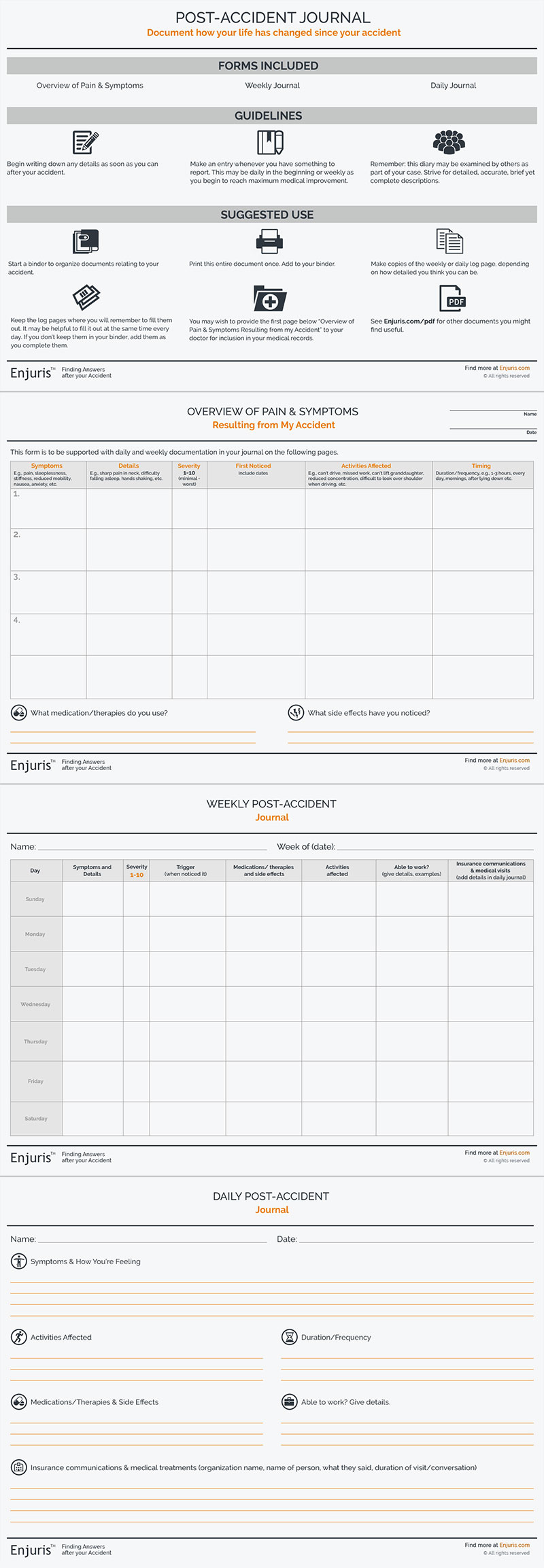
One of the ways you can make sure that no details are forgotten is to keep a post-accident journal (PDF). This is not just a diary; this is a specific book for doctors’ appointments, medication lists, accident details, and injury symptoms that will prove invaluable for your attorney.
 Post-Accident Journal Form
Sample accident journal/diary to help you document the effect on your daily life
Download in PDF format
Account for accident specifics
This should happen immediately after an accident, if possible, though not before you have received appropriate medical attention. Even a few quick items on your phone can do wonders for your injury attorney later on in the legal process. Here are some ideas:
- Road quality
- Weather conditions
- Sun glare
- The driver’s mental state
- Any distractions while driving
- Whether the driver was wearing a seatbelt
- How the accident occurred
These can be incorporated into the accident report and the insurance claim. This can also be added to a proper post-accident journal later on, as everything should be kept in one designated place.
Tweet this
Once you know your side of what happened, you can figure out the rest of the moving parts. Don’t assume the role of investigative reporter, though. Do what you can without interfering with the process.
Conversations with officers, agents and witnesses
You should also keep track of every conversation you personally have with a potential witness or important party to the case. It is better to write everything down, even if it seems unimportant or the witness tries to dissuade you. Your attorney can decide if they need to be spoken with again.
Your attorney might assume the bulk of this work, but he or she likely won’t appear until later in the process. By that time, you will have talked to a large number of people that you might not see again. You won’t remember their names or where they work. Witnesses might have even left the state. If you have their information, they can be contacted again for a deposition or for their testimony.
Pain symptoms, doctors’ visits and medications
One of the most important parts of the post-accident journal is keeping track of pain and medications. This helps your attorney argue your case because it is a quantifiable, measurable output of distress.
For example, your notebook can show that your pain is a consistent six out of 10 on the pain scale, 10 being the worst, and that you regularly take narcotics for relief. Such details can be translated to a jury more easily than something vague such as, “my back hurts.”
It helps to flex your vocabulary and use descriptive adjectives in your journal. Dust off the dictionary and describe your pain as “throbbing,” “stabbing,” “pulsing” or “grinding.” Say that there is a rusted knife stabbing your spinal cord or a giant cork screw twisting in your shoulder muscles. These words paint pictures, which helps others to understand your pain.
These descriptions also help your doctor provide treatment. Write down every doctor you see – physicians, chiropractors, psychiatrists and alternative healers. Also note their contact information and the regimens they prescribe.
Keeping a daily journal will allow doctors to better evaluate your treatment options and see if the current plans are working. Conversely, the journal will allow a potential jury to see any and all doctors’ appointments that you have had, so they can see that you truly are injured. This, along with an updated list of medications, will help your case significantly.
Daily limitations
The most important thing a post-accident pain journal displays is daily limitations after an accident.
Juries need to be shown what you could do before the accident and what you cannot do afterward. These daily limitations at work and at home are where personal injury cases live and die. Writing down everything you can no longer do will tell a story to the jury.
Many people feel that a pain journal can be an invasion of privacy. Nowhere else would we be expected to keep accounts of going to the psychiatrist or how depressed you feel on a daily basis. However, a pain journal lives in a vacuum. The only people who will likely see it are the people involved in your case.
Many injuries are not visually apparent. You might look fine, which could dissuade a jury from giving you a proper settlement.
It’s your job – and your journal’s job – to convey those injuries in a way that can be easily understood. Sometimes a journal is the only thing that can bridge the gap between you and an appropriate settlement in your case.
Enjuris tip: Overshare. Even if you think that you are getting too detailed, write it down. If you aren’t sure you should write it, write it down. There is nothing that is too personal. Your attorney can decide if something is relevant to the case.
Make sure you are consistent. If you write down some details but not others, it will be as if the ones left off didn’t happen. You don’t want the other side using the info in the journal (or lack thereof) as an argument to denying your claim.
If all of these details are written down, it will provide you with a quick reference point for any questions an insurance agent or personal injury lawyer might ask you.
Keeping a post-accident journal also allows you to focus on getting back to your life. Psychiatrists and pain therapists say that journaling allows patients to clear their minds and get negative emotions out on paper. This is actually a therapeutic technique that works well for many patients.
Again, here is our printable post-accident journal (PDF) so that you don’t forget any important details from your accident and post-accident recovery. Keep at it every day, and don’t give up! If you need more patient support and resources, check out our pages for helping with depression and pain as a result of injury.
More accident and pain journals
Feel free to explore sample journals and information created by other organizations for anyone to download and use:
- Enjuris’ post-accident pain journal (PDF)
- The American Cancer Society’s pain log, which can be used regardless of diagnosis
See our guide Choosing a personal injury attorney.