If someone leaves the scene of an accident without providing information, it’s a criminal offense in the Badger State
A hit-and-run is when someone flees the scene of an accident in which they are involved. It’s not always as dramatic as it looks in the movies, though. In general, a hit-and-run occurs any time the driver leaves the scene of a collision without providing their insurance and contact information to the other involved person (or people).
A hit-and-run could apply to any collision, whether it happens:
- While on the road in traffic
- With a parked car in a parking lot or on the street
- Involving a pedestrian, bicyclist, or other road user; or
- With a stationary object (wall, building, mailbox, pet, tree, etc.).
Hit-and-runs are never a good idea for any of the parties — whether you’re the perpetrator (the person who caused the accident) or the victim. A person who leaves the scene of the accident can face stiff penalties under Wisconsin hit-and-run law, and it can be difficult for a victim to collect compensation if they don’t know who caused their injury.
Wisconsin accident reporting requirements
If you’re involved in a crash or collision anywhere in Wisconsin, you’re required to take 4 actions:
- Provide all involved individuals with your name, address, and other contact information
- Provide your vehicle’s registration number and insurance
- Show your driver’s license to other involved parties
- Provide reasonable assistance to anyone injured
If anyone is injured or the accident results in damage valued at $1,000 or higher, you’re required to notify the police department immediately.
If the other vehicle’s driver is not present at the scene, you must locate the driver if possible. If you can’t find the driver, you must either notify law enforcement or leave a note with your name, address and contact information, and the circumstances of the accident.
Wisconsin hit-and-run penalties
The penalties for a hit-and-run in Wisconsin depend on the severity of the accident.
| Severity | Charge | Fine | Jail/prison |
|---|---|---|---|
| No bodily injury | Misdemeanor | $300-$1,000 | Up to 6 months |
| Not “great bodily harm” | Class A misdemeanor | Up to $10,000 | Up to 9 months |
| Great bodily harm | Class E felony | Up to $50,000 | Up to 15 years |
| Fatality | Class D felony | Up to $100,000 | 25 years |
Why do people hit-and-run?
For the most part, a hit-and-run is spontaneous and without premeditation.
Some people simply panic and flee because they’re afraid of getting into trouble and don’t know what to do. Perhaps it’s a teenage driver who’s newly licensed and afraid of the consequences (or they don’t know how their parents will react). Or perhaps it’s someone whose insurance has lapsed, someone driving without a valid license, or a person who already has an arrest warrant and they want to avoid interacting with police.
There’s also a possibility that the person genuinely doesn’t know they caused a collision. For example, if they hit your car gently while navigating in or out of a parking space, it’s possible they weren’t aware there was any contact with your vehicle.
Common defenses to a hit-and-run
There are only a few rarely applied defenses to hit-and-run charges:
- Lack of awareness. As we mentioned above, some people could be unaware that the collision happened.
- Responding to an emergency. If you were involved in an emergency like driving a friend to the emergency room or transporting a pregnant person in labor to the hospital, then you might be able to use that as a defense. This might or might not be accepted, depending on the situation.
- Involuntary intoxication. This applies only if you were drugged and your capacity to drive was diminished by no fault of your own.
How to claim damages as the victim of a Wisconsin hit-and-run
Wisconsin is an at-fault state, which means the person who caused an accident is responsible for paying for the damages related to the accident.
You can claim damages for any type of personal injury. These damages can include:
- Medical treatment, like hospital and doctor visits, prescription medication, diagnostics, ongoing rehabilitative therapies, prosthetic devices, assistive devices, etc.
- Lost wages if you had to take time off from work during your recovery, and lost earning capacity if the accident has left you with injuries that prevent you from continuing to make the same wage you earned prior to the injury.
- Household assistance for daily tasks like cooking, child care, transportation, etc.
- Loss of companionship or consortium if the accident resulted in injury to a family member.
- Loss of enjoyment of life if the injury prevents you from participating in activities you enjoyed previously.
- Wrongful death, if you lost a family member in an accident.
- Emotional distress or mental anguish, and pain and suffering.
- Punitive damages, which could be awarded if the defendant’s action was grossly negligent or intentional.
A plaintiff is entitled to be made whole, or to be restored to the financial condition they would be in if the accident hadn’t happened.
Normally, that means an injured person would file a claim against the at-fault driver’s insurance company. If the amount of the driver’s policy does not cover the full extent of the plaintiff’s damages, the plaintiff can file a personal injury lawsuit to recover the remaining amount.
But what if you can’t identify the at-fault driver?
That limits your options, for sure.
Once you discover damage from a hit-and-run, the first thing you should do is contact the police. They have methods for finding hit-and-run drivers and have access to tools and surveillance that you don’t — but it will be important to act fast. The more time that goes by, the less likely police will be able to identify the driver.
You can also try to locate witnesses on your own. If you’re in an area where there are homes or businesses, find out whether there might be video footage that captured the accident or who was in the area at the time. Even if the accident wasn’t caught on video, it might have captured who entered or exited the premises and be able to lead you to a witness.
Wisconsin uninsured motorist insurance
Wisconsin requires each auto policy to include uninsured motorist coverage at a minimum of $25,000 per person and $50,000 per accident.
This coverage is designed to cover your expenses if you’re in an accident with an uninsured driver, but it also covers a hit-and-run.
You can choose to purchase additional uninsured motorist insurance when you select a policy, and that would provide greater protection if you’re involved in a hit-and-run with higher damages.
If you or the police are able to identify the responsible driver, you can file a lawsuit if the amount of your damages exceeds the amount of insurance coverage. However, you can only sue someone if you know who they are. If the hit-and-run driver is never identified, you can receive damages up to the limit of your own insurance policy.
What can you do if you’re the victim of a hit-and-run?
That depends on the type of accident.
The driver failed to stop in a car crash on the road
If a driver tries to flee, don’t try to apprehend them yourself. Leave it to the police. You don’t want to be involved in a more serious situation such as a dangerous car chase, and you don’t know if they are drunk or dangerous in some other way. Your safety is more important than “catching” the driver.
Whether you’re a driver, pedestrian, or bicyclist, call the police and provide as much information as possible, including:
- The vehicle’s license plate number
- A physical description of the car (color, make, model, identifying characteristics)
- A physical description of the individual if you can get a look (male or female, approximate height/build, hair color, glasses, hat, etc.)
- Damage to the other car
If there are witnesses, get their contact information.
The driver hit your parked car
Parking lots can be dangerous, in part because drivers tend to let their guards down — they often aren’t as careful in a parking lot as they are on the road.
But a moving car is always risky, and parking lots are no exception to the rule.
If you’re approaching your car and find that there’s a dent or scratch that wasn’t there before, what can you do?
A responsible and law-abiding driver will leave a note with their name, phone number, and insurance information. But as you know, not every driver is responsible and law-abiding.
If your car was damaged and you don’t know by whom, you should still file a police report. If the police can find the driver, you’ll have more options for recovering damages.
A Wisconsin driver is also required to carry a minimum of $25,000 in uninsured motorist insurance. If you don’t know who hit your car, you can make a claim using this policy to have your expenses covered.
The driver provided false information
Even if a driver does provide their name and contact information, it’s still considered a hit-and-run if the information is false.
People joke about being “fake numbered”… like when a prospective date gives someone a false phone number so the other person is never able to contact them. In that situation, the only “injury” that happens is a bruised ego or hurt feelings.
But when this happens after an accident, the consequences are much more serious.
Imagine that you were in an accident and dutifully wrote down the name and contact information of the at-fault driver. But when you go to make an insurance claim against the driver, no such driver or policy exists. At that point, there might not be any way to get accurate information or find the person responsible.
Ask to take photos of the other person’s license, registration and insurance card. There’s less opportunity for error in writing down numbers and information if you have a photo for reference.
What if YOU cause an accident?
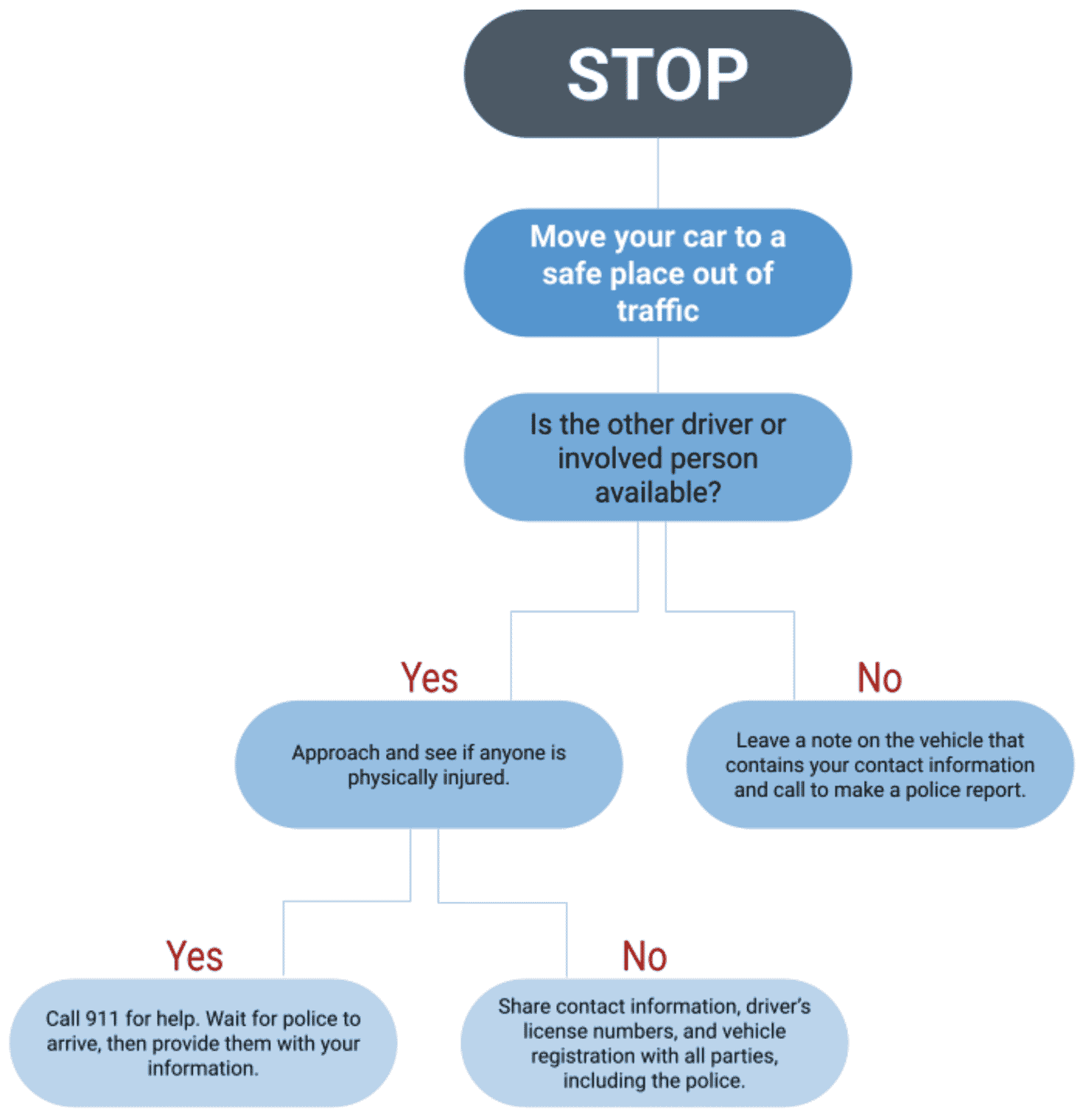
It’s also very important to notify your insurer, regardless of who is at fault and how much information you know about the other driver. Some insurance policies have strict time limits on how soon you need to file a report or notify them of an accident.
Contact a car accident lawyer
A car accident lawyer will be crucial in a hit-and-run investigation, regardless of whether you’re the driver or a victim. As a victim, your attorney will work closely with experts and police in order to try to identify the at-fault driver because that’s the only way you could file a lawsuit if that becomes necessary.
If you left the scene of an accident for some reason, a lawyer might be able to help you mitigate some damages and penalties.
If you need a Wisconsin injury lawyer, use the free Enjuris law firm directory to find a skilled, competent attorney near you who can help with your claim.
See our guide Choosing a personal injury attorney.