
Learn about the compensation (damages) you may be entitled to in your personal injury case
Anytime you’re injured in an accident, you’re entitled to compensation from the party that caused the injury. The amount of compensation you’re entitled to varies depending on the circumstances surrounding the accident and your injury.
If you’re unsure about how to sue or what steps to take, it’s important to speak with an attorney who can guide you through the legal process and help you pursue the compensation you deserve.
In a personal injury case, you’re entitled to compensation from the person or company legally responsible for your injuries. The legal term for this compensation is “damages.” The amount of damages may be agreed to by the parties after a negotiation or may be decided by a judge or jury after a civil trial.
 Damages/Expenses Worksheet
Damages worksheet to track expenses for your injury claim (medical treatment, property damage, lost wages, prescriptions)
Download in PDF format
Damages can be broken down into two groups: compensatory damages and punitive damages. Compensatory damages are intended to compensate a person for the losses associated with their injuries. Punitive damages are rare and are intended to punish the responsible party.
Let’s take a closer look at what damages might be available to you if you decide to pursue a personal injury claim.
Compensatory damages
Compensatory damages are intended to compensate you for the losses caused by your injury. Compensatory damages can be further broken down into two groups: special compensatory damages and general compensatory damages.
Special compensatory damages
Special compensatory damages (sometimes called “special damages” or “specials”) are designed to compensate you for the monetary losses caused by your injury. These losses include:
Medical expenses
Injuries almost always require medical treatment. The cost of treatment can add up quickly. Fortunately, you’re entitled to reimbursement for the medical expenses you incur as a result of your injury. In fact, you’re entitled to future medical expenses as well (i.e., the medical expenses you’re expected to incur after your case is settled). Some examples of medical expenses include:
- X-rays
- Hospital stays
- Emergency room visits
- Physical therapy
- Massage therapy
- Surgeries
- Prescriptions
- Chiropractor
Keep in mind that if your health insurer pays any medical bills related to your injury, the insurer will expect to be reimbursed from the damages you eventually receive. In fact, the insurer will generally place a medical lien on your future award of damages.
Lost income
You’re also entitled to reimbursement for any lost income as a result of your injury. For example, if you couldn’t go to work for two weeks because your ankle was injured in a car accident caused by another driver, you’re entitled to the wages you would have earned during that two-week period.
Similarly, if your injury results in a disability that will reduce your future ability to earn, you’re entitled to compensation for that loss.
General compensatory damages
General compensatory damages (sometimes called “general damages” or “non-economic damages”) are designed to compensate you for the non-monetary consequences of your injury. General damages are difficult to prove, but keeping good records can help.
 Post-Accident Journal Form
Sample accident journal/diary to help you document the effect on your daily life
Download in PDF format
While general damages vary from case to case, common examples include:
Physical pain and suffering
As discussed above, you’re entitled to reimbursement for your medical expenses. However, these expenses don’t take into account the pain and suffering that your injury has no doubt caused.
Physical pain is subjective and as a result insurance companies, judges, and juries have to rely on a number of factors when attempting to determine the value of your pain and suffering. These factors include:
- Type of injury
- Type of medication prescribed
- Length of recovery
- Permanence of the injury
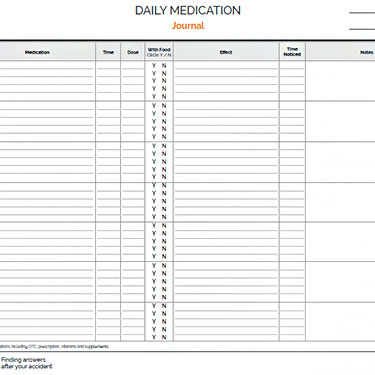 Medication Log Sheet
Printable daily medication log template helps you track your medicines and side effects
Download in PDF format
Emotional distress
In some states, you’re entitled to compensation for the emotional distress (sometimes called “mental anguish”) you may suffer as a result of your injury. Similar to pain and suffering, emotional distress can be difficult to quantify and many states limit the amount of emotional distress damages that you can recover.
Loss of consortium
If you’re married, your spouse may be able to recover loss of consortium damages. The theory behind these damages is that the person who was injured may not be able to provide their spouse with the same level of companionship they were able to provide before the accident. These damages are also difficult to determine and are usually only awarded in cases involving very serious injuries or wrongful death.
Punitive damages
Punitive damages are intended to punish a defendant for their actions and deter similar future conduct. As a result, punitive damages are generally only awarded in cases where the defendant’s conduct is malicious or intentional. What’s more, most states cap the amount of punitive damages that can be awarded.
How to calculate damages in a personal injury case
Many insurance adjusters and attorneys use a formula to arrive at a rough estimate of how much a person’s claim is worth. The formula is as follows:
Special damages x 1-5 (depending on the severity of the injury)
+ lost income = damages.
For example, let’s say you injure your spine in a car accident and incur $60,000 in medical bills. Because of your injury, you also have to miss one year of work for which you would have been paid $45,000. Your formula might look like this:
$60,000 x 5 (because a spinal injury is generally considered severe) = 300,000 + 45,000 = $345,000 (total estimated damages).
Keep in mind that this is only a starting point. The final settlement amount can go up or down depending on a number of factors, such as:
- Quality of the medical evidence
- Length of recovery
- Permanence of the injury
Tweet this
Your actions might impact the amount of damages you recover
If you’re partially responsible for the accident that caused your injuries or you fail to take reasonable steps to minimize your injuries after the accident, the amount of damages you can recover may be reduced.
Comparative and contributory fault
Under the comparative fault theory followed by all states, the amount of damages you can recover is reduced by a percentage that reflects your degree of fault.
In states that follow the pure comparative fault rule, your damages are reduced by your percentage of fault no matter how high that percentage. In states that follow the modified comparative fault rule, your damages are reduced by your percentage of fault, but if that percentage exceeds a certain percent (50% or 51% depending on the state), you cannot recover any damages.
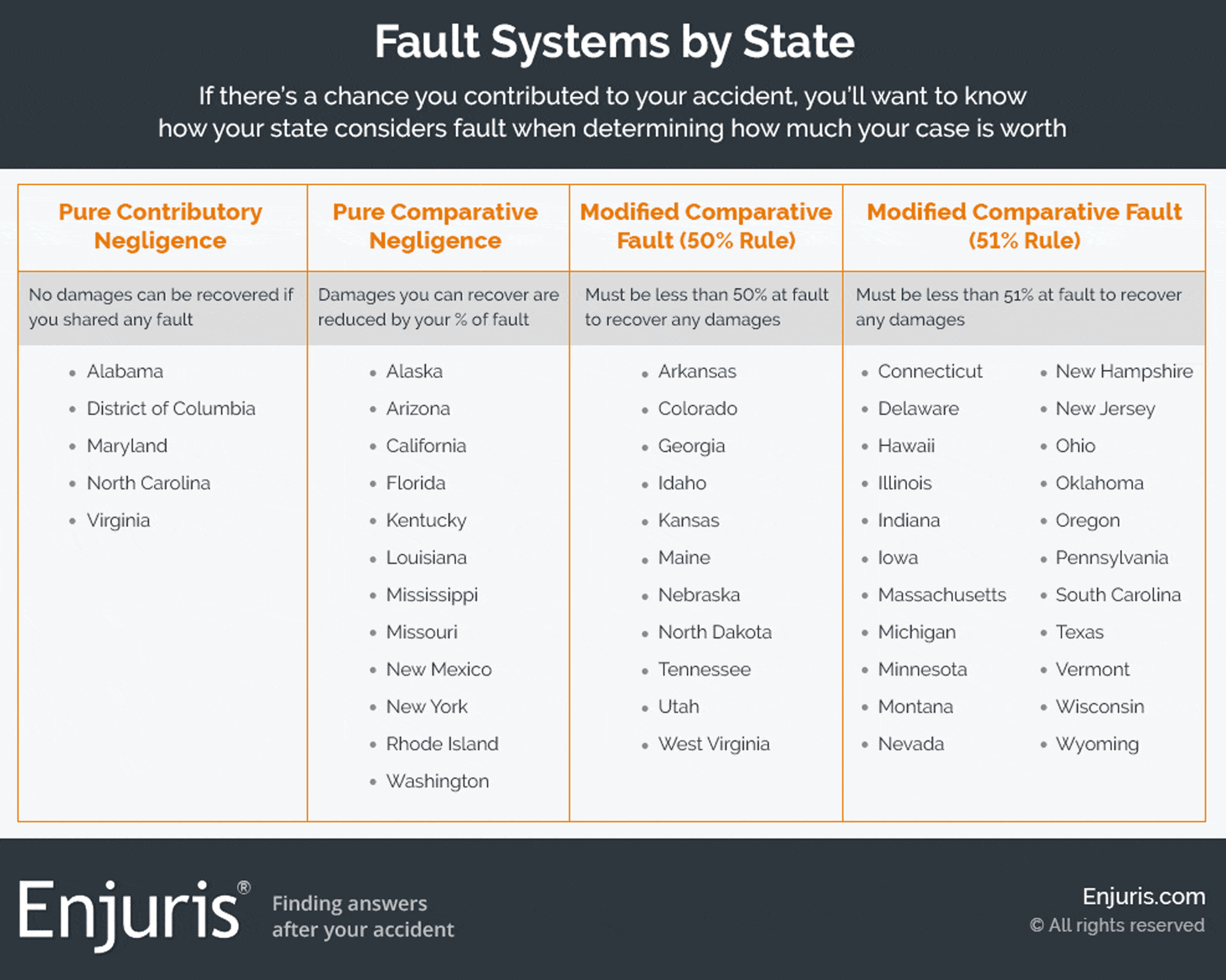
Fault Systems by State
View Full Size Get the Code Use this graphic on your site
Use this infographic on your site
We encourage people to use our infographics, with proper attribution. Just copy and paste the code below to use this infographic on your site. If you need help, let us know!
<a href="https://www.enjuris.com/personal-injury-law/shared-fault-rules/" target="blank"><img src="https://www.enjuris.com/wp-content/uploads/2022/10/fault-systems-by-state-2022.gif" alt="Fault Systems by State" title="Fault Systems by State" style="width: 100%; max-width: 987px; display: block; margin: 15px auto;" /></a>
Failure to mitigate damages
Most states require that you take steps to minimize or “mitigate” the damages caused by your accident. If you fail to do so, your damage award might be reduced. For example, if you injure your leg in a car accident but decide to go hiking rather than to the hospital, your damage award will likely be reduced.
To learn what damages might be available in your specific case, and to make sure you have the evidence you need to support your damages claim, contact a personal injury attorney.
See our guide Choosing a personal injury attorney.