What to do after a car accident in the Beaver State
Whether it’s because of traffic congestion or an abundance of rain, Oregon is consistently ranked as one of the most dangerous states for motor vehicle drivers.
Whether you’re navigating the gridlocked streets of Portland or white-knuckling down coastal route 101, you should be familiar with Oregon’s motor vehicle laws and what to do after a car accident.
Oregon car accident statistics
Oregon ranks as the 10th most hazardous state for drivers in the country, according to data obtained by Insurify. At 13.93%, Oregon’s rate of drivers with prior at-fault accidents is 11% higher than the national average.
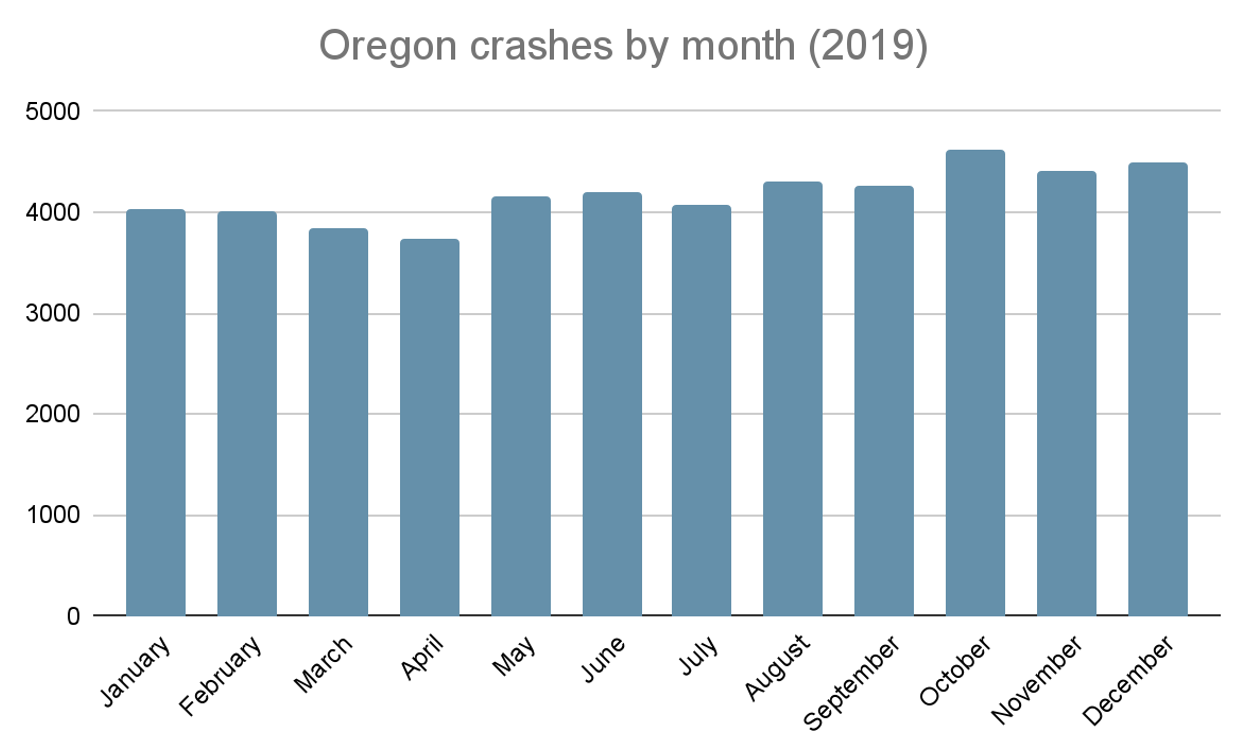
The number of car accidents in Oregon has generally increased over the last decade.
| Oregon car accident statistics (2010-2019) | ||||
|---|---|---|---|---|
| Year | Fatal | Injury | Other | Total crashes |
| 2010 | 292 | 7,451 | 36,350 | 44,093 |
| 2011 | 310 | 8,434 | 40,305 | 49,049 |
| 2012 | 306 | 8,578 | 40,914 | 49,798 |
| 2013 | 292 | 8,074 | 41,128 | 49,494 |
| 2014 | 321 | 8,366 | 42,557 | 51,244 |
| 2015 | 410 | 9,438 | 45,308 | 55,156 |
| 2016 | 448 | 9,891 | 49,709 | 60,048 |
| 2017 | 403 | 9,402 | 47,921 | 57,726 |
| 2018 | 446 | 9,308 | 40,396 | 50,150 |
| 2019 | 456 | 8,993 | 40,679 | 50,128 |
| Source: Oregon Department of Transportation | ||||
The most common time of year for car accidents across the country is during the summer months. In Oregon, most car accidents tend to take place during the winter months.
Laws impacting Oregon drivers
Most laws impacting Oregon drivers can be found in Title 59 of the Oregon Revised Statutes (often referred to as “Oregon’s vehicle code”). These laws cover everything from vehicle registration to when a driver must stop at a crosswalk.
Most of the day-to-day vehicle operation laws you should be familiar with can be found in Chapter 811.
When it comes to Oregon car accident claims, there are 3 laws that will come up almost every time:
- Duty of care. Oregon requires all motor vehicle drivers to exercise “reasonable care” to avoid harming others on the road. To put it another way, the law requires that you operate your vehicle as a person of ordinary prudence would.
- At-fault state. Oregon is an “at-fault” state, which means the driver who caused an accident is responsible for the resulting damages. In “no-fault” states, each driver files a claim with their own insurance company, regardless of who’s at fault for the accident.
- Modified comparative negligence. Oregon is a modified comparative fault state. This means that each driver is assigned a percentage of liability in an accident. A plaintiff’s damages are then reduced by their percentage of fault (if any). What’s more, if the plaintiff’s assigned percentage of liability is 51% or more, the plaintiff will be barred from recovering ANY damages.
Minimum auto insurance requirements in Oregon
Almost all states require drivers to carry car insurance. Pursuant to Oregon Revised Statute Section 806.010, it’s illegal to drive without the following coverage in Oregon:
- Bodily injury and property damage liability coverage
- $25,000 per person
- $50,000 per crash for bodily injury to others
- $25,000 per crash for damage to another’s property
- Personal injury protection (PIP)
- $15,000 per person
- Uninsured motorist (UM)
- $25,000 per person
- $50,000 per crash for bodily injury
Oregon law requires you to carry proof of insurance coverage while you’re driving. You must show your proof of insurance to the other driver if you’re involved in an accident and to the police if you’re pulled over. If you don’t have the required auto insurance, the following penalties apply:
- A fine between $130 and $1,000, and
- A 1-year license suspension
Along with additional liability insurance, drivers in Oregon can purchase the following optional coverage:
- Comprehensive coverage provides coverage for losses other than those caused by a collision (vandalism, falling objects, fire, etc.)
- Collision coverage provides coverage for damage to your vehicle caused by an accident with another vehicle or an object (such as a fence)
- Uninsured motorist (UM) property damage provides coverage for property damage sustained by you or the passengers in your vehicle as a result of an accident involving an uninsured driver.
Post-accident reporting requirements in Oregon
Pursuant to Oregon Revised Statutes 811.700 and 811.705, you must take 3 steps if you’re involved in a car accident that results in injury, death, or property damage:
- Stop. Stop your vehicle at the scene of the accident (or as close to the scene as possible without obstructing traffic).
- Inform. Provide the following information to any person involved in the crash:
- Your name and address, the name of the insurance carrier covering the vehicle, the insurance policy number, and the phone number of the insurance carrier.
- The name and address of the owner of the vehicle, and the name and address of any other occupants in the vehicle.
- Assist. Render reasonable assistance for any injured parties (including taking the injured person to the hospital or making arrangements for the injured person to be taken to the hospital, if necessary).
If you collide with an unoccupied vehicle such as a parked car, you must:
- Stop your vehicle at the scene of the accident, and
- Locate the owner of the property or leave a written note providing your name and contact information.
Failing to take the required steps after a car accident could result in up to 10 years in prison, depending on the seriousness of the accident.
Proving fault after an Oregon car accident
To recover damages after a car accident in the Beaver State, you have to prove that someone was responsible (in legal-ese, “at fault”) for the crash.
In most accidents, proving fault means establishing that the other driver was negligent. To prove that a motor vehicle driver was negligent, you must establish that:
- The driver owed you a duty. All drivers have a duty to exercise reasonable care to avoid harming others on the road.
- The driver breached their duty. To prove that a driver breached their duty, you will have to show that the driver failed to exercise a reasonable degree of care. For example, the driver was following too closely or texting while driving.
- You were injured as a result of the driver’s breach. It’s not enough that the driver failed to exercise reasonable care, you must prove that their failure caused your accident.
Of course, not all car accidents are caused by other drivers. Other potentially liable parties include:
- Property owners. Premises liability laws in Oregon require property owners to maintain their property free from dangerous conditions. This includes public and private roads. If you’re injured as a result of a dangerous condition (such as a large pothole or an obscured stop sign), the owner of the property can be held liable.
- Manufacturers. If your car accident was caused by a defective component (such as a faulty brake system), the manufacturer can be held liable.
Damages available in an Oregon car accident
Oregon allows car accident survivors and their families to recover 3 types of damages:
- Economic damages represent the monetary losses caused by an accident (medical expenses, lost wages, property damage).
- Non-economic damages represent the non-monetary losses caused by an accident (pain and suffering, loss of consortium)
- Punitive damages are intended to punish a defendant and are typically only available if the plaintiff can prove that the defendant acted “with a reckless and outrageous disregard for the health, safety, and well-being of others.”
There is a $500,000 limit (or “cap”) on non-economic damages that applies only to wrongful death cases.
How long do I have to file a personal injury lawsuit in Oregon?
Every state limits the amount of time you have to file a lawsuit following a car accident. This time limit is called the statute of limitations.
In Oregon, the statute of limitations that applies to car accidents resulting in a physical injury is 2 years. In other words, you have 2 years from the date of the accident to file a lawsuit or your lawsuit will be forever barred.
The statute of limitations is extended to 3 years if someone died as a result of the accident and their family member wants to file a wrongful death lawsuit.
If the accident only results in property damage, you have 6 years from the date of the accident to file a lawsuit.
| Oregon car accident statute of limitations | ||
|---|---|---|
| Type of accident | Statute of limitations | Statute |
| Injury to person | 2 years | ORS § 12.110 |
| Wrongful death lawsuit | 3 years | ORS § 30.020 |
| Injury to property | 6 years | ORS § 12.080 |
5 steps to take after an Oregon car accident
If you’re involved in a car accident (especially a serious one), you’re almost certainly going to be overwhelmed with emotion. Do your best to stay calm, and keep these 5 post-accident steps in mind:
- Step 1. Stop and move your car somewhere safe (if possible). Remember, Oregon law requires you to stop at the scene of the accident and exchange information with the other drivers involved.
- Step 2. Call for help. Even if your accident seems minor, it’s a good idea to call the police and get yourself checked out by a medical professional. The police can conduct an investigation and draft a report that may help support your claim for damages. A medical professional can make sure you didn’t suffer any internal injuries that may not be accompanied by symptoms.
- Step 3. Collect evidence. If it’s safe to do so, take photographs of the accident scene (and any damages) and collect contact information for any eyewitnesses.
- Step 4. Notify your insurance company. Most insurance companies won’t cover a claim if it isn’t reported in a certain period of time. You may want to forego making a claim, but there are risks involved with that route.
- Step 5. Talk to an attorney. If you think you may want to file a lawsuit, or if you’re considering settling the matter without insurance, it’s a good idea to talk to an attorney to make sure your legal rights are protected.
Where can I find an Oregon car accident attorney?
Generally speaking, it’s a good idea to meet with a car accident attorney if any of the following statements are true:
- You suffered a serious physical injury in the car accident
- The insurance company denies your claim or offers less than you deserve
- The at-fault driver was uninsured.
- The accident was a multi-car accident or involved a government-owned vehicle
 Your First Meeting with an Attorney
A worksheet to prepare for your first meeting with a personal injury attorney – what to bring, what they'll ask
Download in PDF format
Most initial consultations are free, so meeting with an attorney can provide guidance and peace of mind even if you ultimately decide not to hire an attorney.
- Oregon Car Accident Injuries and Lawsuits
- Guide to Oregon Distracted Driving Accidents and Lawsuits
- Oregon Bike Laws, Accidents and Injury Claims
- Oregon Bus Accident Injury Claims
- Oregon Car Insurance Laws, Requirements and Regulations
- Oregon Drunk Driving Laws, Penalties & Injury Compensation
- Oregon Plane Crashes, Injuries, and Deaths
- Oregon Train Accident Lawsuits & Railroad Employee Claims
- Pedestrian Laws and Injury Claims in Oregon
- What To Do After a Hit-and-Run in Oregon
Did you know that car accident law varies by state?











Hurt in a car crash? You may find these resources helpful



Need a lawyer?

What does an injury lawyer do?
A personal injury lawyer helps individuals who have sustained injuries in accidents to recover financial compensation. These funds are often needed to pay for medical treatment, make up for lost wages and provide compensation for injuries suffered. Sometimes a case that seems simple at first may become more complicated. In these cases, consider hiring an experienced personal injury lawyer. Read more
Common car accidents