Find out what constitutes a “super DUII” in the Beaver State
Roughly 30% of all fatal car accidents in Oregon are caused by intoxicated drivers, according to the National Highway Traffic Safety Administration (NHTSA). That’s nearly 1 in 3 deadly crashes.
Drunk drivers wreak havoc on the roads, but they also create all sorts of unwanted work for those in the judicial system.
In this article, we’ll take a look at drunk driving in Oregon, including the penalties for drunk driving and the options available for people injured in a drunk driving crash.
Oregon drunk driving statistics
The rates of fatal alcohol-related accidents have actually gone down over the years in Oregon. Nevertheless, the state still averages about 3.7 alcohol-impaired driving fatalities per 100,000 people (above the national average of 3.2).
| Alcohol-impaired driving fatality data: Oregon vs. U.S. (2018) | ||
|---|---|---|
| Oregon | National | |
| Total alcohol-impaired fatalities | 153 | 10,511 |
| Percent of alcohol-impaired driving fatalities of total fatalities | 30.2% | 28.8% |
| Under 21 alcohol-impaired driving fatalities | 11 | 980 |
| Percent of under 21 alcohol-impaired driving fatalities of total under 21 fatalities | 23.4% | 24.0% |
| Alcohol-impaired driving fatalities per 100,000 population | 3.7 | 3.2 |
| Source: Responsibility.org | ||
Blood alcohol concentration (BAC) limits in Oregon
In Oregon, you can be charged with driving under the influence of intoxicants (DUII) if you operate a vehicle with a blood alcohol concentration (BAC) of 0.08% or more.
In addition, Oregon has a “zero tolerance” policy for drivers under the age of 21. Under the policy, if you’re under the age of 21 and have ANY amount of alcohol concentration in your system, you can be charged with a DUI.
How much is too much?
While it depends on many factors (such as your biological gender, your weight, how much you’ve eaten that day, etc.), the state of Oregon provides this helpful chart below. Cells highlighted in dark orange indicate being over the legal limit.
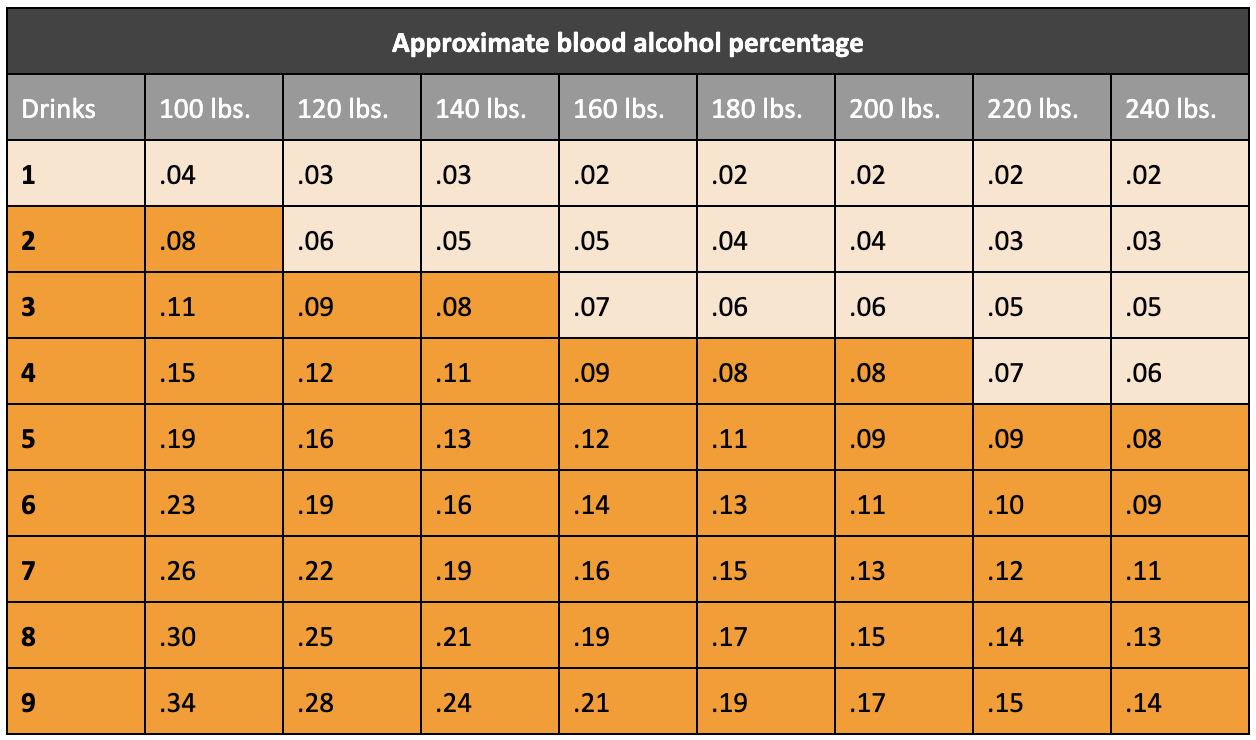
Operating a motor vehicle with a BAC of 0.08% or more is considered a “per se violation,” which means no further evidence of intoxication or impairment is needed to be charged with a DUII. However, drivers in Oregon can be charged with an impairment DUII even if their BAC falls under 0.08%.
To be charged with an impairment DUII, you must be “affected” by alcohol or drugs while operating a motor vehicle.
Evidence often used to support a decision that a person is affected by alcohol or drugs includes:
- Erratic driving
- Poor performance on a field sobriety test
- Slurred speech
- Odd behavior
- An admission of being impaired
Do I have to agree to take a BAC or field sobriety test?
Oregon’s implied consent law requires that you submit to a sobriety test if you’re stopped by a law enforcement officer who has reasonable grounds to believe you’re driving while under the influence of alcohol or drugs.
If you refuse to submit to a test, your license will be suspended for 1-3 years and evidence of your refusal can be used against you in a criminal trial.
Notably, sobriety checkpoints are NOT allowed in Oregon.
Penalties for driving under the influence in Oregon
Most 1st time DUII convictions are misdemeanors. However, you can be charged with a felony DUII if you receive 3 convictions within a 10-year period.
On top of that, if your BAC is higher than 0.15%, you can be charged with a “super DUII” (also called a “high BAC”) which carries enhanced penalties.
Here’s a closer look at the penalties for driving while under the influence of intoxicants in Oregon:
| Oregon DUII penalties | |||
|---|---|---|---|
| Offense | Fines | Jail | License suspension |
| 1st offense | Minimum of $1,000 ($2,000 if BAC is .15% or more) | 48 hours to 1 year in jail (or 80 hours of community service) | 1 year |
| 2nd offense | Minimum of $1,500 ($2,000 if BAC is .15% or more) | 48 hours to 1 year in jail (or 80 hours of community service) | 3 years |
| 3rd offense | Minimum of $2,000 (if the person is not sentenced to a term of imprisonment) to $125,000 (if convicted of a class C felony) | 90 days (if convicted of DUII at least 2 times in the past 10 years) to 5 years in jail | Permanent (may petition the court to restore license after 10 years) |
Tips to prevent drunk driving accidents
Despite the known dangers of drunk driving, people sadly continue to drink and then get behind the wheel.
Being a responsible driver is simple: don’t drink and drive.
Here are 5 tips to help prevent drunk driving accidents:
- Plan a safe ride home before you show up to the bar or party (e.g., choose a non-drinking friend as a designated driver or schedule a taxi).
- If someone you know has been drinking, don’t let that person get behind the wheel.
- If you’re hosting a party where alcohol will be served, make sure all guests leave with a sober driver.
- Always wear your seatbelt (it’s your best defense against drunk drivers).
- If you see an impaired driver on the road, call the police immediately and tell them everything you can about the vehicle and driver. Don’t get too close though.
DUI-related accidents and personal injury lawsuits
If you’re injured in a motor vehicle accident caused by an intoxicated driver, you can file an insurance claim like you would in any other car accident.
You may need to file a personal injury lawsuit against the intoxicated driver if:
- The intoxicated driver is uninsured and your uninsured motorist coverage won’t cover your damages,
- The intoxicated driver’s insurance company doesn’t offer you enough money to settle, or
- Your damages exceed the intoxicated driver’s policy limits.
Keep in mind that in order to recover damages, you’ll need to prove that the intoxicated driver caused your accident. You can’t, for example, recover damages if YOU caused an accident and the other driver involved happened to be intoxicated.
Be sure to call the police after an accident with an intoxicated driver. The police can conduct a field sobriety test and draft a report that may help support your claim down the road.
Oregon’s dram shop law
Dram shop laws hold establishments that sell alcohol (restaurants, bars, theaters, etc.) responsible for serving intoxicated patrons who later cause an accident.
Oregon’s dram shop law can be found in Oregon Revised Statute 471.565. The law states that an establishment may be held liable for damages caused by an intoxicated patron if the following conditions are met:
- The vendor provided alcohol to the intoxicated person while the person was “visibly intoxicated,” and
- The plaintiff did not “substantially contribute” to the intoxication of the patron by:
- Providing or furnishing alcohol beverages to the patron,
- Encouraging the patron to consume or purchase alcohol, or
- Facilitating the consumption of alcohol by the patron.
Steps to take after a drunk driving accident
Once you have taken care of your immediate health concerns, call the police so they can investigate the accident and draft a police report. Be sure to let the responding office know if you suspect the other driver is intoxicated. Your statement (and any evidence you can provide) may help the officer establish the necessary reasonable grounds to administer a field sobriety test.
In addition to calling the police, look around for witnesses and collect their contact information. Witnesses are notoriously difficult to track down days or weeks after a crash. You should also take photographs of the scene, including anything that might support your claim that the other driver was intoxicated.
Be sure to attend all of the follow up appointments with your doctor. Insurance companies and defense attorneys will look for any reason to pay you less by claiming you failed to “mitigate your damages” by not listening to your doctor or not attending medical appointments.
Finally, stay off of social media! Although it may seem harmless, social media posts about your accident or health can be used against you.
Are you ready to receive the compensation you deserve? Use our free online directory to contact an Oregon drunk driving injury attorney near you.

Enjuris comprehensive state-by-state guide to drunk driving laws and penalties across America. Compare DUI, DWI, and OUI penalties, BAC limits, fines, jail time, and more in every state.
See our guide Choosing a personal injury attorney.