
Find out how to establish liability when a bike accident occurs in the Beaver State
Oregon is the 2nd most bike-friendly state in the country, according to the national nonprofit League of American Bicyclists.
The League of American Bicyclists grades 5 categories: infrastructure and funding, education and encouragement, legislation and enforcement, policies and programs, and evaluations and planning.
Oregon received As or Bs in all 5 categories.
Despite the high grades, bicycle accidents still happen in Oregon.
Common causes of bicycle accidents in Oregon
Oregon bicycle accidents have declined slightly over the last 5 years, while the number of fatal accidents has remained relatively consistent.
On average, there are 825 bicycle accidents, resulting in 850 injuries and 10 deaths every year in Oregon.
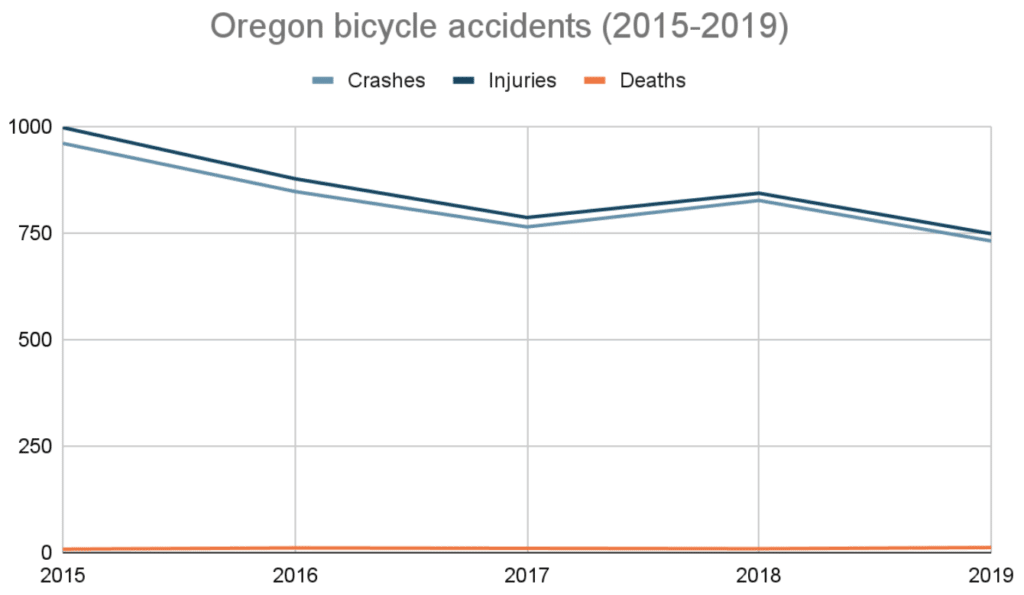
Although Oregon would like to eliminate all fatal bike accidents, Oregon’s 1.8 fatalities per 100,000 bicycle commuters rate is the 2nd lowest in the nation.
The “failure to yield to bicyclists” is the most common cause of bicycle accidents in Oregon, resulting in 353 accidents in 2019.
Other common causes of bicycle accidents include:
- Improper lane change
- Following too closely
- Passing errors
- Right-of-way errors
- Failure to signal
- Failure to obey traffic signals
- Distracted driving
- Drunk driving
“There’s just so many cars, and everybody is shooting out of the side streets, and it’s really hard to see you when they’re looking at 2 lanes of cars from each direction,” said one Bend resident. “So it’s just better not to even be on the road.”
Oregon bike laws
Oregon has a number of statutes intended to keep bicyclists safe on the road. Most of these statutes can be found in Chapter 814 of the Oregon Revised Statutes.
Generally speaking, Oregon bicycle laws can be grouped into 2 categories: bicycle-equipment laws and bicycle-operation laws. Let’s take a look at the highlights.
Bicycle-equipment laws
- All bicycle riders under the age of 16 must wear an approved helmet while operating a bicycle.
- Bicycles must be equipped with a white light on the front that is visible at least 500 feet away in the dark and a red light or reflector on the rear that is visible at least 600 feet away.
Bicycle-operation laws
- Every person riding a bicycle on a public road has the same rights and duties as a motor vehicle driver except where those rights or duties can have no application.
- A person operating a bicycle who is approaching a stop sign can proceed through the stop sign without stopping if the person slows the bicycle to a safe speed and yields the right of way to pedestrians and vehicles lawfully within the intersection.
- A person operating a bicycle must use a bicycle lane or path if one is available.
- A person operating a bicycle must give the appropriate hand and arm signal continuously for at least 100 feet before stopping or executing a turn.
- A person operating a bicycle must not carry a package if it prevents them from keeping at least 1 hand on the handlebar.
Establishing liability (fault) after a bike accident in Oregon
To recover damages after a bicycle accident in the Beaver State, you need to prove that someone else’s actions (or inactions) caused your accident.
There are 3 main types of bicycle accidents:
Bike accidents caused by motor vehicles
Most bike crashes tend to be simple falls, but the most serious bike crashes involve other cars.
If you’re involved in an accident with a motor vehicle, you’ll need to prove that the motor vehicle driver was negligent.
To prove negligence in Oregon, you must establish the following 3 elements:
- The driver owed you a duty. All drivers have a duty to exercise “reasonable care” to avoid harming others on the road.
- The driver breached their duty. To prove that a driver breached their duty, you will have to show that the driver failed to exercise a reasonable degree of care. For example, running a red light or texting while driving almost certainly constitutes a breach of duty.
- You were injured as a result of the driver’s breach. It’s not enough to prove that the driver failed to exercise reasonable care; you must prove that the failure caused the accident and resulting injuries.
Bike accidents caused by road conditions
Premises liability laws require property owners in Oregon to keep their property free from conditions that pose an unreasonable risk of harm.
If a bicyclist is injured as a result of a condition that poses an unreasonable risk of harm (such as a large pothole or obscured traffic signal), the owner of the property can be held liable.
It’s important to keep in mind that public roads are owned by the town, city or state, and plaintiffs must follow special procedures when suing the government.
If your bicycle accident was caused by poor road conditions on a public road, it’s a good idea to meet with an experienced personal injury attorney as soon as possible to ensure that you follow the proper procedures.
Failing to follow the proper procedures could result in your lawsuit being permanently barred.
Rhianna’s father filed a $9.1 million wrongful death lawsuit against the city and the Oregon Department of Transportation (ODOT), alleging that road conditions contributed to his daughter’s death.
The lawsuit alleges that the city of Corvallis and ODOT were negligent because:
- The design of the intersection failed to comply with existing state law stopping sight-distance standards.
- Officials did not inspect or maintain the required sight distance standards prior to the collision.
- Officials did not fix or modify the intersection to improve sight distances for vehicles, drivers and pedestrians.
- They failed to have a policy to recognize and address line-of-sight issues.
- There were no signs posted to warn pedestrians or bicyclists about obstructions in lines of sight.
Rhianna wasn’t the first to be hit as she crossed the intersection at Highway 99W and Third Street. Two other bicyclists were previously killed crossing the same intersection.
Bike accidents caused by a defective bike component
If your bicycle accident is caused by a defective bike component (such as a faulty brake system), the manufacturer can be held liable.
Product liability claims are based on negligence or strict liability.
In a product liability case based on negligence, you must prove that:
- The manufacturer owed you a duty of care (generally speaking, manufacturers owe a duty of care to all potential users to prevent injuries arising as a result of a fault or failure of their products),
- The defendant breached their duty of care, and
- The defendant’s breach caused your injuries.
In a product liability case based on strict liability, you must prove that:
- The bike component was sold in an “unreasonably dangerous” condition,
- The unreasonably dangerous condition existed when the component left the defendant’s control, and
- The unreasonably dangerous condition caused your injuries.
Modified comparative negligence and bicycle accident liability
It’s not uncommon for a bicyclist to be partially at fault for their accident.
Oregon has a modified comparative negligence law in which a plaintiff’s damages are reduced by their percentage of fault.
For example, if a jury finds that a bicyclist is 30 percent at fault for their accident, the bicyclist’s damages will be reduced by 30 percent.
What’s more, if the plaintiff is found to be more than 50 percent at fault for the accident, they’re barred from recovering ANY damages.
Does insurance cover a bike accident?
Oregon has a fault-based insurance system, which means that whoever causes an accident is responsible for paying the damages.
To put it another way, if a motor vehicle driver causes a bike accident, the injured bicyclists can file a claim against the at-fault driver’s auto insurance policy.
But what happens if a bicyclist causes an auto accident or if the at-fault driver fled the scene and cannot be found? Who pays for damages?
Generally speaking, your car insurance policy will NOT cover an accident that you caused while riding your bicycle. However, some car insurance policies have additional coverage (such as PIP coverage) that might apply.
What’s more, homeowners’ and renters’ insurance policies sometimes cover damages to your bicycle. Health insurance typically does not cover damages to your bicycle, but it will, of course, cover certain injuries.
If a motor vehicle driver causes your accident and flees, your uninsured motorist (UM) coverage (which is required in Oregon) will cover the damages up to the policy limits.
Bike accident injuries and damages
When bicyclists collide with motor vehicles, the bicyclists don’t often come out on top.
Fortunately, Oregon law allows bike accident victims to recover the following damages:
- Economic damages represent the monetary losses caused by your accident (e.g., medical expenses, lost wages, property damage).
- Non-economic damages represent the non-monetary losses caused by your accident (e.g., pain and suffering, loss of consortium).
| Common bicycle accident injuries | |
|---|---|
| Head | Skull fracture, concussion, brain contusion, intracranial hemorrhage |
| Face/eye | Contusions, facial fractures, dental fractures, corneal foreign bodies |
| Musculoskeletal | Fractures, dislocation, strains |
| Chest | Rib fractures, parenchymal lung injury |
| Abdomen | Splenic rupture, hepatic laceration, renal contusion, pancreatic trauma, vascular perforation, small or large bowel contusion, rupture, traumatic hernia |
| Genital and urinary | Urethral and vulval trauma, rectal trauma, pelvic fractures |
| Source: American Family Physician Journal | |
Steps to take after a bike crash
If you’re able to do so safely, take the following steps after an Oregon bike crash:
- Seek medical attention. Even if you don’t think you’ve been seriously injured, it’s a good idea to see a doctor immediately after a bicycle accident. The symptoms of some injuries, including serious internal injuries, may not appear for hours or even days after an accident. What’s more, going to the hospital after a crash creates a record that can be used to support a legal claim down the road.
- Call the police. The police can conduct an investigation and draft a police report. Police reports aren’t always admissible in court, but they can include helpful information, such as the names and contact information of any witnesses.
- Don’t apologize or admit to liability. Even if you think the accident was your fault, avoid apologizing for the accident or saying anything else that suggests you’re at fault. It’s up to the court to decide who’s at fault.
- Collect driver information. Be sure to write down or take a picture of the driver’s name, license, contact information, insurance information and license plate number.
- Collect witness information. Witnesses are notoriously difficult to track down after an accident. The best chance of collecting their contact information is immediately after the crash.
- Preserve evidence. Take pictures of the scene and any damages (including physical injuries). In addition, if your shirt was bloodied or your bike was mangled, be sure to preserve those items.
- Review all of your insurance policies. As discussed above, some of your insurance policies (homeowners insurance, renters insurance, etc.) may provide coverage for your bike accident.
- Don’t post anything about your bike crash on social media. Social media posts, more often than not, will hurt your personal injury case.
Oregon is teeming with bike accident attorneys. However, you want to be sure to hire the right bike accident attorney for your case. Whether your bicycle accident occurred in a big city like Portland or a small town like Oakland, you can use our free online directory to locate an experienced bike accident attorney in your area.
See our guide Choosing a personal injury attorney.