
Recover the compensation you need to manage your traumatic brain injury
Head and brain injuries occur as a consequence of car crashes, slip and falls, and other accidents that involve a forceful blow to the victim’s head. Though some head and brain injuries are immediately apparent, others allow the victim to appear healthy at first and only manifest days or weeks later.
The most serious head injuries result in traumatic brain injury (TBI). TBI is caused by an impact to the head that disrupts the normal functioning of the brain. The severity of TBI ranges from mild (i.e. a brief change in mental status or consciousness, such as a concussion) to severe.
In this article, we’ll take a look at common head and brain injuries (with a focus on TBI), who’s liable for these injuries, and what damages might be available.
Head and brain injury statistics
Unfortunately, head and brain injuries are more common than you might think.
Here are some startling facts gathered from the American Association of Neurological Surgeons, the Brain Injury Association of America, and the Centers for Disease Control and Prevention:
- An estimated 1.7 million cases of TBI occur every year in the United States
- Approximately 5.3 million people live in the US with a disability caused by TBI
- Every 9 seconds someone in the US sustains a brain injury
- Approximately 50,000 people die from TBI every year
- Rates of death caused by TBI are highest among those 75 years of age and older
- 2.2 million people are treated for TBI in emergency departments and trauma centers in the US every year
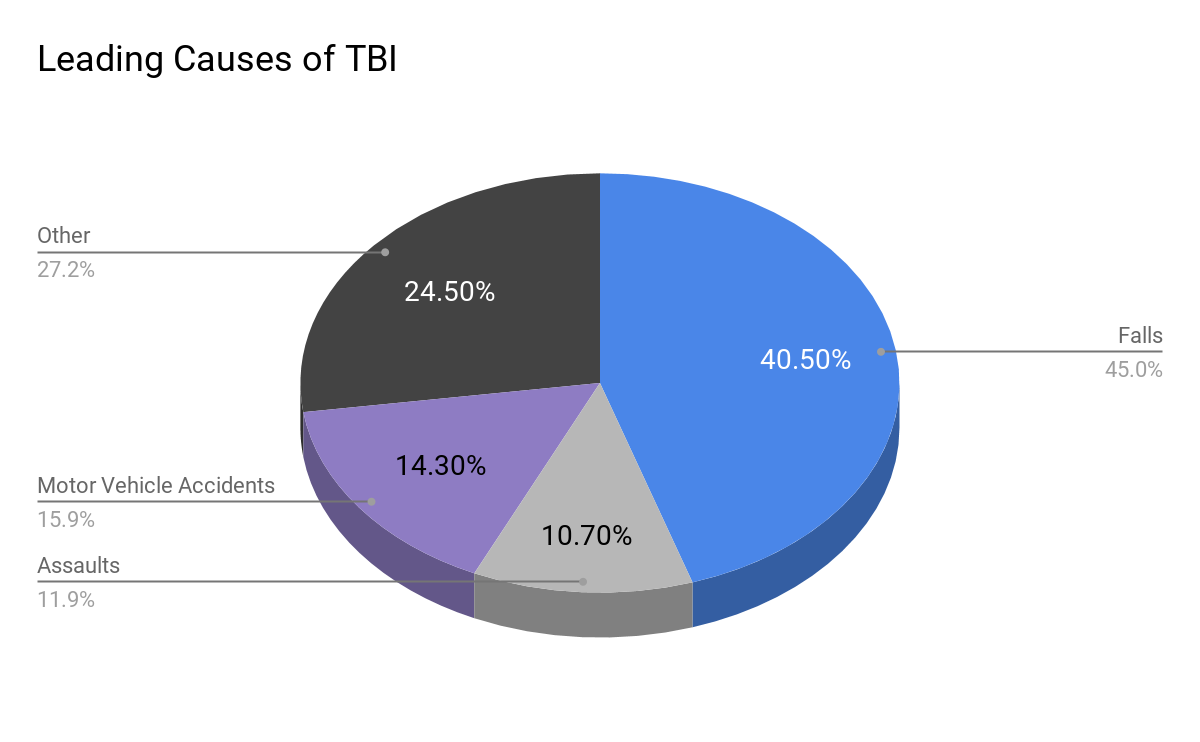
The causes of TBI vary tremendously. You might think that car accidents are the leading cause of TBI, but in fact most people with TBI sustained the injury as a result of a fall.
Symptoms of a head or brain injury
Similar to neck and back injuries, the symptoms of a head injury aren’t always obvious. What’s more, some symptoms may not appear until months after the injury is sustained. Some common symptoms include:
- Dizziness
- Vomiting
- Trouble balancing
- Difficulty speaking
- Indifference
- Depression
- Irritability
- Changes in personality
- Difficulty sleeping
- Sensitivity to noise and light
- Numbness of body parts
- Loss of consciousness
- Difficulty remembering new information
- Changes in vision
If you or a loved one exhibit any of these symptoms, be sure to see a healthcare provider immediately and be sure to tell the provider about any recent accidents or injuries to your head.
Can I be compensated for my brain or head injury?
If you’ve suffered a head or brain injury in Arizona, you may be able to recover damages. Your legal recourse depends on the cause of the injury.
Negligence
If your head or brain injury is caused by another person or entity’s carelessness, you can recover damages by filing an insurance claim or a negligence lawsuit.
In Arizona, you must prove 3 elements to establish negligence:
- Duty. You must prove that the other person or entity owed you a duty of care.
- Breach. You must prove that the other person or entity breached that duty (in most cases, this means the person or entity failed to behave as a reasonable person would under the circumstances).
- Damages and causation. You must prove that the damages you sustained were caused by the other person or entity’s breach. In other words, but for the actions of the person or entity, you wouldn’t have suffered the injury.
Accidents that result in negligence claims based on a head or brain injury include, but are not limited to:
- Pedestrian accidents
- Swimming pool accidents
- Defective products
- Medical malpractice
- Slip and falls
- Car accidents
- Bicycling accidents
- Motorcycle accidents
Workers’ compensation
If you suffered a head or brain injury as a result of a workplace accident, you may be able to file a workers’ compensation claim.
Workers’ compensation is a form of insurance that pays medical expenses and lost wages to employees who are injured while doing their job.
Most injuries are covered so long as the injury occurred during the course of employment. Even if you already had the head or brain injury and the work-related accident merely aggravated the injury, you’re still eligible to receive workers’ compensation benefits.
Intentional tort
In rare cases, someone may have intentionally caused your head or brain injury. For example, you may have been intentionally struck in the head. This is called an “intentional tort,” and—in addition to the criminal action that may be brought for assault—you can seek further damages in a civil lawsuit.
What damages can be recovered?
In a personal injury case, you’re entitled to compensation from the person or entity legally responsible for your injuries. The legal term for this compensation is “damages.”
In Arizona, there are three basic types of damages available in a personal injury lawsuit:
- Economic damages (sometimes called “special damages”)
- Non-economic damages (sometimes called “general damages”)
- Punitive damages
Let’s take a closer look at each of these.
Economic damages are intended to compensate you for the monetary losses associated with your head or brain injury. These losses might include:
- Medical expenses
- Lost income due to missing work
- Any other out-of-pocket expenses you incurred due to your injury
Non-economic damages are designed to compensate you for the non-monetary consequences of your injury. For example, the subjective pain and suffering that you experience as a result of your injury. General damages vary from case to case, but common examples include:
- Physical pain and suffering
- Emotional distress
- Loss of consortium
Punitive damages are generally not awarded in personal injury cases. In Arizona, punitive damages are only available if the defendant’s conduct was:
- Grossly negligent: conduct that is extreme or reckless as opposed to careless or unreasonable, or
- Willful and wanton: conduct that is intended to cause harm (such as the intentional tort described above).
Many insurance adjusters and attorneys in Arizona use a formula to arrive at a rough estimate of how much a person’s claim is worth. Here’s the formula:
Special damages x 1-5 (depending on the severity of the injury) + lost income = damages.
For example, let’s say a car accident results in TBI and you incur $150,000 in medical bills. Let’s also say that, because of your injury, you miss 6 months of work for which you would have been paid $30,000. Your formula might look like this:
$150,000 x 5 (because TBI is generally considered a catastrophic injury) = $750,000 + $30,000 =
$780,000 (total estimated damages)
Keep in mind that this is only a starting point. The amount can go up or down depending on a number of factors, including:
- Quality of your medical evidence
- Length of your recovery
- Permanence of your injury
- How your injuries impact your day-to-day life
When dealing with a head or brain injury, your recovery will depend in large part on the medical evidence that supports your claim. For this reason, it’s important to seek medical attention immediately following your accident.
In the case of a workers’ compensation claim, you can recover medical expenses and income replacement benefits. In general, all reasonable and necessary medical treatment will be covered. As for income replacement benefits, the amount you receive will depend on the severity of your injury.
What if I’m partially at fault?
Arizona follows the pure comparative fault theory. Under this theory, the amount of damages a plaintiff can recover is reduced by a percentage that reflects their own degree of fault – no matter what that percentage may be.
For example, using the example above, if a judge or jury found that you were 20% at fault for the car accident, you would only be able to recover $624,000 (80%) of the $780,000 in total damages.
Head and brain injury resources in Arizona
Suffering a head or brain injury is a traumatic experience. Additional support is available in Arizona. We encourage you to contact these organizations to help you on your road to recovery.
- Brain Injury Alliance of Arizona
- Arizona Center for Disability Law
- Brain Injury Association of America
- Upcoming brain injury events
We also encourage you to consider talking with an attorney who can help you with the legal implications of your accident while you just focus on getting better. Use our free online directory to find an Arizona brain injury lawyer near you.
See our guide Choosing a personal injury attorney.