
You might be surprised at some doctrines that seem to act like loopholes in the law
The law is complicated; that’s why lawyers and courts are in such high demand. If we could settle all of our disputes on our own, we would. But since we can’t, it’s good to know what types of rules and doctrines (and defenses) might apply in your case.
You don’t have to go to law school to understand the law. Yes, the legal system is full of nuances, doctrines, and rules unknown to the general public. But if you become a party to a lawsuit, it could benefit you to understand some of the common concepts within personal injury law.
As you begin to learn about these accepted legal doctrines and rules, remember that different states have different laws. If you intend to suggest or rely on one of these rules, you should consult a personal injury lawyer in your state to ensure it’s valid for your lawsuit.
Contributory negligence
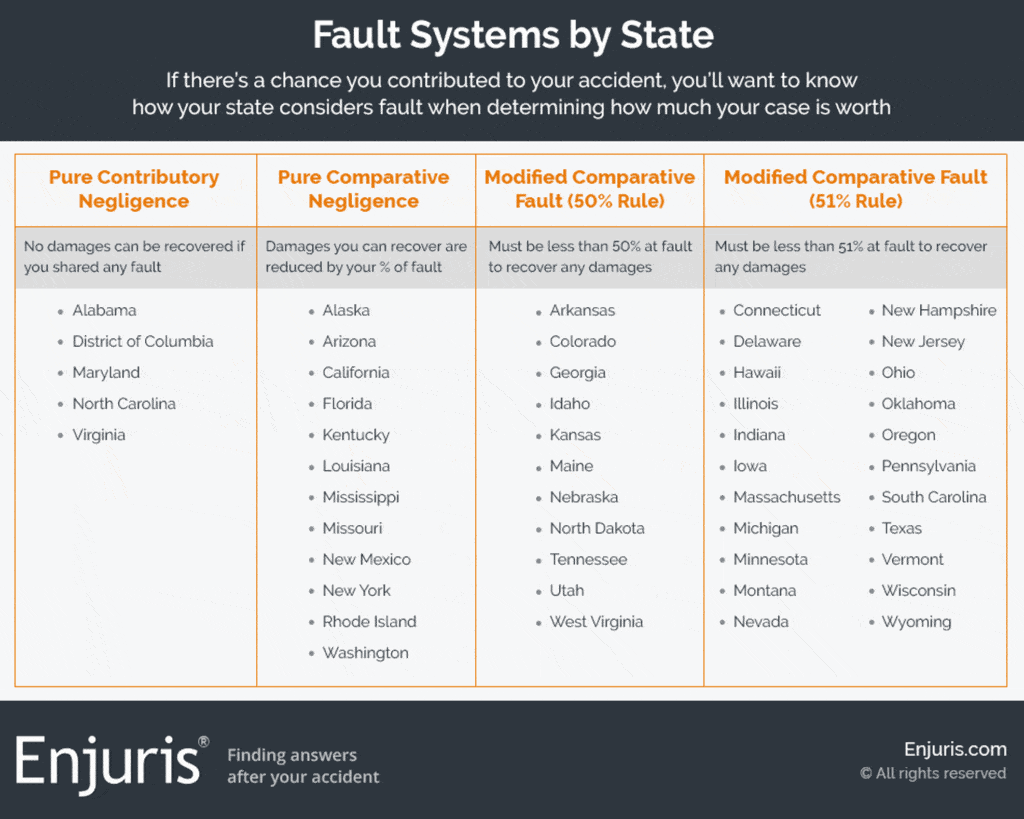
There are some jurisdictions where the law says that if the plaintiff (injured person) contributes to their own injury in any way—even 1%—they are not permitted to recover damages.
This applies in Alabama, District of Columbia, Maryland, North Carolina and Virginia.
Comparative negligence
In states that follow comparative negligence rules, the plaintiff’s contribution to their injury is considered, but it doesn’t completely bar them from recovering damages.
How comparative negligence is handled in your case depends on the state where it’s being adjudicated. In some states, the plaintiff’s amount of damages is reduced according to their percentage of fault. In others, this is true only to a certain threshold—they must be less than 50% or 51% at fault.
You can see how your state handles comparative negligence:
The “Eggshell Skull” rule
This doctrine holds that a defendant is liable for the plaintiff’s unforeseeable and uncommon reactions to a tortious act, even if the injury is far more severe than what would have been anticipated with an “average” person.
In other words, a defendant must take their victim as they find them, even if the victim’s injuries are unusually severe due to a pre-existing condition.
Vicarious liability
This is when one person is held responsible for the negligence of another, like an employer being held liable for an employee’s actions within the scope of employment. This is often invoked in workplace injury cases.
Res ipsa loquitur
This is the Latin phrase that means “the thing speaks for itself.” This doctrine allows for an inference of negligence if an injury occurs in a way that would not normally happen without someone’s negligence and the cause of the injury was in the defendant’s control.
An example of res ipsa loquitur is when negligence is apparent, but specifics are hard to prove. For instance, if surgical tools are left inside a patient’s body during a procedure, it’s clear that someone (the doctor or surgical staff) was negligent in leaving them there, and there is no other way that the injury could have occurred.
Collateral source rule
The collateral source rule prevents the defendant from benefiting from the plaintiff receiving compensation from sources other than the defendant, like insurance. Essentially, the defendant cannot reduce their liability by the amount the plaintiff receives from a collateral source.
Joint and several liability
In cases with multiple defendants, this doctrine allows the plaintiff to recover all the damages from one defendant, who must then seek contribution from the others.
In practice, the plaintiff only needs to prove that one defendant was liable for the injury rather than proving how each defendant was individually liable. It’s then up to that defendant to be compensated by the other defendants.
Duty to mitigate
The injured party has an obligation to make reasonable efforts to minimize their damages. Failure to do so might reduce their recovery.
Assumption of risk
If a person voluntarily engages in an activity with known risks and is injured, they might be prevented from claiming damages.
Usually, this is applied when the plaintiff has engaged in an abnormally dangerous activity.
Strict liability for ultrahazardous activities
This imposes liability for damages on a party engaged in certain extremely dangerous activities, even if they took all possible precautions.
Strict liability applies to three common types of civil cases:
- those involving animals
- those involving abnormally dangerous activities
- those involving defective products
Statute of Limitations
There are strict time limits within which a personal injury lawsuit must be filed. If the plaintiff misses this deadline, they usually lose the right to file the lawsuit. Different types of lawsuits and states’ laws for statutes of limitations vary, so it’s important to consult an attorney to find out the time frame for filing a lawsuit.
The Good Samaritan Law
This law protects individuals who voluntarily assist those injured or in peril from being sued for wrongdoing, as long as their actions were reasonable under the circumstances. Usually, this applies when a civilian attempts to help a victim at an accident scene. If the injured person’s condition worsens as a result of the help, the helper would be protected under the law.
Attractive Nuisance Doctrine
This holds a landowner responsible for injuries to children trespassing on the land if the injury is caused by a hazardous object or condition on the land that is likely to attract children. Examples of this might be unfenced swimming pools, trampolines, ladders, empty refrigerators, or anything else that might appeal to a child as a play area but is unsafe.
Dram shop acts
These laws hold businesses that sell liquor responsible for injuries caused by intoxicated patrons under certain circumstances. For instance, some states have laws that hold a restaurant or bar liable if it serves alcohol to a guest who is already intoxicated, and that guest causes someone else to be injured.
These are similar to social host laws, which apply to private hosts. In other words, if someone serves alcohol to a guest in their home and that person injures someone, the host could be liable. Usually this applies to serving alcohol to minors, but state laws vary.
Family immunity and parental immunity doctrines
Some jurisdictions prevent family members from suing each other. This usually becomes relevant in disputes where one family member sues another and generally favors the defendant.
These legal concepts can help you gain a deeper insight into the complexity of personal injury law. These doctrines and rules reflect the evolving nature of legal thought and societal values, aiming to balance individual rights and social responsibilities.
If you’re involved in a dispute and have questions about legal strategy, your state laws, or any nuances related to the lawsuit, you can contact a personal injury lawyer for more information and guidance.
See our guide Choosing a personal injury attorney.