
Swimming is a favorite pastime for many Americans. People love it as a full-body workout, low-impact exercise, great for cardiovascular health, for relief of anxiety and depression, and as a lifesaving skill. Anyone can engage in watersports or swimming at any age; people start getting their babies accustomed to water by just a couple of months old.
Americans LOVE to swim. According to the Centers for Disease Control and Prevention (CDC), swimming is the 4th most popular recreational activity in the United States and the most popular recreational activity for children ages 7-17. There are an estimated 10 million swimming pools in the US and roughly 91 million people swim in oceans, lakes, and rivers every year.
However, despite the benefits, swimming can have serious safety risks. Even a strong, skilled swimmer can drown—no one is immune, and a casual dip in the pool can end in serious injury or death. Approximately 10 people die from unintentional drowning every day in the US, according to the CDC. Roughly 20% of these people are children under the age of 14.
By the numbers: U.S. swimming and safety
91
Million
Each year, 91 million people swim in oceans, lakes, and rivers.
40
Million
Nearly 40 million adults (15.4%) in the U.S. do not know how to swim.
#1
for Kids
Swimming is the #1 recreational activity for kids aged 7–17.
1 in 5
Deaths
1 in 5 drowning deaths involves a child under age 14.
- Swimming is the 4th most popular recreational activity in the U.S.
- The U.S. has an estimated 10 million swimming pools.
- 10 people die daily in the U.S. from unintentional drowning.
- Even strong swimmers can drown. No one is immune to water-related risks.
- Over half of U.S. adults (54.7%) have never taken a swimming lesson.
- 36.8% of Black adults say they can’t swim, compared to 15% of all adults.
Source: Centers for Disease Control and Prevention (CDC), May 2024
Non-fatal swimming accidents
Swimming accidents don’t always end in death. For every person who dies from drowning, 5 people receive emergency department care for nonfatal submersion injuries.
These injuries range from minor to severe and include:
- Brain damage. When a person is drowning, water enters their lungs and deprives the brain of oxygen. The part of the brain that controls thinking and memory is the first area of the brain to be harmed as a result of oxygen deprivation. As a result, victims of near-drowning accidents often suffer debilitating memory loss, seizures, learning disabilities, paralysis, and may even slip into a permanent vegetative state. In most cases, brain damage begins to occur after 5 minutes of oxygen deprivation.
- Recreational water illnesses (RWIs). RWIs are caused by germs and chemicals in the water. They are spread by swallowing, breathing, or having contact with contaminated water. RWIs include gastrointestinal, skin, ear, respiratory, eye, neurologic, and wound infections.
- Aspiration pneumonia. Aspiration pneumonia is a lung infection that develops after a person inhales water into their lungs.
- Acute respiratory distress syndrome (ARDS). ARDS is a severe lung condition that occurs when water fills up the air sacs in a person’s lungs.
- Hypothermia. Hypothermia occurs when your body loses heat faster than it can produce heat. Believe it or not, a person can get hypothermia even when it’s hot outside and the water is relatively warm. To avoid hypothermia, keep an eye out for the signs (shivering, altered judgment, blueness of the fingers, toes, or lips) and get out of the water when they appear.
Can you drown when you’re not in the water?
Though it’s uncommon, it’s actually possible to drown after you get out of a swimming pool.
The term “dry drowning” refers to an incident that occurs after you’ve inhaled a small amount of water (usually from a brief struggle in the pool). The water irritates your airway and when you exit the pool your muscles start to spasm and you choke.
Similarly, “secondary drowning” occurs when your lung tissue becomes irritated (usually from a near-drowning incident). This irritation leads to inflation which causes your lungs to create fluid. It’s this fluid (rather than the pool water) that you drown in. Frighteningly, this can happen 24 hours after you’ve left the water.
Dry drowning and secondary drowning account for 1-2% of all drowning deaths, and can also lead to long-term respiratory problems and brain damage.
Who’s at risk of drowning?
According to the CDC, children ages 1-4 are the most likely to drown, followed by children ages 5-7. Males are far more likely to drown than females, and minorities (particularly Black Americans) are much more likely to drown than whites.
Drowning is responsible for more deaths among children ages 1-4 than any other cause except birth defects.
There are a couple of risk factors that make a residential swimming pool more dangerous than some other places, one of which is when a pool isn’t properly fenced or locked. According to the Consumer Product Safety Commission (CPSC), nearly 300 children under age five drown in residential pools each year. Many of these deaths could be prevented with proper fencing and safety measures. About 68% of these drownings happen in pools that don’t have four-sided fencing.
The following factors increase the risk of drowning:
- Lack of swimming ability
- New parents
- New pool owners
- Multiple children around the pool
- Underestimating the mobility of a toddler
- Lack of pool barriers
- Lack of close supervision
- Failure to wear a life jacket
- Seizure disorders
- Alcohol use
Statistics on child drownings
According to the Centers for Disease Control and Prevention, drowning is the leading cause of death for children under five years old. It’s the second leading cause of unintentional injury death for children ages 5-14. There are more than 4,000 unintentional drowning deaths in the U.S. each year—this averages to 11 per day. There are also an estimated 8,000 nonfatal drownings, or 22 per day.
In 2018-2019, children under one year old had the highest percentage of unintentional drowning deaths in bathtubs. For children ages 1-13 (59% for children ages 1-4, 46% for children 5-13), the highest rate of drownings occurred in swimming pools (7%); and for teens ages 14-17, the highest rate of drownings (62%) was in natural bodies of water.
For children under age 1, 75% of drownings that year occurred in bathtubs, 7% were in swimming pools, and 3% were in natural bodies of water. The remaining 15% were unspecified.
Not surprisingly, the number of drowning deaths is higher in June, July and August than in other months, because children in most parts of the nation are more likely to be enjoying swimming pools, lakes, and other recreational swimming facilities during that time.
An average 1.31 of 100,000 people drowned each year in the U.S. between 2018 and 2021. However, there was some variation by state.

Drowning deaths and children
For two decades, the highest rate of unintentional drowning deaths was among children aged 1-4. However, it’s a risk for all children, regardless of age. Here’s a look at drowning deaths for children over a two-decade period:

And there are differences in numbers of male and female children, too. The charts below break down numbers of child drownings by gender, age, and location.


Finally, there are differences in the numbers of drownings based on whether a child is in an area that’s urban or rural.

Child drownings at Airbnb and vacation rental properties

It’s difficult to provide specific statistics on the numbers of drownings at Airbnbs or vacation rentals, but short-term rentals like Airbnb homes have more rooms than the entire hotel and motel industry in the US—and swimming pools in these types of homes aren’t subject to the same regulations as those in a larger facility, like a hotel.
Unlike hotels or community pools that are subject to strict safety standards, many vacation rentals (like those on Airbnb or Vrbo) feature private swimming pools with minimal safety measures. Families on vacation might assume their rental’s pool is as safe as a hotel’s, but the reality is often very different.
When is a pool owner liable?
Most swimming pool accident cases are premises liability cases. The term “premises liability” refers to a set of rules that impart certain duties on landowners.
Some states base the specific duties owed on the status of the visitor. In these states, visitors are generally divided into 3 categories.
- Invitees: Someone who foreseeably enters the property even if they weren’t granted express permission (such as a resident entering a public pool)
- Licensees: Someone with express or implied permission to enter the property for non-business reasons (such as a friend invited over for a pool party)
- Trespassers: Someone not authorized to be on the property
The specific duties owed can generally be described as follows:
- Invitee: Invitees are owed the highest degree of care. Landowners must keep the property reasonably safe and warn of dangerous conditions.
- Licensee: The landowner must warn the licensee of unsafe conditions that the landowner knows about and the licensee is not likely to discover.
- Trespasser: Landowners don’t owe trespassers any duty of care unless the trespasser is a child. If the trespasser is a child, the attractive nuisance doctrine applies and the landowner must exercise reasonable care to avoid a reasonably foreseeable risk of harm to children caused by an artificial condition that might be attractive to children (such as a swimming pool).
Once the duty owed is determined, the injured person must prove that:
- The landowner breached the duty owed,
- The breach caused the harm, and
- The injured person was in fact harmed.
In states that don’t base the duties owed on the status of the visitor, landowners generally owe ALL VISITORS a duty to maintain their land in a reasonably safe condition and to warn of dangers that are known or knowable.
So what does all this mean?
Generally speaking, if a landowner leaves their pool inadequately protected or unsupervised, they’ll be liable for any injuries that occur.
In most cases, a landowner who leaves their pool inadequately protected or unsupervised will be liable for any injuries that occur.
Of course, other laws might apply, and other parties may be held liable depending on the nature of the accident. For example, if a swimmer holds another swimmer underwater, the swimmer may be guilty of battery. Or if a pool pump malfunctions and injures a swimmer, the injured swimmer may be able to file a product liability lawsuit against the manufacturer of the defective pool pump.
Safety differences in vacation rentals vs. hotels and public pools
The big difference between a vacation rental and a hotel pool or public pool is that vacation rental homes often have a private pool that’s directly accessible to the living area, without dedicated fences.
Hotels and public pools typically have a controlled environment that includes safety features that are required and routinely maintained. For instance, a hotel pool facility usually has four-sided fencing and locked gates that enclose the pool area and prevent unsupervised access. They also post clear depth markers and warning signs to indicate the shallow and deep ends of the pool. There’s also usually emergency equipment available, like life rings, reaching poles, first aid kits, poolside telephones, and defibrillators.
Most hotel pools don’t have lifeguards, but a sign will be posted that indicates guests may “swim at your own risk.” They also usually have CPR-trained staff on site.
Vacation rental pools often don’t have this type of safety protection. Many rentals have backyard pools that open directly from the house or patio, and some don’t have a perimeter fence that isolates the pool.
Many Airbnb/Vrbo properties don’t have proper fencing, pool alarms, or warning signs. They typically don’t have depth markings to alert guests of deep areas. There’s also not always safety equipment like life jackets or safety devices to pull a person in distress out of the pool.
It’s the responsibility of the guests to provide their own safety; an Airbnb isn’t going to vet guests to make sure anyone in the house is a certified lifeguard or knows CPR—you’re on your own, just like you would be if you had a pool in your own backyard.
Regulatory gaps and enforcement issues
A hotel, resort or municipal pool is a public accommodation, which means it must obey state and local pool safety codes. It is also subject to health department inspections and certifications. Codes usually mandate fences, alarm systems, lifesaving equipment, water quality checks, and other measures.
Short-term rentals are neither private homes nor public lodging. The law treats an Airbnb host as a homeowner. Airbnb is not held to the same pool safety standards as a hotel. Although a host must follow local laws, there’s no standard policy that verifies pool safety for all Airbnb rentals. Therefore, safety practices can vary by state, local area, and the host’s honesty.
In May 2023, a 16-year-old on spring break was staying at an Airbnb in Orange Park, Florida. He believed he was in the shallow end of the pool, but the pool had two hidden drop-off slopes. He stepped into a much deeper area by accident and couldn’t get his footing to return to a higher surface.
His mother attempted to save him but there were no flotation or rescue devices available. The property also had no markings to warn of the sudden depth change. The teen died and his family filed a lawsuit against Airbnb that was settled for $1.3 million.
In June 2023, a family was vacationing at a short-term rental home in Miami. Their two young children were found unresponsive in the pool. They learned later that the property was under investigation for various safety violations, including a lack of proper fencing.
The children wandered to the pool unnoticed; although it’s possible they might have survived if there’d been a faster emergency response, they did not. This case led to public outrage and calls for more strictly enforced rental rules.
Statistics on rental property drownings
The American Red Cross has reported that 87% of fatal drownings among children under five years old happen in home environments. This includes their own homes and rental homes. Many fewer happen at public swimming facilities. Further, 69% of children who drown in pools were not expected to be near the pool at all—they wandered away from the house or the supervising person.

As mentioned above, short-term rentals now outpace hotels in occupancy. That means more people are swimming in private pools in vacation homes, and the number of pool drownings and injuries would then increase. Airbnb launched a pool safety initiative in 2022, partnering with child safety experts to promote pool safety education and proper fencing guidance.
Defenses to swimming pool accidents
When a swimmer is injured and the pool owner is sued, they will look to establish that the swimmer caused the accident or was at least partially at fault for the accident.
States typically deal with shared fault in 1 of 4 ways:
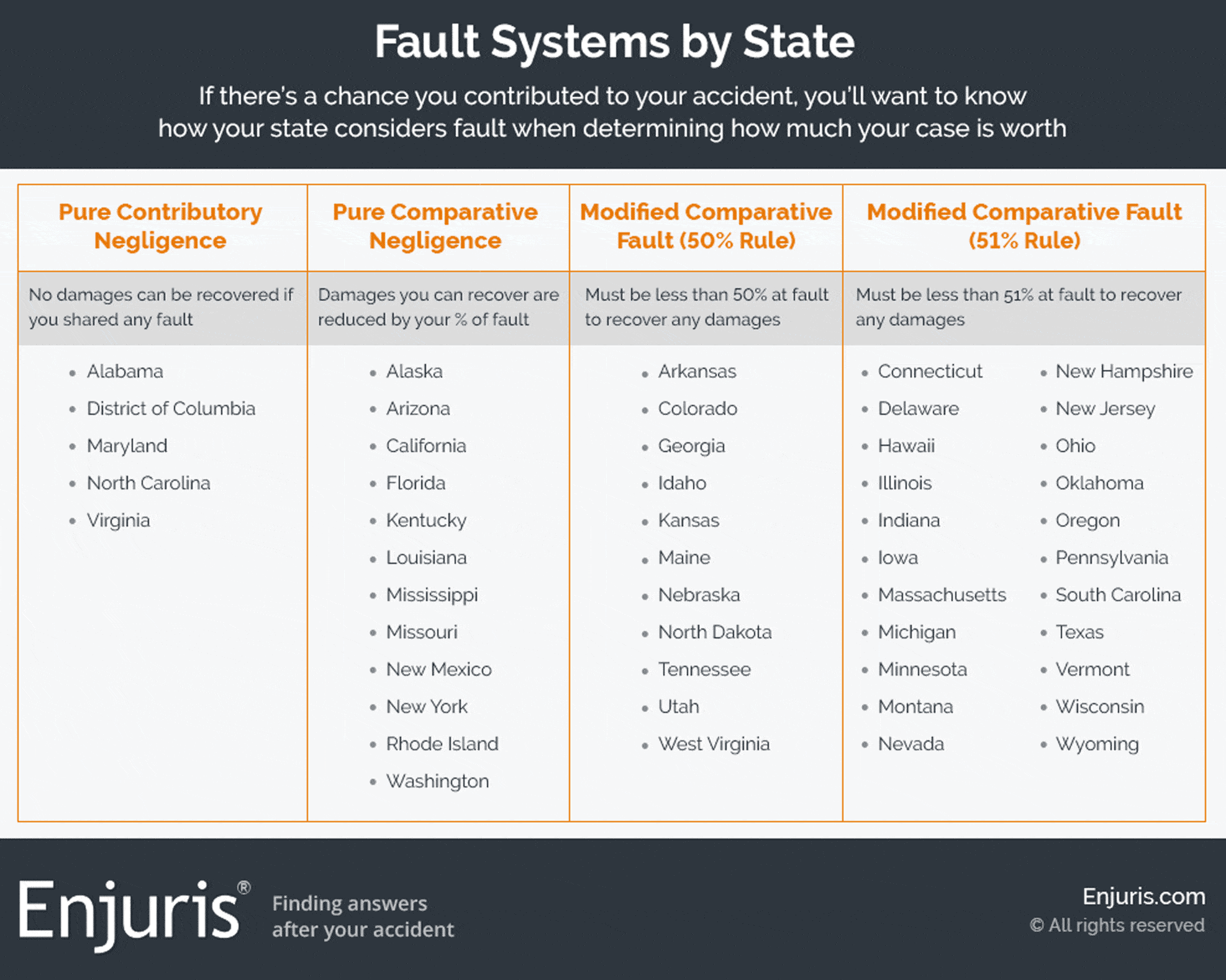
Fault Systems by State
View Full Size Get the Code Use this graphic on your site
Use this infographic on your site
We encourage people to use our infographics, with proper attribution. Just copy and paste the code below to use this infographic on your site. If you need help, let us know!
<a href="https://www.enjuris.com/personal-injury-law/shared-fault-rules/" target="blank"><img src="https://www.enjuris.com/wp-content/uploads/2022/10/fault-systems-by-state-2022.gif" alt="Fault Systems by State" title="Fault Systems by State" style="width: 100%; max-width: 987px; display: block; margin: 15px auto;" /></a>
Swimming pool accident damages
In most states, 3 types of damages are available in a swimming pool accident:
- Economic damages are the monetary damages you suffer. These include past and future medical expenses, past and future lost wages, and anything else that has a specific “price tag” attached to it.
- Non-economic damages refer to losses that don’t have a specific dollar value, such as the pain and suffering associated with the injury.
- Punitive damages are those damages that are awarded to punish the defendant when the defendant acted with actual malice.
In the event that a person dies in a swimming pool accident, certain members of the deceased’s family can file a wrongful death lawsuit. In order to recover damages, the family member will have to prove liability the same way the deceased would have had to prove liability had they survived.
If the family member is successful, they can typically recover damages based on the following factors:
- The financial dependency of the survivors of the deceased
- The future earnings of the deceased
- The cost of medical, funeral, and burial services
- The value of the emotional distress caused by the death
How to prevent pool accidents
Pool Safely, a campaign to improve pool and spa safety launched by the US Consumer Product Safety Commission, has the following tips for avoiding pool accidents:
- Never leave a child unattended in or near water
- Teach children how to swim
- Teach children to stay away from drains
- Ensure all pools and spas have compliant drain covers
- Install proper barriers, covers, and alarms on and around your pool or spa
- Learn how to perform CPR on children and adults
Good fences make good pool safety
The type of fence you install can make a life-saving difference, especially for families with young children. The best types of pool fences meet specific safety standards, are difficult for children to climb, and fully enclose the pool area with self-latching, self-closing gates.

A four-sided mesh isolation fence is the best practice for pool safety. This type of fence completely separates the pool from the house and yard. The CDC reports that this type of fence reduces the drowning risk for children by 83%. The fence should be at least 4 feet high, according to the CDC and CPSC, and the gate should be self-closing and self-latching, with latches out of a child’s reach. A mesh fence is transparent, climb-resistant, removable, and strong. It’s ideal for temporary or child-focused protection.

An aluminum fence is also a great option; it’s durable and rust-resistant. You should choose a fence with vertical bars spaced no more than four inches apart so children can’t climb over. You could also opt for a similar style in vinyl or wrought iron. Any material that’s durable and strong can work, as long as the design follows pool barrier height and spacing codes.
Unsafe options
There are also some styles of fences to avoid.
Chain-link fences, wood fences with horizontal rails, or low hedges or decorative walls aren’t safe choices for pool surroundings. They might look nice, but these are easy for a child to climb and don’t meet most states’ code requirements.


Here’s a comparison of different types of pool fences and their safety ratings for children based on several factors:
| Type of fence | Child safety rating (1–5) | Climb resistance (1–5) |
Visibility through fence (1–5) | Maintenance needs (1–5, lower is better) | Cost level (1–5) |
Typical lifespan (years) |
|---|---|---|---|---|---|---|
| Four-sided isolation fence | 5 | 5 | 4 | 2 | 3 | 15 |
| Three-sided perimeter fence | 2 | 2 | 3 | 2 | 2 | 10 |
| Mesh fence | 5 | 5 | 5 | 3 | 2 | 10 |
| Aluminum fence | 4 | 4 | 4 | 2 | 3 | 20 |
| Glass fence | 4 | 3 | 5 | 4 | 5 | 20 |
| Wood fence | 3 | 2 | 2 | 3 | 2 | 10 |
| Chain-link fence | 2 | 1 | 3 | 2 | 1 | 15 |
Requirements for pool fences
Most states have requirements for pool fences with respect to height, self-closing and latching mechanisms, and alarms. However, counties or municipalities might have local rules that are stricter than the state regulations, so it’s important to check your local information, also.
Homeowner’s insurance and pool fence requirements
Your homeowner’s insurance policy might also have requirements specific to fences if you have a pool. These aren’t legally binding like state or local laws, but insurer requirements can directly affect whether your pool is covered by insurance, how much your premium will cost, and whether your policy is approved or renewed.
A swimming pool increases your home’s liability risk. If a person—particularly a child—drowns or is injured in your pool, you could be sued for damages. To reduce the risk, your insurer might:
- Set its own rules for underwriting standards, including fence height, gates, alarms, etc.
- Require pool fencing, even if it’s not already required by the state or local government
- Deny claims or cancel a policy if safety measures aren’t followed
State-by-state pool fence requirements
Again, check your local ordinances or regulations. Here’s a list of pool fence height, latch and alarm requirements by state.
| Requirement | States |
|---|---|
| Four-foot high fence required, plus self-closing and latching gate | Alabama, Arkansas, Connecticut, Georgia, Hawaii, Idaho, Indiana, Iowa, Kansas, Kentucky, Louisiana, Maine, Maryland, Massachusetts, Michigan, Minnesota, Mississippi, Missouri, Montana, Nebraska, New Hampshire, New Jersey, New Mexico, North Carolina, North Dakota, Ohio, Oklahoma, Oregon, Pennsylvania, Rhode Island, South Carolina, South Dakota, Tennessee, Utah, Wisconsin, Wyoming |
| Four-foot high fence required, plus self-closing and latching gate; alarm required | Florida, New York, Texas, Virginia, West Virginia |
| Five-foot high fence required | Arizona, California |
| Five-foot high fence required; alarm required | Nevada |
| No fence required | Alaska, Colorado, Delaware, Vermont |
| 42-inch high fence required | Illinois |
| 60–72-inch fence required, plus self-closing and latching gate | Washington |
Children and inexperienced swimmers might be at higher risk of drowning than other people, but being in and around water can be risky for anyone. As summer heats up, so do pool-related emergencies. However, a little prevention can go a long way toward avoiding tragedy.
Families, pool owners, and swimmers need to be aware of how to take precautions regarding pool-area safety, like fences and locks, warning signs, and available safety equipment. You should also be familiar with legal liability considerations to avoid being negligent and responsible for someone’s injury if you’re a pool owner or property manager. Understanding the risks can save a life.
The Pool Safely Pledge
The Pledge is a call to action for everyone to commit to specific steps to stay safer in and around water.
PoolSafely.gov, an Enjuris Safety Ally, encourages kids to pledge to never swim alone, ask for swim lessons, and stay away from drains.
Adults pledge to always designate a water watcher, learn CPR, ensure their children know how to swim, remove portable pool ladders when not in use, and make sure pools have proper fencing, self-closing gates, and compliant drain covers.
Visit PoolSafely.gov/pledge to sign the Pledge electronically or request a hard copy.

See our guide Choosing a personal injury attorney.