
Vicarious liability may help you recover more damages
Vicarious liability is a legal concept that can be used to hold employers liable for the actions of their employees.
Imagine a delivery truck driver rushing to meet a tight deadline, speeding through a residential area and causing a multi-car collision. Under the theory of vicarious liability, the injured parties can look not only to the driver for compensation but also to the deeper-pocketed company employing the driver.
In this article, we’ll take a look at vicarious liability, including when it applies and some common defenses raised by defendants.
What is vicarious liability?
Generally speaking, vicarious liability is a term used to describe the liability that a supervisory party bears for the actions or inactions of a subordinate or associate based on the relationship between the two parties.
The most common type of vicarious liability is respondeat superior.
The doctrine of respondeat superior holds an employer liable (legally responsible) for the wrongful acts of its employee.
In order to prevail under the theory of respondeat superior, a plaintiff must prove that:
- The employee was negligent,
- The employee was acting within the course of their employment at the time of the accident, and
- The employee was engaged in conduct that was a benefit to the employer
David filed a lawsuit against Walmart, alleging that the truck driver was negligent and that Walmart was vicariously liable for the driver’s actions under the doctrine of respondeat superior. David argued that the driver was an employee of Walmart and was acting within the scope of his employment at the time of the accident. The driver had run a stop sign, which was a clear act of negligence.
A jury in Virginia ultimately awarded Evans $17 million in damages, holding Walmart vicariously liable for the truck driver’s negligence.
Common defenses to claims involving respondeat superior
Employees (particularly modern employees) have lives of their own that sometimes overlap with their work life. For example, an office worker might step outside of their cubicle to receive a private phone call from their child’s school. Similarly, a delivery driver may stop at a Starbucks drive-thru to purchase a coffee in between deliveries.
Consequently, the most common defense to respondeat superior claims is to argue that the “frolic and detour” exception applies.
The frolic and detour exception says that an employer may not be held liable for their employee’s actions during the time they were engaged in the unauthorized activity (frolic) or taking an unauthorized route (detour). The rationale behind this exception is that employers should not be held responsible for the actions of their employees when those actions fall outside the scope of their employment and are not related to the employer’s interests.
To determine whether the frolic and detour exception applies, courts will typically consider the following factors:
- The degree of deviation from the employee’s duties,
- The amount of time spent on the unauthorized activity, and
- Whether the activity was related to the employer’s interests in any way
The second most common defense raised in claims involving respondeat superior is that the negligent individual is not actually an employee. This is a common defense because the doctrine of respondeat superior only applies to employees, not independent contractors.
Courts typically look at the following factors when determining whether an individual is an employee or an independent contractor:
- The extent of control the agent and the principal have agreed the principal may exercise over details of the work,
- Whether the agent is engaged in a distinct occupation or business,
- Whether the type of work done by the agent is typically done under a principal’s direction or without supervision,
- The skill required in the agent’s occupation,
- Whether the agent or the principal supplies the tools required for the work and the place in which to perform it,
- The length of time during which the agent is engaged by a principal,
- Whether the agent is paid by the job or by the time worked, and
- Whether the agent’s work is part of the principal’s regular business
Damages in respondeat superior cases
In most personal injury cases, plaintiffs want to sue an employer rather than an employee. This is because employers typically have higher amounts of liability insurance (i.e., deeper pockets).
Practically speaking, personal injury lawyers typically sue both the employer and the employee. If both are found liable, the plaintiff can usually seek the full amount of damages from either the employee or the employer under joint and several liability rules.
However, it’s important to note that joint and several liability rules vary among jurisdictions, and some states have modified or abolished this doctrine in certain cases. As a result, the specific application of joint and several liability in a respondeat superior case depends on the jurisdiction in which the case is filed. As is always the case, it’s best to talk to a lawyer near you about your specific situation.
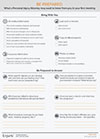 Your First Meeting with an Attorney
A worksheet to prepare for your first meeting with a personal injury attorney – what to bring, what they'll ask
Download in PDF format
See our guide Choosing a personal injury attorney.