
A chain reaction car accident is more complicated than a single or two-car collision. Learn how your state handles fault.
Being involved in a car accident is stressful enough without worrying about how you’re going to handle a legal claim. Between personal injuries and damage to your vehicle, the last thing you want to consider is proving fault.
But, the first thing that the insurance company wants to establish is whose fault it was. If you’re in an accident, it’s crucial to file a police report and helpful to take car accident photos to provide insurance adjusters and the court with evidence of how the accident happened.
Sometimes, it’s straightforward, but not always.
Chain reaction car accidents
A pile-up accident is a chain reaction accident. These are sometimes the most dangerous types of auto accidents because they involve multiple vehicles. Also, though an accident happens in a split-second, people see the first few collisions and react, but sometimes those knee-jerk maneuvers lead to even more impacts.
This kind of accident is more complicated than a single and two-vehicle collision because there can be multiple plaintiffs and defendants, and the parties are often sharing damages from a single sum of money.
The question in a chain reaction is:
Could you have done something differently to prevent part of the accident?
There’s usually one driver who begins the circumstances that lead to a pile-up or chain reaction. If Driver A hits Driver B, and Driver B hits Driver C, who’s at fault? Probably Driver A is the most at fault, but does Driver B bear some burden, too? What if Driver C argues that if Driver B had swerved after the first impact, Driver B would never have collided with Driver C? Or what if Driver C claims that Driver B was already following too closely before being hit by Driver A, and had he been the correct distance from Driver C, that impact wouldn’t have happened?
Clearly, there are lots of variables within a multi-car accident, and many reasons why and how they happen.
It’s up to the insurance companies to examine the evidence and make a determination of fault for each of the drivers involved. If the insurance companies aren’t able to agree on how the case should be settled, you might find yourself in court.
Contributory vs. comparative negligence
Contributory and comparative negligence are legal principles in which the plaintiff’s actions are a contributing factor to the injury in an accident, which can reduce the amount of damages recovered from the defendant.
Here’s an example of these two important legal concepts in action:
Pure contributory negligence: In a pure contributory negligence state, if the plaintiff is even 1% at fault and the defendant is 99% at fault for the accident, the plaintiff would still receive no damage award.
Result: Joe doesn’t receive any damages for the accident.
Comparative negligence: In a pure or modified comparative fault state, the court would compare the plaintiff’s negligence with the defendant’s. So, if the plaintiff was 10% responsible, his award would be reduced by that amount.
Result: Joe would receive $450,000, which is the original award reduced by 10%.
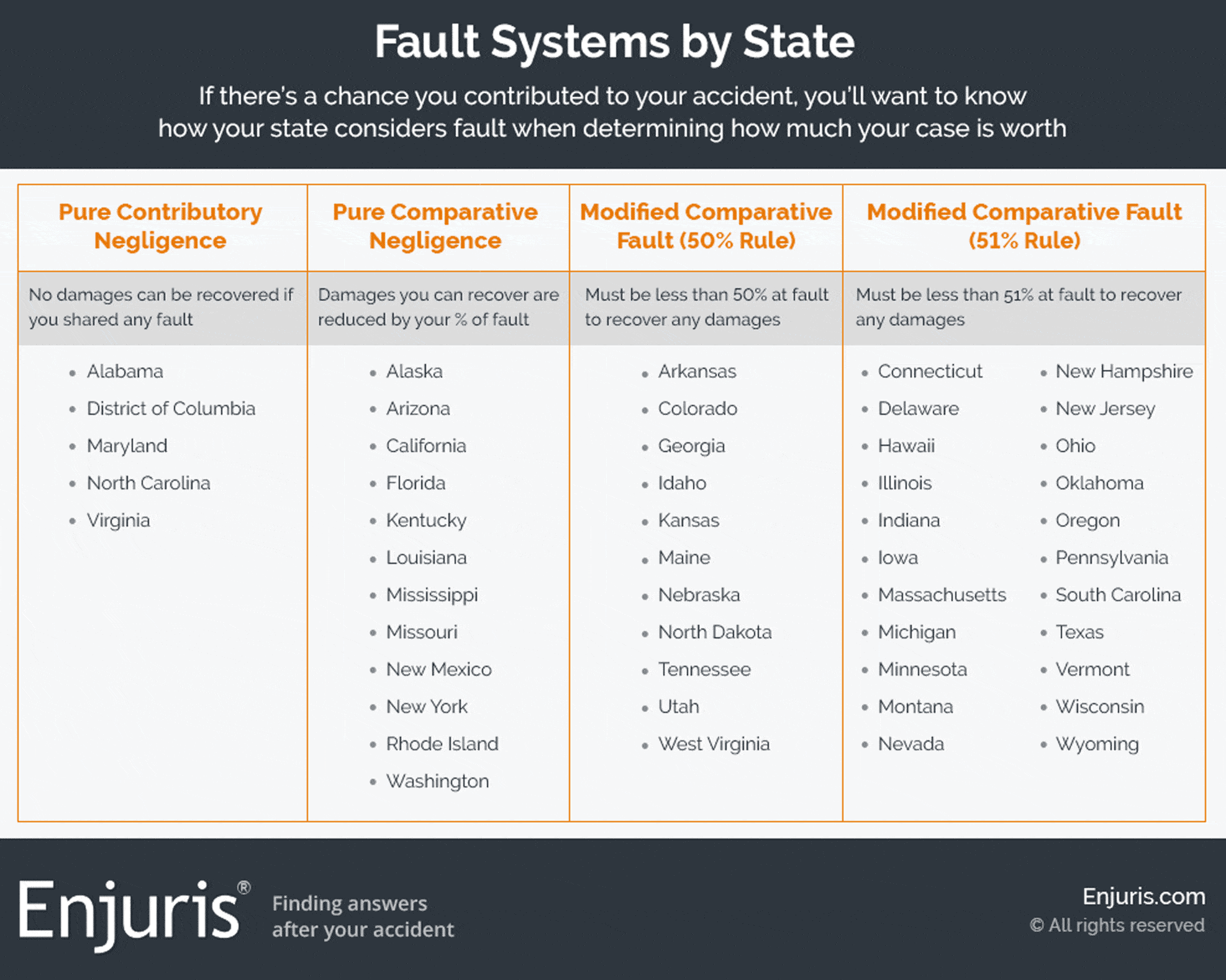
Fault Systems by State
View Full Size Get the Code Use this graphic on your site
Use this infographic on your site
We encourage people to use our infographics, with proper attribution. Just copy and paste the code below to use this infographic on your site. If you need help, let us know!
<a href="https://www.enjuris.com/personal-injury-law/shared-fault-rules/" target="blank"><img src="https://www.enjuris.com/wp-content/uploads/2022/10/fault-systems-by-state-2022.gif" alt="Fault Systems by State" title="Fault Systems by State" style="width: 100%; max-width: 987px; display: block; margin: 15px auto;" /></a>
Of course, in a pile-up car accident with more than two vehicles, the calculations and assignations of fault become more complicated.
What to do if you’re in a multi-car accident
Stay in your vehicle. If you’re involved in a pile-up wreck and have no injuries that you’re immediately aware of, then stay in the car. You’re safer there than outside if additional vehicles add to the crash. Wait for first responders to arrive and tell you how and when to exit the vehicle.
Turn on your hazard lights. In a chain reaction highway accident, other cars might approach the accident scene at high speeds. They might not realize that cars are stopped or that there has been an accident until it’s too late. Even if you’re in the middle of the collided cars, turn on your hazards to help other drivers be aware.
Collect as much information as possible. Once the first responders have said it’s safe to leave your car, begin gathering evidence if you can do so safely and without injuring yourself further. This includes photos, police reports, license plate numbers, contact information for eyewitnesses, and any other relevant information.
Get a physical examination. Even if you think you weren’t injured, it’s important to get a full physical exam immediately after a car accident. If anything arises later that might be connected, your doctor will have a full medical report.
Call your insurance company. As soon as you’re safe, it’s crucial that your insurance company is one of your first calls. They will ask questions and offer advice for handling the situation. DON’T speak with another driver’s insurance company.
Be careful what you say. If a police officer asks for your account of what happened, be truthful but don’t admit fault. It’s best to avoid sharing anything about an accident on social media, but if you must, you can say that you were involved in a collision but avoid posting any details about how it happened.
Finding a personal injury lawyer for a pile-up car accident
Since a multi-car accident is more complicated than most car accidents, there’s a higher likelihood that there will be attorneys involved for all parties because the insurance companies might not be able to settle.
When you need to call a personal injury lawyer, consider using the Enjuris Personal Injury Law Firm Directory to find an attorney in your state who knows the laws and can advocate for your best interests.
 Your First Meeting with an Attorney
A worksheet to prepare for your first meeting with a personal injury attorney – what to bring, what they'll ask
Download in PDF format
 Personal Injury Attorney Interview Sheet
Worksheet with questions to ask a personal injury attorney to help determine if he or she will be a good fit for your case
Download in PDF format
See our guide Choosing a personal injury attorney.