


A legal guide for the hardcore among us
Riding a motorcycle is like a rite of passage. You’re cool. You’re hardcore. Florida’s traffic-jammed highways might not sound ideal for motorcycles, but the state actually has some great roads for bike enthusiasts.
Florida also leads the nation for bike-related fatalities. Motorcycles account for one-fifth of all motor vehicle deaths in the state. Despite this, only one in seven riders wear a helmet, and one in five riders does not have motorcycle insurance. The estimated cost of a motorcycle fatality? $1.48 million.
You’d think that being on a vehicle that has so little between you and the hard pavement would incentivize you to put something in between, but here’s the lowdown on how many Florida riders wear the following equipment:
- Helmet: 86%
- Face shield/glasses: 81%
- Boots: 64%
- Gloves: 63%
- Jacket or vest: 55%
In 2013, the most recent year for which data is available, 2,494 people died in vehicle crashes in Florida. Of that number, 18% – 449 of them – were motorcyclists. Meanwhile, according to that data source, a third of Florida motorcycle riders don’t think they should be required to wear a helmet.
Duty of care in Florida motorcycle accidents
When a biker is recovering in a hospital bed, covered in road rash and hurting in places he or she hadn’t even known existed, the last thing he wants to hear from doctors or relatives is “If only you’d been doing this, then you wouldn’t have gotten into an accident!” It’s far more complicated than that – like in this story.
Motorcyclists are expected to follow the same road rules as are drivers of other vehicles in Florida. This means the same traffic laws, though it also means they get the entire lane to themselves – which a lot of car drivers like to ignore.
What it doesn’t mean is that a motorcyclist can split lanes or weave between lanes of traffic if things become clogged up with cars. Some states let you do that; some states don’t.
Florida requires motorcycle riders to take a Basic Rider Course and to get a proper license, or an endorsement added to their existing driver’s license.
In terms of insurance coverage, did you know that PIP insurance, or personal injury protection, is only required for four-wheeled vehicles in Florida? And helmets aren’t even required for riders who are more than 21 years old and have an insurance policy that carries at least $10,000 in medical coverage.
But at least eye protection is required by law!
If a motorcyclist gets into an accident, the duty of care is like any other negligence case. This means that the accident was caused by someone’s careless actions, and the victim must establish that:
- The victim was owed a duty of care by the defendant;
- The defendant somehow breached that duty;
- The breach caused the plaintiff’s injuries; and
- It resulted in damages.
Road conditions
Road conditions around a vehicle accident can very much change a situation, and this can be the case in scenarios involving motorbikes. Florida has many dangerous roads that spell danger for motorcycles and cars alike.
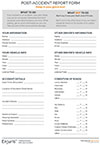 Accident Report Form
Sample post-accident report form to keep in your glove box - fill out at the scene or as soon as you can after a car accident
Download in PDF format
Other conditions, such as rain, can become big factors in accidents – especially if a bike skids out. In these cases, a motorcyclist needs to be able to demonstrate his or her own level of care.
A consistent history of maintaining the bike can be shown through an inspection record.
Other important factors, such as replacing tires before they’re worn, can also be looked at.
Because a motorcycle is so much smaller than a car, it can be difficult to see under certain conditions, such as at night or when the sun is low in the sky. Another driver’s duty of care doesn’t change under these circumstances, but these factors can have an impact on another’s liability.
Damages in a Florida motorcycle case
When someone has been in an accident and the dust has settled, one of the natural questions that comes afterward is, “Do I have a legal claim?” Generally, if someone has injured you and there are damages involved, the answer is “yes.”
The next question is, “How much is that claim worth?”
In Florida, one can recover compensatory damages. This is the term used to refer to an amount of money that is intended to restore you to where you were before the injury. These can include economic damages and non-economic damages.
Economic damages generally include:
- Medical expenses
- Lost income
- Lost earning capacity
- Property damage
- Estimated future medical expenses
- Out of pocket costs
Non-economic damages can include:
- Pain and suffering
- Mental anguish
- Loss of consortium (the loss of a relationship with a partner)
- Inconvenience
- Emotional distress
- Loss of enjoyment of life
There are also punitive damages, which are intended to punish the party that was at fault. These are rarely awarded in Florida personal injury cases. For a case to qualify for punitive damages, the defendant’s conduct must have been wanton, willful, reckless or malicious. Even then, Florida law limits punitive damages to a maximum of $500,000 or three times the amount of compensatory damages, whichever is greater.
Florida’s statute of limitations for these personal injury cases is four years. However, if the worst were to occur and the motorcyclist were to die as a result of his or her accident, that window would shrink to two years.
Determining fault in a Florida motorcycle accident
Deciding who is guilty and how much is not always simple to figure out, especially when each state has different rules.
Florida is a no-fault state, which means that in the event of an accident, motorists are expected to turn to their own vehicle insurance for coverage.
Motorcyclists aren’t required to carry personal injury protection (PIP) insurance, but Florida does require riders to carry $20,000 of total bodily injury/$10,000 per-person bodily injury, and $30,000 single-limit liability.
This no-fault system is intended to relieve the court system of smaller cases that an insurance adjuster can handle.
However, if injuries are considered “permanent,” the victim can sidestep this system and sue the other driver for compensation.
A permanent injury is defined under section 627.737(2) as:
(a) Significant and permanent loss of an important bodily function.
(b) Permanent injury within a reasonable degree of medical probability, other than scarring or disfigurement.
(c) Significant and permanent scarring or disfigurement.
(d) Death.
Florida follows the “pure comparative negligence” system. This means that even if the motorcyclist were 99% responsible for his own accident, he could still recover for that 1% left over.
To-do list after your accident
If you’ve been in an accident, there are several steps to take that can impact your case. Hopefully you’re not Googling this while at an accident scene, but if you are, please keep these in mind:
- Stay at the scene: Unless the ambulance has already taken you away, stay with your vehicle and wait for the police. That way you can properly complete an accident report.
- Gather information: Get the other person’s name, contact information, insurance information, driver’s license number, license plate number, car make and model, witness contact information, and take down any details about the accident itself. If you’re not coherent enough to do this, get someone else to do it.
- Don’t make small talk: Don’t converse with the other party except to exchange information. Don’t apologize, don’t talk about the accident and don’t say anything unnecessary. It can be used against you later.
- Get checked out: Go to the hospital and then follow up with your doctor, even if you don’t feel like it’s necessary. Your insurance company will notice if there’s a gap in between the hospital visit and a later treatment date, and they will question it. If your injuries take a while to manifest, they might not connect the dots and deny treatment.
If you’re unable to complete these because of your injuries, don’t panic. Do as many as you can. We have created an Accident Report you can keep in your glove compartment for emergencies. Print it out and throw it in there – hopefully you won’t have to use it.
Accident Report Form
Sample post-accident report form to keep in your glove box - fill out at the scene or as soon as you can after a car accident
Download in PDF format
Keep track of symptoms and costs
Make sure to keep track of your symptoms and medical bills. A post-accident journal and an expense sheet can help significantly to cut down time when organizing everything.
 Post-Accident Journal Form
Sample accident journal/diary to help you document the effect on your daily life
Download in PDF format
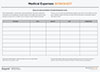 Damages/Expenses Worksheet
Damages worksheet to track expenses for your injury claim (medical treatment, property damage, lost wages, prescriptions)
Download in PDF format
Hire the right lawyer for your FL motorcycle case
Then, you’ll need to think about hiring a lawyer who’s familiar with motorcyclists. There are very important differences between Florida motor vehicle law and motorcycle law, so when you meet with different attorneys in your area (and we recommend that you sit down with several lawyers before hiring one), make sure they themselves are clear on the differences.
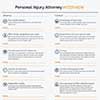 Personal Injury Attorney Interview Sheet
Worksheet with questions to ask a personal injury attorney to help determine if he or she will be a good fit for your case
Download in PDF format
We have a list of questions and criteria here that you can use to help narrow down a shortlist and then interview lawyers. Here’s the high-level rundown of steps to take when looking to hire a Florida motorcycle lawyer:
- Decide what is important to you (quick settlement, maximum payout, personality, languages, removal or inclusion in the process, fees, etc.)
- Find 3-5 motorcycle lawyers to approach.
- Call to set up appointments (preferred over emailing).
- Ask the right questions and look for certain telltale signs.
- Confirm the lawyer hasn’t been disciplined.
More resources
- Tips on finding a qualified personal injury attorney – where to look
- Choosing a personal injury attorney – interview questions
- Preparing to meet with a personal injury attorney
- When do you NOT need an attorney after an accident?
- Find a Florida motorcycle attorney in the Enjuris law firm directory.
See our guide Choosing a personal injury attorney.