A car accident injury lawyer can help minimize your liability and maximize compensation after a crash
Delaware is the second smallest state in the U.S., the first being Rhode Island. Delaware is comprised of 2,044 square miles, which is equal to 96 miles in length and 39 miles wide.
The Delaware Department of Transportation (DelDOT) maintains more than 5,000 miles of roads, which is nearly 90% of all roadways in the state. These include bridges, freeways, two-lane undivided roads and toll roads in urban, suburban and rural communities.
Whether you live or work in The First State or you’re there to explore the coastline and beaches, camping, or other recreation, it’s important to be familiar with Delaware car accident laws—because you just never know what can happen.
Delaware car accident statistics
In its recent State Highway Safety Report, Delaware officials reported that the number of traffic related fatalities had dropped from 132 in 2019 to 116 in 2020. The five-year average was 119.4; this is important because we know that 2020 might not be an accurate reflection of fatality statistics because the COVID-19 pandemic changed people’s driving habits at that time.
Notably, the fatality rate (fatalities per 100 million vehicle miles traveled) was 1.39 in 2020, which was higher than its 1.29 in 2019 and significantly higher than its 2018 level of 1.09.
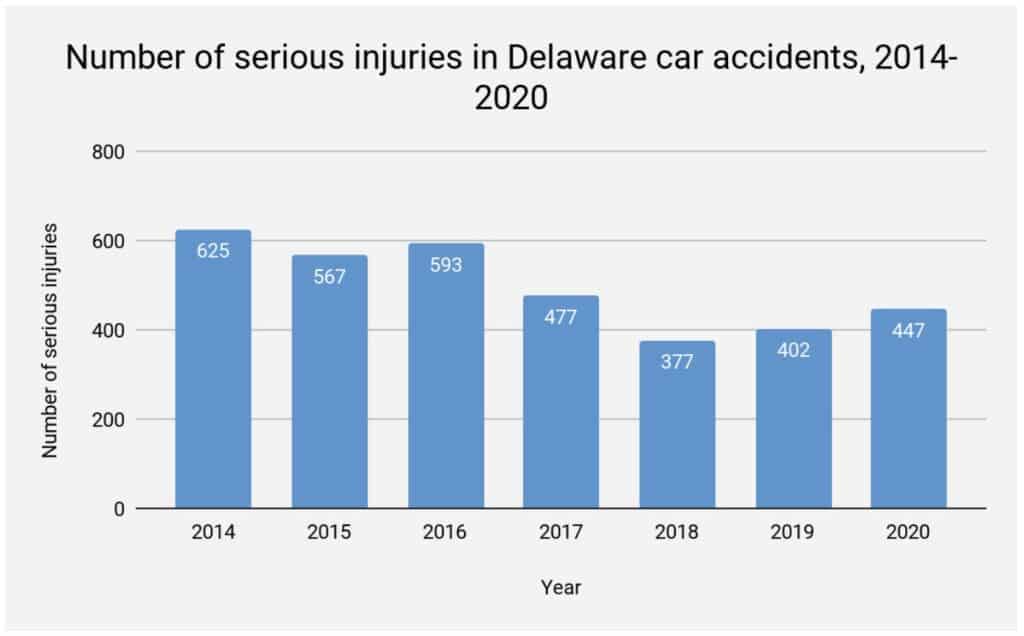
The number of serious injuries has generally decreased over the past several years but is appearing to rise in the most recent figures.
Here’s another look at the types of traffic fatalities in Delaware in recent years:
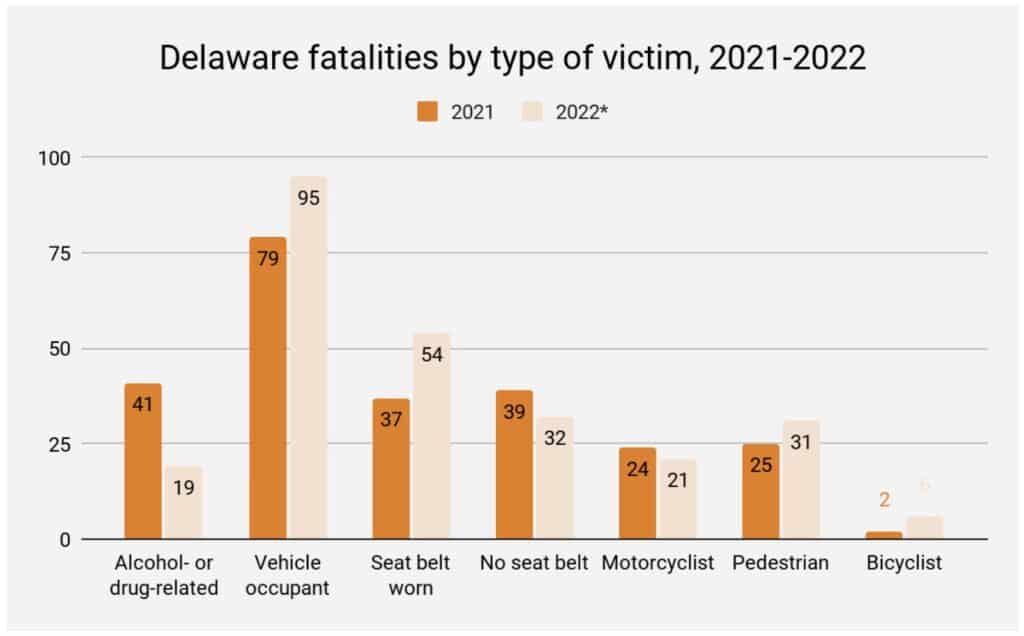
Source: Delaware Office of Highway Safety
* Jan.1 to Dec. 14, 2022
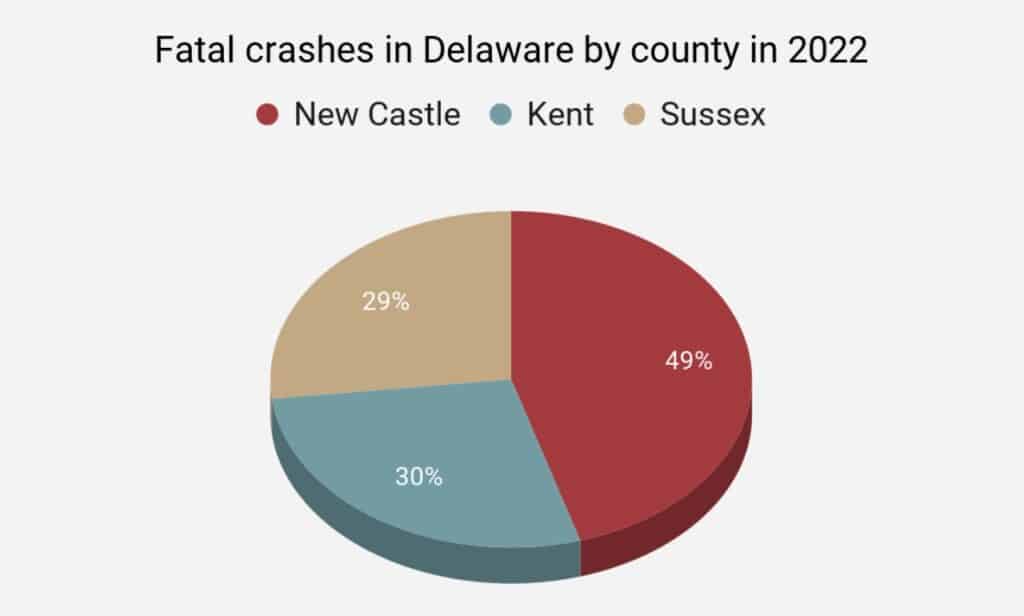
Breaking it down further, here’s a look at the percent of fatal crashes by county in Delaware in 2022:
Delaware car accident laws
The vast majority of car crashes are not fatalities, but you’re statistically likely to be involved in at least one car accident (probably two or three) in your lifetime.
If and when that happens, you should be prepared with some basic knowledge about the laws of the state where the accident took place. Whether you caused the accident or were the victim, you have both rights and responsibilities.
Delaware is a no-fault insurance state
Each state is categorized as “fault” (or “tort”) or “no-fault” for car accident insurance purposes. Delaware is no-fault, which means each driver is required to carry their own personal injury protection (PIP) insurance.
The state of Delaware requires its insurers to pay a portion of your medical expenses, lost wages, and property damage, regardless of who was liable for the accident.
You may only file a car accident lawsuit if the crash resulted in very serious injuries or a large amount of expenses. A lawsuit can include non-economic costs that aren’t covered by insurance, like pain and suffering, loss of consortium, loss of enjoyment of life, emotional trauma, and similar. You can also file a lawsuit if your financial expenses from a car accident exceed the the amount of your insurance policy maximum.
If you’re in an accident in Delaware—regardless of who is at fault—you’ll turn to your own insurance policy to cover your expenses.
So, it doesn’t matter who’s at fault?
It still matters.
Delaware follows a modified comparative fault rule, otherwise known as the 51% Rule. In order to recover anydamages from a crash, you must be less than 51% liable for the accident.
If your percentage of fault or liability is 50% or higher, you can’t recover damages.
This is one reason why it could be important to retain a personal injury lawyer, even if you’re not planning to file a lawsuit. Your lawyer can negotiate with the insurance company and work to minimize the amount of fault you have for a crash, which could be the difference between recovering financial damages or not.
Delaware car accident statute of limitations
The statute of limitations is the amount of time you have between the date of an injury and your deadline for filing a lawsuit. In Delaware, you may file a lawsuit for up to two years from the date of the accident or the date of your injury diagnosis.
However, a lawsuit is your last resort. Your first method for recovering financial damages is an insurance claim—and that time period is sigificantly shorter. It’s recommended that you report the accident to your insurance company as soon as possible after the crash.
Most insurance companies have a specific period of time in which you must report an accident, and that could be as short as a few days. If you’re considering covering expenses out-of-pocket, you should still make a report. A report is not the same as a claim, and if you don’t make a report in time, you might lose your ability to make a claim later. You need to check on timing and procedure for claims with your specific insurance company.
Delaware reporting requirements
Delaware Code Title 21 § 4203 requires that a driver must immediately report the crash to police when:
- The collision resulted in injury or death;
- The collision results in property damage of $500 or more; or
- An involved driver appears to be impaired as a result of alcohol or drugs
Delaware car insurance laws
If you’re a licensed driver in Delaware, you’re required to have the following minimum coverage for other people in case you cause an accident:
- $25,000 bodily injury per person, per accident
- $50,000 total bodily injury liability for two or more people per accident
- $10,000 for property damage
You’re also required to carry PIP insurance coverage for yourself and your passengers, regardless of who caused an accident at a minimum of:
- $15,000 for one person injured in an accident, and
- $30,000 for all people injured in the accident
Three ways to recover damages after a Delaware car accident:
- Make a claim to your own insurance company if the losses are covered;
- File a third-party claim to the at-fault driver’s insurance if your insurance does not cover the full extent of your losses; or
- File a personal injury lawsuit against the at-fault driver.
10 most common causes of car accidents
- Distracted driving. Distracted driving is a serious problem. People depend on cell phones for maps, podcasts, music, traffic reports, and other functions, but you should never, ever handle your phone or any electronic device while driving. Distractions can also include eating, passenger behavior, personal grooming, or any other behavior that takes your mind, eyes or hands off driving.
- Drunk driving. You’re not allowed to drive if your blood alcohol content (BAC) is 0.08% or higher. Being under the influence of alcohol, drugs, or some medications can severely affect your driving and raises your risk of causing an accident. Delaware has a zero tolerance law for anyone who is under the age of 21. If you’re caught driving with any alcohol in your system and you’re under the legal drinking age, your license will be revoked for two months for the first offense and six-12 months for subsequent offenses, along with fines up to $1,000.
- Aggressive driving. You’ve likely heard of “road rage,” which is when a person becomes so angry at another person that they might bully or physically harm someone on purpose because they’re annoyed. But there are other kinds of aggressive driving that don’t necessarily involve anger at a specific individual. Some drivers might be impatient and speed or swerve around cyclists or cars they think are going too slowly, make unsafe lane changes, or behave recklessly in some other way that could result in an accident.
- Speeding. Sometimes speeding is aggressive, and sometimes it is carelessness. You might speed because you’re in a hurry or running late, but you shouldn’t. Speeding doesn’t get you to your destination any faster if you crash or get a ticket. And when you speed, you have less time to react to a traffic situation in front of you and stop if necessary.
- Reckless driving. Similar to aggressive driving, reckless driving is any kind of action behind the wheel that’s unsafe. It might be speeding, weaving, dodging other cars, failure to stop at lights or stop signs, or any other number of reckless driving practices that break road rules or are unsafe.
- Inexperienced drivers. Your teenager might be the most responsible kid around, and they might care a lot about following road rules, driving at the correct speed, heeding stop lights and signs, and doing everything “right.” But younger drivers are inexperienced. That lack of experience could cause even the most careful driver to misjudge the speed of an oncoming car, poorly execute a turn, or make another mistake that results in an accident. And, some teenagers are more likely to take risks than an older driver would. Statistically, younger male drivers are most likely to make risky driving decisions.
- Tailgating. Tailgating is when a driver follows too closely behind the driver in front of them. Some tailgating is aggressive, but sometimes it happens because someone isn’t paying attention or simply doesn’t see the practice as dangerous. When traveling 55 mph, you should leave 16 car lengths (which is about 243 feet) between your vehicle and the car in front of you. Tailgating is dangerous because when you’re too close to another vehicle, you don’t have enough time to stop if you need to do so quickly. No car can stop on a dime, even if you react quickly. And, even if you stop fast enough, there’s no guarantee that the driver behind you will be able to do so. As a result, tailgating can result in chain-reaction accidents.
- Weather conditions. Wisconsin is no stranger to severe weather — ice, snow, wind, and other conditions are a regular part of life in the Upper Midwest. When the weather is extreme, it’s best to stay off the roads when you can. But when that’s not practical or realistic, exercise caution and drive slowly.
- Failure to obey traffic laws. Traffic laws are more than just stopping at red lights. Following the speed limit, staying in your lane, passing bicyclists safely, and yielding to pedestrians are just a few of the many necessary aspects to driving responsibly. Be familiar with the traffic laws in your local area and state, and obey them at all times to reduce your risk of a collision.
- Failure to stop at a red light or stop sign. Although stopping for stop signs and traffic lights are part of following traffic rules, they’re also among the ones drivers break most often. Even if you think you’re driving through a “quiet” intersection, you must stop completely at stop signs and lights.
If you’ve been in a car accident, your first priority is to seek medical attention. It’s important to obtain a medical evaluation immediately, even if you don’t think you’re hurt.
If you believe you’re entitled to receive damages to compensate for your costs, you can contact a Delaware personal injury lawyer for assistance.
Did you know that car accident law varies by state?












Hurt in a car crash? You may find these resources helpful


A personal injury lawyer helps individuals who have sustained injuries in accidents to recover financial compensation. These funds are often needed to pay for medical treatment, make up for lost wages and provide compensation for injuries suffered. Sometimes a case that seems simple at first may become more complicated. In these cases, consider hiring an experienced personal injury lawyer. Read moreNeed a lawyer?

What does an injury lawyer do?
Common car accidents