
#WFH
It’s more than a hashtag. Working from home is the new way of life for millions of people across the country (thanks, COVID).
Whether you’re new to the “home office” concept or you’ve been telecommuting before it became so common, you might not know exactly how workers’ compensation (benefits you can receive if you’re injured at work) is affected if your injury happens at home rather than in the office or another work location.
Prior to the COVID-19 pandemic, about 9 million people in the U.S. worked from their homes. Today, in 2025, that number has increased to an estimated 34.3 million. This represents more than 20% of the employed population. This includes remote and hybrid workers. Although the pandemic triggered a shift to work-from-home jobs, the number has stabilized, which indicates a broader acceptance by employers of these types of work arrangements.
Although people don’t tend to think much about the possibility of being injured at work when your workplace is your own home, there are injuries that can happen—and they might be eligible for workers’ compensation benefits.
The most common type of injuries among remote workers are musculoskeletal disorders, such as back pain, neck and shoulder pain, and carpal tunnel syndrome. The reasons why these are frequent among employees working at home are that workers at home don’t always have an “office” setup. They might be using makeshift workstations, leading to poor posture and increased risk of back, neck and shoulder problems. Unlike a traditional office, a remote worker might feel freer to move about their environment—switching things up and working at their kitchen table, on the couch, or even while lying in their bed. This also leads to musculoskeletal issues. Finally, it seems to be the trend that remote employees are working longer hours and could be experiencing more stress; this can also contribute to health problems.
Working from home does not disqualify you from receiving workers’ compensation benefits. At-home workers’ compensation claims are possible, but proving the connection to your job is often more challenging than for workplace injuries.
We usually think of work injuries as falling on construction sites, back injuries from heavy lifting, or injuries like back and neck problems related to the positioning of your phone or computer peripherals at your desk.
In a worksite environment — whether it’s an office, restaurant, construction site, school, or anyplace else — you can receive workers’ compensation benefits for an injury that happens anytime you’re in your work location (or a location where you’re required to be in order to do your job).
Tripped on a phone cord? Slipped on a puddle in the bathroom? Cut your hand on a glass that fell into the sink?
Workers’ compensation would cover any of these injuries that happen at your job.
But working at home is different.
If you slipped on a puddle in your bathroom at home, you probably can’t claim workers’ compensation benefits (but you should probably talk to your kid, partner, or roommate who left the puddle).
Workers’ compensation benefits and laws vary by state, but here are 3 basics concepts you need to know:
- Workers’ compensation is a no-fault benefit insurance process. If you’re injured while you’re on a work site or while performing any duties or tasks related to your job, you can be compensated for your injury even if it was purely an accident — that is, not caused by negligence.
- Workers’ compensation covers your injuries that happen while you’re at work. That’s anytime you’re performing duties related to your job or requested by your employer, whether it occurs in an office, at home, or elsewhere.
- Workers’ compensation covers medical treatment and a portion of your lost wages. One of the biggest benefits to workers’ compensation is that you can receive coverage for your costs as soon as your claim is approved. There shouldn’t be a lengthy process that leaves you with unpaid medical bills or out-of-pocket expenses. However, workers’ compensation won’t cover pain and suffering, emotional distress, loss of consortium, or other non-economic damages, and it doesn’t cover the full value of your lost wages.
How at-home workers’ comp claims differ from worksite injuries
Filing for workers’ compensation benefits as a remote employee follows the same basic process as a workplace claim—report the injury, seek medical care, and file with your employer’s insurer. But there are some important differences.
- Proof of connection to work is more difficult
When a worker is physically present in the workplace, there are usually supervisors, coworkers, or even security cameras that can confirm that an accident happened at work. If the accident happens while working at home, there’s not likely to be a witness, so the worker’s own account of what happened will be more important. The worker can bolster their claim with medical records and other documentation. - Greater scrutiny by the insurance company
Since the employer can’t directly monitor your home environment, an insurer might need to investigate an at-home claim more carefully. You might be asked to describe your home office setup, your work schedule, exactly what task you were doing at the time of the injury, or similar. - Higher risk of a dispute with the insurance company
There’s typically little dispute as to how an on-site accident happened, particularly if you were witnessed falling from a ladder, etc. Since workers’ compensation is no-fault insurance, you only need to prove that the injury happened while you were at work, and the cost of your injuries. However, with a remote injury, the insurer might argue that you were engaged in a personal activity (like cooking, cleaning, childcare, etc.) when the injury happened. - Reports could be less immediate
Typically, an on-site injury is reported to a manager immediately. At home, however, a worker might delay reporting their injury because they assume it won’t be covered. But don’t assume—and don’t delay—because the delay can hurt your claim. - Home environment hazards
Generally, the employer controls the environment in an on-site workplace. They follow OSHA standards and take other precautions based on industry best practices. But at home, the responsibility falls on the individual worker. It also means the injured worker must show the injury was tied to job duties and not general household risks. For instance, if you fall down the stairs in your home while returning to your desk after a bathroom break, this might be considered a general household accident and not a workplace accident.
However, if you suffer carpal tunnel syndrome or some other musculoskeletal condition that develops over time because of poor ergonomics in your work station, you might be able to receive workers’ compensation for that type of injury.
When is an at-home work injury eligible for workers’ compensation?
First, you would need to show that the injury was related to your job. Ask yourself these questions:
- Was your employer benefiting from the task you were doing (or your actions) at the time the injury happened?
- Were you doing an activity required by your employer when you were injured?
- Did your employer approve the at-home activity before the injury happened?
There are 2 legal phrases that simplify the conditions under which your workers’ compensation claim for a work from home injury might be applicable:
- “In the course of” defines the period of time when the injury happened as being during work time.
- “Arising from” defines an injury that happens while performing work-related tasks or duties.
| Injuries more likely to be covered | Injuries less likely to be covered |
|---|---|
| Falling while carrying work files or equipment | Slipping while on a personal break (like getting a snack) |
| Tripping over a power cord while using a work-issued laptop | Falling while doing laundry during work hours (i.e. a task unrelated to work) |
| Developing a repetitive stress injury from job-required typing or using a mouse | An accident that cannot be connected to your work injury |
| Injury during a mandatory video conference |
In short, the injury is more likely to qualify if it happened during an activity that was required by your job.
The personal comfort doctrine
Some states follow the personal comfort doctrine. The principle is that an employee is still covered under workers’ compensation while taking short comfort-related breaks — i.e. getting a snack, using the bathroom, making fresh coffee, or related activities.
However, if you’re injured during one of these times, whether your claim is covered will strongly rely on the specific facts and your state’s case law to determine whether it was a deviation from work activities when you were injured.
How to file a claim for a work-from-home injury
- Report the injury
Even though you’re not in the office, you can still follow reporting procedures for a workers’ compensation claim.
- Notify your employer immediately. Most states require reporting within a specific period of time. This is often 30 days, but it could be as few as 10.
- Be specific. Describe exactly how and when the injury happened, including what task you were performing.
- Identify witnesses if possible. If a family member saw the incident, note their name and contact information.
- Seek medical care
Prompt medical attention is critical for both your health and your claim.
- Inform the doctor that it’s a work-related injury so that’s noted in your chart.
- Some states require treatment from a doctor approved by your employer or their insurance carrier. Check before scheduling.
- Keep all documentation. This includes medical records, prescriptions, receipts, and doctors’ notes. These may serve as evidence later.
- File a claim
Your employer should provide you with the correct workers’ compensation claim forms or instructions as soon as you’ve notified them of the injury.
While each state has its own set of workers’ compensation forms, most include a “first report of injury” or similar. Submit that form, along with medical evidence and additional documentation. Your employer should also file the claim with their insurance carrier.
If your employer hasn’t provided you the forms, you can usually find them on your state workers’ compensation board website and submit them directly online. - Negotiations with the insurance carrier
As mentioned, a remote-work claim is more likely to be scrutinized because it happens outside the employer’s control. You should expect to be questioned about your home office setup, a detailed timeline of events, and possibly asked for interviews or additional medical exams.
It’s important to remain consistent in explaining the injury; if your account changes, the insurer will likely argue that the injury wasn’t actually work-related. - Be prepared for challenges
- The lines between work and personal tasks can be blurry. If you were injured while multitasking (for instance, cooking lunch during a work call), coverage might be disputed.
- There might not be witnesses. Many at-home injuries happen without anyone else present, making documentation crucial.
- Employer resistance. Some employers will push back on claims due to higher insurance costs.
- What to do if your claim is denied
Having your at-home work injury claim denied is common, but it’s not the end. Don’t give up, because there are still options:
- File an appeal through your state workers’ compensation board.
- Request a hearing before a workers’ compensation judge.
- Consult a workers’ compensation attorney, who can help gather evidence and argue that your injury was job-related.
Workers’ comp coverage benefits the employer, employee, and the courts
Often, the workers’ compensation board will award benefits unless there’s a compelling reason not to. It’s in their own best interest (along with yours and your employer’s) to provide benefits and satisfy a claim.
Here’s how:
| Employee benefits | Employer benefits | Court system benefits |
|---|---|---|
| Medical expenses and a portion of lost wages are covered during your recovery period. | The employee is prevented from filing a lawsuit related to the injury. | Avoids bottlenecks and large caseloads of work-related injury lawsuits that can overburden the court system. |
How an employer can limit liability for an injury when an employee is working from home
There are a few steps the employer can take to make the lines clearer for what would or wouldn’t be covered by workers’ compensation:
- Define the employee’s work hours and duties. Even if you’re offering flexible hours, it’s reasonable to ask what they are and when you can expect the employee to be working.
- Set guidelines for the employee’s workspace. An employer can offer guidance and training to an employee on how to set up an ergonomic workstation in their home to avoid occupational injuries like carpal tunnel or other kinds of strain related to positioning and lighting.
- Establish a remote work policy with clear expectations. This might include accounting for time spent working, having a designated work area, how equipment is used, specific duties to be covered at home, and other guidelines.
Tips for creating a safe work environment at home
If you’re new to working at home because of the pandemic, you might not have had the time or opportunity to set up a workable, comfortable workspace as you would have if it was a planned transition.
Many people today are working in spare bedrooms, on kitchen tables, in basements, or in a corner of the playroom because they’re doing their best to adapt to a new situation. But here are some tips to help keep you safe at work (even if work is in your bedroom):
- Have an appropriate chair and desk that’s comfortable and well-suited to your size.
- Correctly position your computer, monitors or other peripherals, keyboard, and other things you reach for often so that they don’t cause strain.
- Consider a phone headset if you’re going to be using a phone often.
- Set up lighting to reduce eye strain.
- Create accessible storage for files or other items so you can eliminate tripping or lifting hazards.
- Be aware of the placement of electrical cords and other fire hazards.
At-home workers’ compensation claims are possible, but proving the connection to your job is often more challenging than for workplace injuries. Always report promptly, document thoroughly, and follow up with medical care. If the insurance company denies your claim, remember that appeals and legal support might still help you secure workers’ compensation benefits.
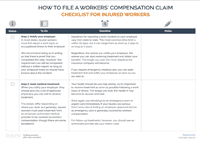 Workers’ Compensation Checklist
Download this checklist for injured workers to learn how to file a workers’ comp claim and track your progress.
Download in PDF format
Finding a workers’ compensation lawyer can be especially beneficial if you’ve been injured while working from home, because these claims are often more complicated than traditional workplace accidents. At-home injuries can raise questions about whether the activity was really job-related, whether the employer is responsible for the home environment, and how to prove your case without witnesses or on-site documentation. A lawyer can help you gather medical evidence, establish the connection between your job duties and your injury, and fight back if the insurance company denies your claim. They can also handle appeals, negotiate benefits, and ensure you don’t miss important deadlines. In other words, a workers’ comp attorney increases your chances of getting fair coverage when your claim is likely to face extra scrutiny.