
• Skip to main content
  • Skip to primary sidebar

New Hdr Right

Enjuris
Finding answers after your accident
Contributor loginSearch
Get help Call Now

Nav Menu

  • Find a Lawyer
  • Accident Resources
        • Personal Injury Law
          • You've been hurt. Now what?
          • Do I have a claim?
          • Finding the best attorney to represent you
          • Dealing with insurance
          • Laws by state
          • View all
        • Accident Types
          • Car accident
          • Truck accident
          • Workplace injury
          • Wrongful death
          • View all
        • Workers' Comp
          • Common work injuries
          • Finding the best workers’ comp lawyers
          • How workers’ comp benefits work
          • Personal injury vs. workers’ compensation
          • View all
        • Injury Guides
          • Spinal cord / column
          • Brain Injury
          • Occupational injuries
          • Whiplash
          • View all
        • More
          • Blog
          • Questions & answers
          • Tell your story
          • Forms and worksheets
          • Videos
          • For students
          • Our Safety Allies
          • About us
          • Legal dictionary
  • Attorney Marketing
    • Social Media Management
    • Become a Partner
    • Join lawyer directory
    • HERO program
    • Compare plans and features
    • Guest blogging for attorneys
    • Enjuris Excellence badge
    • Legal marketing help
Accident Help (Home) » Injury Blog » How Has the Pandemic Changed the Legal Industry?

How Has the Pandemic Changed the Legal Industry?

How can I contribute?

About Enjuris Attorney Editor

Contributor: Enjuris Attorney Editor

Add as preferred source on Google

How has the pandemic impacted the legal industry?

From airlines to restaurants, the COVID-19 pandemic impacted just about every industry in the United States.

More than a year after the pandemic, coronavirus cases are finally declining throughout most of the country and industry leaders are beginning to wonder what post-pandemic “normal” will look like.

Let’s take a look at the 3 biggest ways in which the COVID-19 pandemic changed the legal industry, and whether or not you can expect these changes to be permanent.

The digitalization of the legal industry

The pandemic forced the notoriously old-school legal industry to embrace technology in a dramatic way. With many law firms and courts closed, lawyers were suddenly forced to work from home using tools like Zoom, LawWare, Document Direct, Slack, and Microsoft Teams.
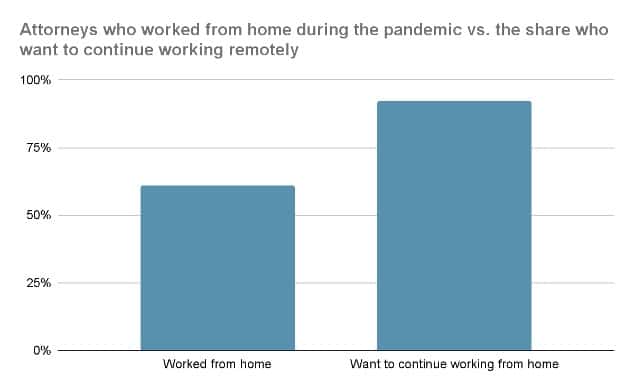
Source: Boston Consulting Group

Many legal experts anticipate that at least some degree of telecommuting will remain in the legal profession. This belief is based, in part, on the fact that law firms were able to transition to remote offices much more smoothly than expected.

Facing facts:A Loeb Leadership survey of law firm leaders found that 98% of the 136 respondents reported at least a moderate amount of success in rapidly moving their employees to a home office, while 77% of respondents said the transition has been highly successful.

What’s more, law firms discovered that they can save a ton of money by reducing their office footprint. As Kent Zimmermann, a consultant at Zeughauser Group who advises law firm leaders, explains:

“There was already some movement in that direction, but I think [the pandemic] will accelerate momentum toward less big corner offices [and] more flexible arrangements in more firms for more people.”

The pandemic didn’t just change where lawyers work, it changed how lawyers provide legal services.

Courts that had lagged behind on the path to digitalization were forced to allow lawyers to submit court forms online, and to conduct depositions, hearings, and trials remotely. The U.S. Supreme Court (a historically camera-shy institution) even live-streamed oral arguments for the first time in its history.

The #SupremeCourt live-streamed oral arguments for the first time in U.S. history because of the pandemic.  Tweet this

Although most courts are open for in-person business again, the pandemic has forced states to examine how they can use technology to improve access to justice. For example, Michigan recently launched a permanent online dispute resolution service for certain civil disputes and small claims matters.

Reduced legal services and litigation delays

Lawyers experienced a significant dropoff in work during the pandemic, as many potential clients, understandably hesitant to venture outside their homes, put off seeking legal help.

The lack of new clients coincided with the lack of work that could be done for existing clients due to court and law firm closures.

Facing facts: During the pandemic, the number of new legal matters being opened decreased by roughly 30% compared to the number of cases opened in the months leading up to the pandemic.

We don’t expect this trend of reduced legal services to continue. Lawyers across the country have already reported a rise in disputes related to the pandemic. These disputes include:

  • Coronavirus-related personal injury and wrongful death claims
  • Disputes arising out of employment relationships
  • Domestic violence disputes
Facing facts: About 13% of consumers say they anticipate having at least 1 legal issue directly related to the coronavirus.

What’s more, the courts are beginning to sort through the massive backlog of cases that were put on hold during the pandemic.

Changing role for female attorneys

The pandemic was particularly hard on female attorneys with children, who in many cases took on a disproportionate amount of the childcare work.

Readers familiar with our annual Women in Law School reports will remember that, although women have outnumbered men in law school classrooms for 5 years in a row, they are still underrepresented in the legal world and especially in leadership positions.

What’s more, women have been leaving the legal industry at a higher rate than men. It will be interesting to see whether these trends continue and perhaps become even more extreme as a result of the pandemic.

Interested in reading more about COVID-19 and the law? Take a look at our legal guide to coronavirus injuries and lawsuits.

Filed Under: Resources You'll Love Tagged With: covid-19

Primary Sidebar

Grow your personal injury law firm. Attract & convert more clients.

Tired of expensive marketing
that doesn't deliver?

Partner with Enjuris and reach millions of accident victims actively seeking legal help.
Join Enjuris Partners

Enjuris Partners

  • AL - Nomberg Law Firm
  • CO - Babcock Tucker
  • FL - Lorenzo & Lorenzo
            Palmer | Lopez
  • GA - Gerber & Elkins Law
  • MT - Murphy Law Firm
  • SC - Chappell, Chappell & Newman
  • TX - Brown Trial Firm
            Neal Davis Law Firm

Blog categories

  • News Stories
  • My Accident Story
  • Resources You'll Love
  • Questions & Answers

In your state

AL AZ CA CO FL GA IN MT NC OH SC TN TX

Attorneys, write for Enjuris. Join our Contributor Program.

Start Writing

Footer Form

Need an attorney? Our Enjuris Partners are ready to help FIND OUT IF YOU HAVE A CASE
Start here

© 2026 Enjuris. All rights reserved.

X/Twitter Facebook LinkedIn YouTube Blog feed Instagram TikTok Reddit
Learn about

Car accident attorneys
Defective product attorneys
Personal injury attorneys
Medical malpractice attorneys
Wrongful death attorneys
Workers compensation attorneys
Birth injury attorneys

Personal injury lawyers: Partner with us Lawyer online marketing

System overview
Video
Powered by

SEO Advantage

3690 West Gandy Blvd., Suite 444
Tampa, FL 33611
Attorney SEO services


Enjuris is a platform dedicated to helping people who are dealing with life-altering accidents and injuries. We support students, families, caregivers and communities with resources, personal stories and a national directory of partner attorneys.

Copyright © 2026 Enjuris.com. All rights reserved. The accuracy, completeness, or currency of information on this site is not guaranteed. The information provided is not legal advice, does not constitute a lawyer referral service, and no attorney-client relationship is or will be formed by use of this site. For state-specific information, particularly regarding attorney advertising, refer to the Terms of Use. Your use of this website constitutes acceptance of the Terms of Use and Privacy Policy.

Press Enter to Search