
Learn how to recognize repetitive strain injuries (RSI) and receive workers’ compensation benefits
When most people think about workplace injuries, they think about employees falling from ladders or losing a finger to a saw blade. But workplace accidents are often less dramatic. Some injuries occur gradually over time as a result of repetitive movements and stress.
This article looks at repetitive strain injuries in the workplace, who’s at risk, what treatment is available, and what legal remedies exist.
What are repetitive strain injuries?
Repetitive strain injuries (also called “repetitive stress injuries” or “repetitive motion injuries”) are temporary or permanent injuries to muscles, nerves, ligaments, or tendons as a result of performing the same motion over and over.
There are a number of more specific injuries that fall under the RSI umbrella. The most common is carpal tunnel syndrome, which occurs when the nerve that travels from the forearm to the hand becomes compressed by swollen ligaments and tendons.
Other injuries that are considered repetitive motion injuries include:
- Tenosynovitis
- Raynaud’s disease
- Thoracic outlet syndrome
- Bursitis
- Tendinitis
- Ganglion
In simple terms, repetitive strain injuries occur as a result of insufficient recovery time between physical demands.
As board-certified occupational health physician Dr. Peter Greaney explains:
What are the symptoms of RSI?
Common symptoms of repetitive motion injuries include:
- Pain
- Swelling
- Tingling
- Numbness
- Stiffness
- Weakness
- Cramping
- Sensitivity
Who’s at risk?
Any manual task that requires repetitive movements or working in fixed or awkward positions for long periods of time can trigger a repetitive strain injury. The 4 types of occupations that are particularly at risk are:
- Office work (such as typing and clerical duties)
- Process work (such as assembly line and packing duties)
- Piece work (such as sewing)
- Manual work (such as bricklaying and carpentry)
Interestingly, recent studies have shown that the onset of repetitive motion injuries may be affected by factors like work satisfaction. People who experience high amounts of psychological stress at work are more likely to develop repetitive motion injuries than those who don’t experience high amounts of stress.
Tweet this
What treatment is available?
Minor repetitive motion injuries can be treated with home remedies, such as:
- Rest
- Ice packs
- Over-the-counter pain relievers
For repetitive strain injuries that are more serious, the following may be necessary:
- Physical rehabilitation. Physical rehabilitation for repetitive stress injuries may include occupational therapy, exercise programs to stretch and strengthen the area, condition exercises to prevent further injury, pain management techniques, and education regarding proper ergonomics for the workplace.
- Surgery. A surgical procedure that can improve tendon health may be necessary. Damaged tendons can be removed to promote the formation of healthy tissue and, in certain cases, surgeons can repair tendon tears to reduce pain and restore function.
RSI prevention
The best way to avoid repetitive strain injuries is to implement good ergonomics in your workplace. Ergonomics is a science concerned with designing and arranging things people use to avoid occupational injury. Egonomics looks at the design of tools, equipment, workstations, and job tasks.
The following are examples of “good” ergonomics:
- Adjusting a workstation to fit a specific task
- Properly locating bins so workers can place products in the bins rather than tossing the products
- Mechanical supports to eliminate the use of extreme force
- Varying the speeds of conveyor belts so certain activities can be performed at slower rates
- Adjusting a seat so that it’s tilted slightly forward to encourage good posture
In addition, the following more general tasks can help prevent repetitive strain injuries:
- Report early symptoms before they get worse
- Ease back into work after a vacation
- Maintain good general health and fitness
- Take regular breaks
What to do if you suffer a repetitive work injury
If you suspect you’ve suffered a repetitive motion injury because of work, you should take the following 3 steps:
Step 1: Seek out a medical provider. The most important thing for you to do is seek medical attention the moment that repetitive motion injury symptoms appear. By seeking medical attention early, you may be able to avoid developing a more serious injury.
In addition, you’ll want to start creating a medical record in the event that you have to file a workers’ compensation claim or personal injury lawsuit down the road.
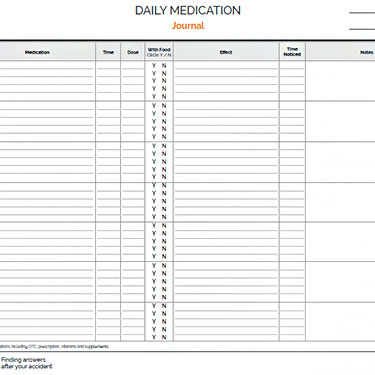 Medication Log Sheet
Printable daily medication log template helps you track your medicines and side effects
Download in PDF format
Step 2: Tell your employer. The law requires that employers identify and correct hazards such as those that lead to repetitive strain injuries. An employer can’t fix the problem if they’re not aware that a problem exists in the first place.
Step 3. Consult with an attorney. If you’ve suffered a repetitive motion injury at work, you may be able to file a workers’ compensation claim. Workers’ compensation laws, which vary by state, are designed to ensure that employees who are injured at work receive compensation without having to file lawsuits against their employers. In general, workers’ compensation pays medical expenses and wage loss benefits.
Most injuries are covered so long as the injury occurred during the course of employment. What’s more, even if your injury existed before you started work, you may be able to recover compensation if the pre-existing injury was temporarily or permanently aggravated by a work-related task.
There are, however, strict requirements that must be followed in order to receive workers’ compensation claims. An experienced workers’ compensation attorney can help make sure you get the compensation you deserve for your repetitive strain injury.
- Workers’ Compensation
- 10 Telltale Signs of a Bad Workers’ Compensation Attorney
- Carpal Tunnel: A Leading Cause of Occupational Injury
- Common Injuries that Affect Nurses and Other Health Care Professionals
- Common Reasons Workers’ Compensation Claims Are Denied
- Directory of State Workers’ Compensation Agencies
- FedEx Employee Injuries & Workers’ Compensation Claims
- Guide to Severance Pay, Unemployment, and Workers’ Comp Claims
- Guide to Social Security Disability Benefits
- H2S Exposure Illnesses & Workers’ Compensation
- Health Care Workers Are Suffering From Mental Health Issues
- Hearing and Vision Loss in the Workplace
- How Much Does A Workers’ Compensation Lawyer Cost?
- How to Prepare for a Workers’ Comp Doctor Evaluation
- How to Prevent Cold Work Injuries
- How To Prove Workplace Defamation & Sue for Damages
- How to Report a Workplace Injury
- Lump Sum vs. Lifetime Benefits For Your Workers’ Comp Settlement
- Manhole Injury Lawsuits and Workers’ Compensation
- Repetitive Strain Injuries in the Workplace
- Seeking Financial Compensation for a Firefighter or EMT Injury
- The Most Common Types of Occupational Diseases
- The Most Dangerous Professions in America
- Third-Party Workplace Injury Claims vs. Workers’ Compensation
- Tips for Finding a Skilled Workers’ Compensation Lawyer Near You
- Tips to Help Prevent Heat Related Injuries
- What If My Employer Doesn’t Have Workers’ Compensation Insurance?
- What is Hazard Pay, and Who Are Essential Frontline Workers?
- White Finger Syndrome and Workers’ Compensation
- Workers’ Comp for Flight Attendants & Other Airline Employees
- Workers’ Compensation After a Poultry Plant Injury
- Workers’ Compensation For Cell Tower Technicians