
Workers’ compensation benefits for first responders and frontline emergency workers
When we’re in a moment of need or danger, we rely on trained emergency professionals to come to our aid. Firefighters and emergency medical technicians (EMTs) are on the scene of nearly every accident and incident, ready to render aid and get people the help and care they need.
But what happens to the emergency responders when they suffer an injury while working?
Firefighters and EMTs put themselves in harm’s way every day to rescue other people. Fortunately, when they suffer an injury in the line of duty, they’re entitled to workers’ compensation benefits to help them recover financially.
5 most common work-related injuries to EMTs
1. Overexertion and body motion injuries.
These types of injuries are caused by heavy or awkward lifting, forceful exertion, and repetition. Generally, this happens when handling patients (for instance, moving a patient to a stretcher, carrying a stretcher, or lifting patients on backboards). There could also be awkward lifts or strains that happen when an EMT rescues someone who is trapped in a vehicle or otherwise awkwardly positioned.
2. Exposure to harmful substances.
Often, this happens through accidental needle sticks, which can expose a worker to a bloodborne pathogen. The Centers for Disease Control and Prevention (CDC) and EMT training authorities emphasize the use of proper personal protective equipment (PPE) at all times in order to reduce the likelihood of an exposure injury.
We also now know that exposure to viruses like COVID-19 can lead to illnesses in health care workers.
3. Slip- or trip-and-fall accidents.
EMTs walk (or run) daily in unfamiliar areas, which could include unstable stairs, broken walkways or areas with environmental hazards (such as a rescue from water or a remote area). But in addition to the risk of losing their footing on uneven ground, these people are also potentially carrying stretchers or patients—so there’s a heavy load added to what could already be hazardous conditions for walking.
Yes, their own. Ambulances crash, with t-bone accidents and intersection collisions being the most frequent. Although ambulances use their lights and sirens, they are moving faster than other vehicles, which means that, like any vehicle, it’s more difficult to stop at a high speed. Not every other driver on the road is attuned to the sound of a siren or sees the lights, and ambulance accidents do happen, leaving their EMT drivers and occupants with car accident injuries.
5. Injuries from violence.
Sadly, even though EMTs are the helpers, the public isn’t always receptive. An EMT never knows what they’re walking into—whether it’s a person whose behavior might be violent because of alcohol or drugs or a person who’s been injured by violence, and the threat is still present.
Common injuries to firefighters
Firefighters also face additional hazards that EMTs might be less likely to encounter.
These include:
- Burns or inhalation injuries from contact with fire
- Exposure injuries or illnesses from contact with or inhalation of hazardous chemicals
- Injuries from excessive heat
Here’s a look at the average number of firefighter injuries per year, based on the most current data available:
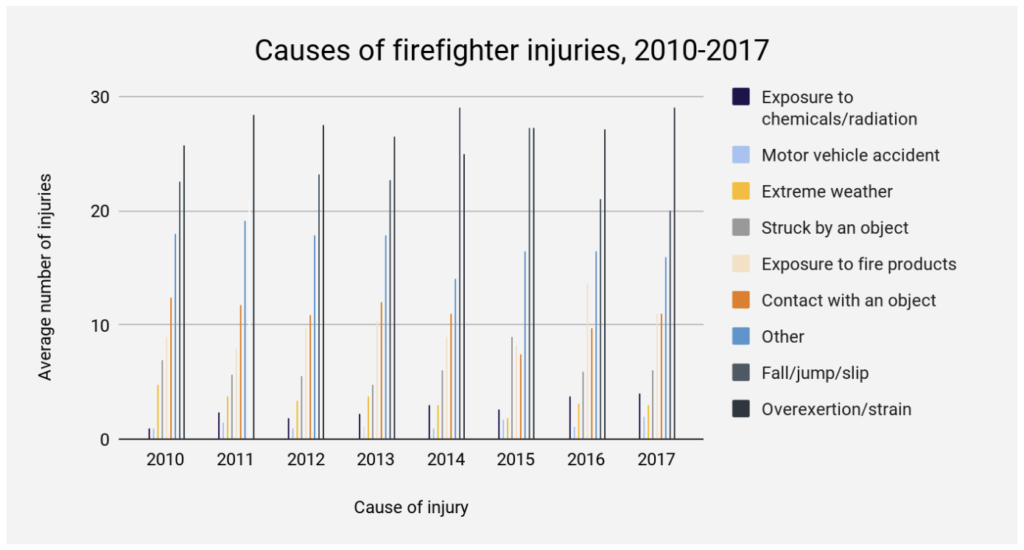
Source: U.S. Fire Administration
Workers’ compensation benefits for emergency responders
Nearly every employer in the nation is required to provide workers’ compensation benefits, and that includes firefighters, EMTs and other first responders.
Specific benefits and amounts vary by state, and some states also provide additional benefits to this category of workers.
One of the main principles of workers’ compensation is that it’s no-fault insurance. That means you don’t need to prove that any person or entity was negligent or at fault for the injury. An injured worker only needs to prove that they were at work at the time of the injury, the injury actually exists, and it cost them money.
You can recover benefits that include:
- A percentage of your wages for time off work during your recovery
- Disability benefits
- Medical treatment related to the injury, current and future
- Transportation to medical appointments
- Job retraining if you’re unable to resume work in the position you had before the injury
- Wrongful death benefits for survivors if the worker dies from work-related injuries
If you’re able to claim workers’ compensation benefits, you’re not permitted to file a lawsuit against your employer for damages related to the injury. This is because the workers’ compensation system is designed to protect both the employee and the employer.
The employee benefits from having a quick claim evaluation and the ability to receive benefits swiftly and without the burden of proving fault. The employer benefits by not being at risk of becoming a defendant in a lengthy, costly and sometimes publicized lawsuit.
3rd-party liability lawsuits
There are certain instances when an injured worker may file a lawsuit against a party that is not their employer.
If you’re injured because of the negligence of a person or entity other than your employer, you can file a personal injury lawsuit. This is most likely because of an injury that would lead to a premises liability claim or a defective product lawsuit.
The Fireman’s Rule
The Fireman’s Rule prohibits a first responder from filing a lawsuit for injuries they suffered at work. It essentially provides qualified immunity to the land owner for a rescue that takes place on the property under the principle that a first responder assumes certain risks as part of their job.
However, in the states listed below, a firefighter or other first responder may sue for damages if their injury was caused by negligence, neglect or omission:
Alabama
Maine
Minnesota
New York
Oregon
Vermont
Colorado
Massachusetts
Montana
North Carolina
Pennsylvania
West Virginia
Florida
Michigan
New Jersey
North Dakota
South Carolina
Wyoming
The Fireman’s Rule does not bar an injured first responder from making a claim for workers’ compensation benefits.
What to do if you’re injured at work as a firefighter or EMT
First things first—even heroes need help sometimes.
Whether your injury is an emergency or not, seek medical assistance. You should head to the nearest hospital, urgent care or your own doctor.
When you’re at work and an accident happens, that sometimes makes it “easier” to recover workers’ compensation because you need to prove that your injury is the result of an accident that occurred while you were on the job.
But some of the common types of injuries to firefighters or EMTs—the ones that happen over time but not as a result of a specific incident—can be more difficult when it comes to receiving workers’ compensation benefits.
If you suffer strain from heavy lifting, a repetitive motion injury, or an illness from exposure to a hazardous substance, you might not be able to pinpoint exactly when your symptoms began. And, if you can, it would still be difficult to establish that they were caused by your work.
Even in that situation, the first step is a medical diagnosis. When you’re in a medical exam, tell the examining doctor about your job so they note in your records that the diagnosis is a condition that could be related to your line of work.
The next step is to seek the assistance of a workers’ compensation lawyer.
If your state provides additional benefits for frontline workers or first responders, your lawyer will know where to go and how to go about acquiring them. Don’t let yourself be shortchanged.
If not, and you need to work your way through the workers’ compensation system, your lawyer will be integral to that process, too. Many people wrongly assume that receiving workers’ compensation benefits will be easy, but the burden of proving that an injury that happened over time is directly related to your job can be tricky.
Also, if the injury has left you permanently disabled or you’ll require future or ongoing treatment, you need a professional to determine exactly what your costs will be. Once you accept a settlement or benefits package from workers’ compensation, you can’t go back for more if you run out of money or it doesn’t cover the full extent of your costs.
Your lawyer will work with financial and medical experts to ensure that you receive the maximum amount possible to recover your losses.
If you need a workers’ compensation lawyer in your state, you can use the Enjuris law firm directory to find a skilled, qualified attorney who can help.
Connect to top-rated lawyers in seconds using our comprehensive national directory
- Workers’ Compensation
- 10 Telltale Signs of a Bad Workers’ Compensation Attorney
- Carpal Tunnel: A Leading Cause of Occupational Injury
- Common Injuries that Affect Nurses and Other Health Care Professionals
- Common Reasons Workers’ Compensation Claims Are Denied
- Directory of State Workers’ Compensation Agencies
- FedEx Employee Injuries & Workers’ Compensation Claims
- Guide to Severance Pay, Unemployment, and Workers’ Comp Claims
- Guide to Social Security Disability Benefits
- H2S Exposure Illnesses & Workers’ Compensation
- Health Care Workers Are Suffering From Mental Health Issues
- Hearing and Vision Loss in the Workplace
- How Much Does A Workers’ Compensation Lawyer Cost?
- How to Prepare for a Workers’ Comp Doctor Evaluation
- How to Prevent Cold Work Injuries
- How To Prove Workplace Defamation & Sue for Damages
- How to Report a Workplace Injury
- Lump Sum vs. Lifetime Benefits For Your Workers’ Comp Settlement
- Manhole Injury Lawsuits and Workers’ Compensation
- Repetitive Strain Injuries in the Workplace
- Seeking Financial Compensation for a Firefighter or EMT Injury
- The Most Common Types of Occupational Diseases
- The Most Dangerous Professions in America
- Third-Party Workplace Injury Claims vs. Workers’ Compensation
- Tips for Finding a Skilled Workers’ Compensation Lawyer Near You
- Tips to Help Prevent Heat Related Injuries
- What If My Employer Doesn’t Have Workers’ Compensation Insurance?
- What is Hazard Pay, and Who Are Essential Frontline Workers?
- White Finger Syndrome and Workers’ Compensation
- Workers’ Comp for Flight Attendants & Other Airline Employees
- Workers’ Compensation After a Poultry Plant Injury
- Workers’ Compensation For Cell Tower Technicians