
What’s your legal liability if someone is injured on your property? What can you do if you’ve been injured?
A slip and fall accident isn’t really a literal term… it could be a trip and fall, miss and fall… or any kind of variation. Regardless, the law allows an injured person to make a claim against the owner of the property if the owner was negligent.
Generally, these types of personal injury cases fall under premises liability laws, which vary by state.
Continue reading for answers to some of the most common questions that arise from slip and fall accidents.
Q: What is negligence?
A: Negligence is when a person fails to take proper care to avoid harm to someone else. There are 4 elements to negligence:
- The defendant had a duty of care to the plaintiff (injured person).
- The duty was breached when the defendant’s action or inaction caused the plaintiff’s injury.
- The plaintiff’s injury was proximately (directly) caused by the defendant.
- The injury cost the plaintiff money or physical pain and suffering.
Q: What is premises liability law?
A: The owner of a property can be liable for an injury suffered by another person on the premises. Usually, this relates to a person who has either express or implied consent to be on the property — either a guest or someone who’s there for business purposes.
Premises liability is based on whether the accident was foreseeable, which means the average person would’ve anticipated that the accident could happen based on the condition of the property. It also depends on whether the property owner made a reasonable effort to keep the property safe and to provide adequate warning if there is a dangerous condition.
Q: I was injured at a family member’s home, but I don’t want to sue them. What should I do to have my costs covered?
A: You don’t have to damage your relationship or feel like you’re costing someone money. Instead, you can sue their insurance company. Every residence or business is required to have insurance for this very reason. Injuries happen, and insurance protects the homeowner or business owner for being responsible for covering the costs.
Q: What if the accident happened on a rental property?
A: In general, the property owner (landlord) is responsible for maintaining the property. However, there might be instances when the renter is negligent (like if they do something that causes a hazardous condition, or if they fail to notify the landlord of danger so that the landlord can repair it).
Premises liability cases against a landlord are often complex. You should consult with an experienced attorney in your area for legal advice about your specific claim.
Q: What are the common causes of a slip and fall accident?
A: Most slip and fall accident injuries are caused by:
- Wet or slippery floors
- Snow or ice on sidewalks, steps, or other walking areas
- Worn or defective conditions on floors (cracked tiles, broken steps, torn carpet, etc.)
- Poor lighting in walking areas
- Unmarked hazards
- Uneven floors or surfaces
- Loose or broken sidewalks
Q: Where do slip and fall accidents occur?
A: A slip and fall accident can happen anywhere but the most common places where these injuries occur are:
- On snow and ice
- On sidewalks
- At work
- In apartment buildings or on someone’s private property
- In retail stores, businesses, and supermarkets
How many people die from slip and fall accidents?
A: Slips and falls may seem like minor accidents, but they can have fatal consequences, particularly for older adults or those with pre-existing medical conditions.
According to the Centers for Disease Control and Prevention (CDC), falls are the leading cause of injury-related death among adults aged 65 and older.
In 2020, more than 36,000 older adults died from falls. It’s projected that there will be seven fall deaths every hour in the United States by 2030.
The five states with the highest age-adjusted fall death rate in 2021 were:
| State | Fall death rate per 100,000 | Number of deaths |
|---|---|---|
| Wisconsin | 176.5 | 1,635 |
| Minnesota | 141.8 | 1,230 |
| South Dakota | 140.3 | 197 |
| West Virginia | 133.7 | 420 |
| Colorado | 130.7 | 920 |
It’s not just elderly people who suffer fatal slips and falls. When all ages were considered, falls were the second leading cause of preventable injury-related death behind motor vehicle accidents in 2020. Many of these deaths occurred in the workplace, as 805 workers died in falls and 211,640 were injured badly enough to require days off of work.
Despite his serious condition, fraternity members waited approximately 12 hours before calling for medical help. Tragically, by the time Tim reached the hospital, it was too late to save him. His death led to significant changes in Pennsylvania’s hazing laws and prompted a nationwide conversation about the dangers of hazing and the importance of promptly seeking medical assistance after a fall.
Q: Can I get workers’ compensation benefits for a slip and fall injury?
A: If your injury happens on your work site or during the course of performing work-related duties or tasks, you may be eligible for a workers’ compensation claim.
However, if the injury happens while you’re working on a site not owned or managed by your employer (for example, if you’re working as a subcontractor on a construction site or if your job involves visits to other offices or residences), you can often file a third-party claim if you’re injured because of a condition on the property. That means even though you were at work, you can still sue the property owner for your injuries if they were caused by negligent maintenance of the property.
Q: My slip and fall injury was on public property. Can I still sue?
A: Sometimes, yes. If you were injured on property owned by a government agency (city, state, or local municipality), you may still be able to sue for your injuries, but the process might be different.
The main thing to be aware of is that your deadline to file a lawsuit might be shorter, and there might be a few extra steps (like filing a Notice of Claim, for example).
However, there are some states that have sovereign immunity. This concept protects certain government employees and agencies from being sued.
It can be complicated and difficult to know if you’re able to file a lawsuit against a government agency or if you’re prohibited from doing so because of sovereign immunity. If your injury happened on public property, you should contact a lawyer who’s familiar with your state’s laws and processes.
Q: What type of damages can I recover from a slip and fall injury?
A: In a personal injury lawsuit, you can recover damages to cover the costs of your injury and its effects on your life.
Economic damages have specific costs, like medical treatment (including doctor or hospital visits, rehabilitative therapies, prescription medication, assistive devices, and other items) and lost wages if your injury prevented you from returning to your job at the capacity you were in before the accident.
Non-economic damages include pain and suffering or mental anguish, loss of consortium, loss of enjoyment of activities, and possibly punitive damages. Usually, these costs become an issue if the injury is especially severe or life-changing.
Q: There was a hazardous condition, but I think the accident was partially my fault. Can I still recover damages?
A: That depends on the laws in your state. Each state follows 1 of 4 fault systems:
- Pure contributory negligence: You cannot recover any damages if you shared any fault.
- Pure comparative negligence: You can recover damages that are reduced by your percent of fault.
- Modified comparative fault (50% rule): You can recover damages if you were 50% or less at fault.
- Modified comparative fault (51% rule): You can recover damages if you were 51% at fault.
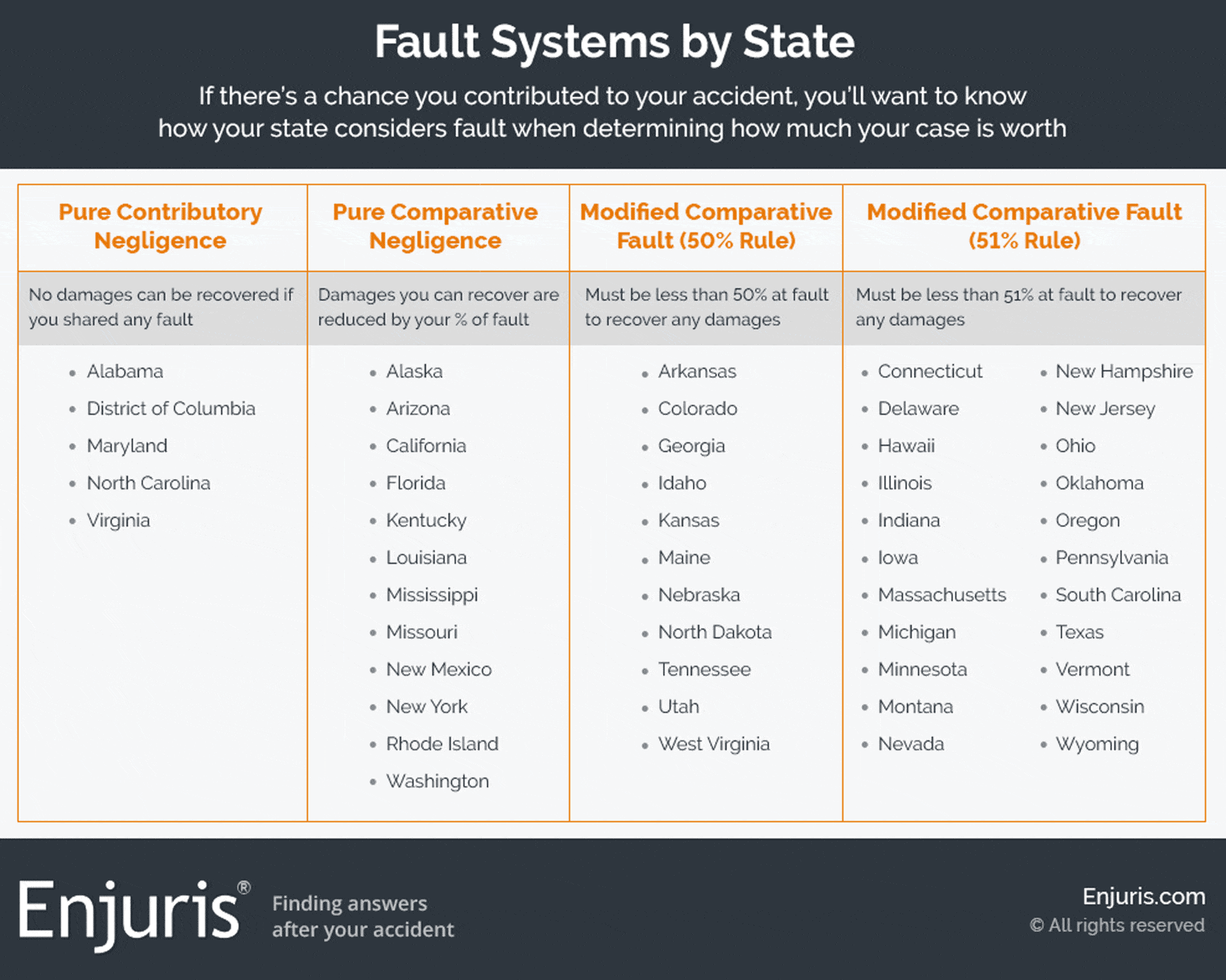
Fault Systems by State
View Full Size Get the Code Use this graphic on your site
Use this infographic on your site
We encourage people to use our infographics, with proper attribution. Just copy and paste the code below to use this infographic on your site. If you need help, let us know!
<a href="https://www.enjuris.com/personal-injury-law/shared-fault-rules/" target="blank"><img src="https://www.enjuris.com/wp-content/uploads/2022/10/fault-systems-by-state-2022.gif" alt="Fault Systems by State" title="Fault Systems by State" style="width: 100%; max-width: 987px; display: block; margin: 15px auto;" /></a>
How does this work?
Here’s an example:
So, if you were texting, for example, and not watching where you were going, the court might find that you were 45% at fault. Depending on which fault system your state follows, your damage award could be reduced or you might not receive any damages at all.
Q: What should I do after a slip and fall accident?
A: There are a few actions you should take immediately:
- Seek medical treatment. It’s important that you visit a medical provider right away so that your injuries are documented in your medical records. If you wait and visit the doctor days or weeks later, it will be harder to prove that the injuries are the result of your slip and fall accident.
- Report the accident to the property owner. Especially if your accident happens on public property or someplace like a shopping center, it’s essential that you ensure it has been properly documented.
- Gather evidence. If you’re in a physical condition to do so, or if there’s someone else nearby who can help, document the scene as best you can. This includes taking photos of the hazard, lighting conditions, handrails, weather, and any other relevant information. You should also take photos of your own shoes or clothes.
It can also be important to your case to obtain contact information for any witnesses who observed the area or the accident. Take each person’s name and contact information so that you or your lawyer can be in touch later to get their account of what happened.
If your injury accident happened in or near a business or public property, there might be a surveillance video that captured the incident. This is something to look for quickly because many places routinely delete surveillance video within a few days (or sooner), so it’s a good idea to act as soon as possible to ask any business that might have cameras if there’s video footage available.
Q: What if someone was injured on my property?
A: If you’re a homeowner or property owner and someone was injured on your premises, you should call your insurance company right away. Homeowners’ insurance will often cover residential premises liability claims.
If you’re aware that there’s a potential hazard on your property (for example, broken steps, holes in the ground, broken tree branches, etc.), you must make a reasonable effort to either repair the condition or provide warning that there’s a dangerous condition.
Q: How can I protect myself from being liable in a premises liability claim?
A: The first priority is to keep your property safe. That means keeping an eye out for potential hazards and fixing them when they do arise.
Second, if there is a hazard that you can’t mitigate immediately, you can provide a warning (signs, cones, caution tape, etc.) so that any visitor to your property is aware to steer clear of the area.
Q: When should I call a slip and fall lawyer?
A: It’s always a good idea to look for a lawyer as soon as possible after an injury accident, especially if there are questions of fact, there’s evidence to be obtained, or the other party is uncooperative or denies liability.
Your lawyer will act quickly to gather evidence and documents that are relevant to the condition of the property, who was responsible for maintaining the area, and other factors. Your lawyer will also evaluate the evidence in order to minimize your liability in order to obtain the most damages. It’s the lawyer’s job to negotiate with the insurance company or the other parties in order to obtain the best possible settlement, or to go to trial if a settlement can’t be reached.
Connect to top-rated lawyers in seconds using our comprehensive national directory
See our guide Choosing a personal injury attorney.