Additur and remittitur may sound like a pair of Roman gladiators or spells you’d learn at Hogwarts, but they are actually two very impactful legal doctrines used to describe processes in which a judge increases or decreases a jury’s award of damages.
While rarely used, these tools can have a big impact on personal injury verdicts, so let’s make sure you understand what they are and when they can happen.
What are additur and remittitur?
Additur and remittitur are Latin terms (as are many legal terms) that refer to a judge’s power to adjust the amount of money awarded by a jury:
- Additur allows a judge to increase the jury’s award of damages.
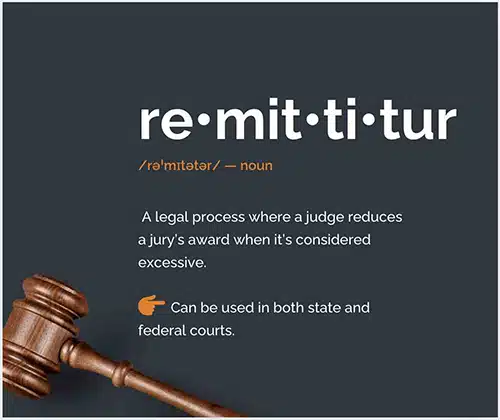
- Remittitur allows a judge to decrease the jury’s award of damages.
These tools are used in rare cases when a judge believes the jury’s award is either shockingly low (additur) or excessively high (remittitur).
Sometimes, the judge will offer the adjusted amount as a condition—meaning the party must accept the new figure or face a new trial on damages.
Can’t remember which is which? Additur is when the judge adds money.

When can a judge use additur or remittitur?
Judges want to honor a jury’s decision. That is, after all, how the legal process is supposed to work. But Judges do serve as a safeguard, and in certain circumstances they might step in:
- Additur is used when a jury clearly undervalues a plaintiff’s damages. For instance, if a plaintiff suffered a serious injury with extensive medical bills and lost income but the jury awards a nominal sum, the judge might increase the award to a more reasonable figure.
- Remittitur comes into play when a jury awards an amount so large that it appears to be based on emotion, prejudice, or some misunderstanding. This often occurs in cases involving punitive damages or significant pain and suffering awards.
It’s important to note that parties involved in a case can request these adjustments. A party may move (file a motion) for additur if the jury awards an inadequate amount of damages, or the court may order additur on its own initiative (sua sponte—another Latin phrase).
Consider the following hypothetical:
Carla Jones, a 27-year-old social media marketer, is T-boned at an intersection in Fort Worth, Texas, by a popular actor who ran a red light. The crash leaves Carla with two broken ribs, a fractured pelvis, and a mild traumatic brain injury. She’s out of work for nearly six months and racks up $85,000 in medical bills, not including lost income and ongoing therapy.
At trial, the jury finds in Carla’s favor but—influenced by the likeability of the defendant—awards her only $15,000 in damages. Carla’s attorney files a motion for additur, arguing that the award is grossly inadequate based on the evidence.
The judge agrees and increases the award to $120,000 to reflect the actual costs and losses supported by medical records and expert testimony. The defendant is given a choice: accept the adjusted amount or proceed to a new trial on damages.
Additur is not allowed in federal courts. The U.S. Supreme Court ruled in Dimick v. Schiedt (1935) that additur violates the Seventh Amendment right to a jury trial in federal cases. Remittitur, on the other hand, is permitted in both state and federal courts.
Real-life examples of additur and remittitur
While rare, these two legal doctrines do appear in real cases—and when they do, they often make headlines.
- Dimick v. Schiedt (1935): In this landmark case, the U.S. Supreme Court addressed the constitutionality of additur. The Court held that increasing a jury’s award without the jury’s consent violates the Seventh Amendment’s right to a jury trial. Justice Sutherland noted, “Maintenance of the jury as a factfinding body is of such importance, and occupies so firm a place in our history and jurisprudence, that any seeming curtailment of the right to a jury trial should be scrutinized with the utmost care.”
- Lazzari v. Guzman (2023): A Florida judge added $4.8 million through additur after determining that the jury failed to include adequate past and future medical expenses in its verdict.
- Lawless v. Town of Freetown (2024): After a jury awarded $75,000 for breach of contract and found a due process violation under §1983, it entered $0 in compensatory damages but $150,000 in “nominal” damages—suggesting the jury may have misunderstood the verdict form. The plaintiff moved for additur or a new trial, arguing the jury intended to award emotional distress damages but entered the amount on the wrong line. The judge denied the motion, finding the verdict was not inconsistent and that recharacterizing the award would violate the Seventh Amendment. The court reduced the nominal damages to $1.
What additur and remittitur mean for personal injury plaintiffs
Although additur and remittitur are rarely used, they are important doctrines that serve as checks on the jury system—ensuring that damage awards are fair and grounded in the evidence.
If you receive a jury verdict that seems unusually low, your attorney may file a post-trial motion for additur—though this option is only available in state court. On the other hand, if the award seems too high, the other party may challenge it. These possibilities serve as reminders of two things: having an experienced attorney on your side is critical, and even after a verdict, your legal battle may not be over.