
You were injured. It was an accident, and it shouldn’t have happened. In fact, you’re pretty certain that it’s the result of someone’s negligence. You know who, you know how, you know when.
It really should be a cut-and-dried case, as they say.
But there’s one problem: You can’t afford a lawyer. Fortunately, there are ways you can still receive what you’re owed, even without a lawyer. And, Enjuris offers tips for finding legal representation on a budget.
Negotiate a personal injury settlement without a lawyer
First, if you can’t (or don’t want to) shell out for a lawyer, you might try to negotiate a settlement yourself. Any negotiation involves risk, and having a lawyer does give you some leverage—but if your case is fairly straightforward, you might be able to do this successfully on your own.
Here are the steps to follow to negotiate your own settlement:
Gather and organize evidence
Collect your medical records, bills (paid and unpaid), accident reports, witness statements, photos, and proof of lost wages. The stronger your documentation is, the more difficult it will be for an insurer to downplay your claim.
What documents do I need? Enjuris offers this checklist of necessary evidence for a personal injury claim.
 Documents & Evidence Checklist
Checklist of 30 items to help you prepare for making a personal injury or accident claim
Download in PDF format
Calculate your losses
- Calculate your economic damages. This includes medical costs, lost income, and other expenses related to the injury.
- Estimate your non-economic damages. Non-economic damages are costs associated with the injury that don’t have a specific financial value, such as pain and suffering, emotional distress, or loss of consortium. There are a couple of ways to calculate this, but most people use the “multiplier method,” which involves multiplying the amount of your economic costs, depending on the severity of the physical injury.
- You can think through what your minimum amount is that you’d accept as a settlement, but don’t share it with anyone else—you don’t want the other party to lowball you, but keep the figure in your head in case you can’t negotiate a higher amount.
Send a demand letter
- There are specific components to a demand letter: It must include the facts of the accident, your injuries, and the requested damages. Include any supporting documents.
See also: 6 Steps to Writing an Effective Payment Demand Letter - You must request a specific settlement amount that is higher than your minimum to allow room for negotiation. Don’t aim for the stars right away—if your demand seems astronomically high, the other party might not think you’re serious about a negotiation. Rather, request an amount that seems like a reasonable calculation of your actual losses.
Be prepared for pushback
An insurance adjuster’s job is to pay out as little as possible to make the claim “go away.” Remember, the less an insurer pays in settlements, the more it profits. The adjuster might try to take one (or all) of these approaches:
- Argue that your injuries aren’t as serious as you say they are
- Question whether your treatment was necessary
- Offer a quick, lowball settlement
You should remain calm, stick to your evidence, and don’t accept the first offer.
Be strategic
When they offer you a low settlement, make a reasoned argument supported by your evidence. Be professional and avoid making an emotional argument; if you’re feeling overwhelmed, you can stop talking and set up a time when you can discuss further. Remember, this isn’t an interrogation—it’s a negotiation in which each side should present its arguments and come to an agreement. You’re not on trial and don’t need to defend yourself or your injuries or treatments.
As a final talking point, remind the adjuster that the insurer will face far higher costs if the case goes to trial. They will likely need to pay litigation fees, retain expert witnesses, and so on. They know this, but you want them to know you know it, too.
Know when to walk away
If the insurer won’t play fair, you’re better off ceasing negotiations and consulting an attorney; once you accept a settlement offer from the insurer, you can’t then reconsider and go back for more. The deal is done. Sometimes, simply the act of hiring a lawyer after a failed negotiation pressures the insurer to offer a higher amount.
What to do if you can’t afford a personal injury lawyer
Your negotiation didn’t go as you hoped. But that doesn’t mean all hope is lost.
It’s possible that your settlement can’t be reached without a lawyer—it happens. But there are ways to get a lawyer on a budget. The good news is that most personal injury attorneys use payment structures designed to make legal help accessible, even if you can’t pay up front. Here’s what you can do if you think you can’t afford a lawyer.
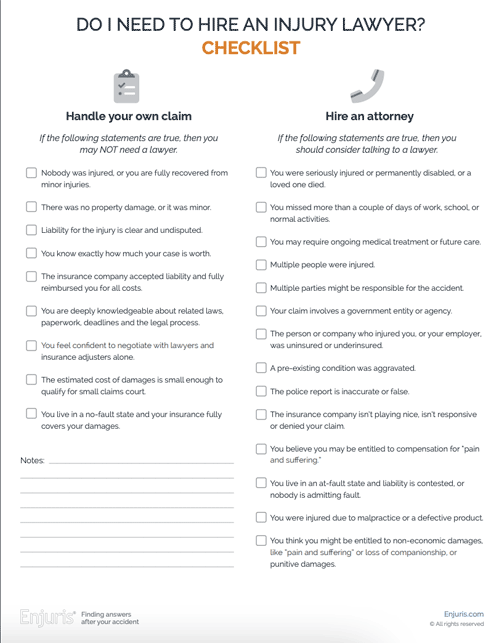 When To Hire a Lawyer Checklist
Can you handle your own claim, or should you hire an attorney? Use this worksheet to determine when you should consider hiring a personal injury or workers' comp lawyer.
Download in PDF format
Understand contingency fee arrangements
A contingency fee is the most common payment arrangement for personal injury lawsuits. In this type of arrangement, a personal injury lawyer will take payment after you’ve reached a settlement or been awarded damages. Typically, the lawyer earns around 33%-40% of your award. If the case isn’t successful, you usually don’t owe attorney fees, though there could be court costs, filing fees, and some other incidentals.
This serves two purposes:
- You don’t pay out of pocket for your lawyer. Again, there could be some court-related costs, payments to expert witnesses, and other expenses. But the lawyer earns his fee only after you’ve received damages.
- The lawyer will only take a case they think they can win. No lawyer is going to litigate a case if they think they’re not going to earn anything at the end; so if a lawyer takes your case, you know they believe they have a decent chance of getting you a settlement or award.
Again, this is not zero cost. It’s zero attorney fees up front.
There are other costs you could incur:
- Court filing fees
- Deposition and transcript fees
- Expert witness fees
- Medical records and other document retrieval
The law firm might pay these costs up front, expecting that you’ll reimburse later. Your responsibility for these expenses, regardless of whether the case is won or lost, should be outlined in your fee agreement.
Request a free consultation
Many personal injury lawyers offer a no-cost initial consultation. This is a good opportunity to understand your rights, discuss the merits of your case, and get a sense of the likelihood of success and costs involved.
Negotiate a fee or payment structure
Some attorneys are open to negotiating the percentage of their contingency fee based on the strength of your case or its potential value. You might also ask about a sliding scale, which means it could be a lower percentage if the case settles quickly and higher if it goes to trial.
Explore the possibility of legal aid and pro bono resources
There are nonprofit legal aid organizations that assist with injury cases, particularly if they involve vulnerable individuals like children, seniors, or disabled people. Some state bar associations maintain lists of pro bono attorneys who volunteer to help clients who can’t afford standard legal fees.
Consider small claims court
Small claims court handles disputes that involve low damages. Each state has its own threshold for a small claims maximum, but case value maximums range from about $3,000 to $10,000. You can check the maximum value of a small claims court case in your state here: Save Time and Money in Small Claims Court.
Small claims court is less formal than a trial court. Most people can represent themselves and it’s a quick, inexpensive way to get a judgment.
Don’t give up!
Lawyers understand that clients come to them in a moment of financial distress; the system is designed to make representation possible without payment until the case is resolved.
Contingency fees, free consultations, legal aid, and even small claims court can help you pursue justice without paying up front. The most important step is to speak with an attorney quickly—you might find that cost is not as much of a barrier as you think.
See our guide Choosing a personal injury attorney.