
Imagine you’re driving home from work when out of nowhere, an intoxicated driver sideswipes your car, causing a catastrophic car accident. The physical and emotional toll is significant, but the financial burden becomes even clearer when the at-fault driver’s insurance policy doesn’t cover all of your damages.
The logical next step would be to sue the at-fault driver for the amount that exceeds their policy limits, but you worry you can’t afford a personal injury attorney. Fortunately, most personal injury attorneys work on a contingency fee basis, meaning they only get paid if they recover money on your behalf. In this article, we’ll unpack the details of contingency fee arrangements, providing clarity on this often misunderstood aspect of personal injury law.
What is a contingency fee arrangement?
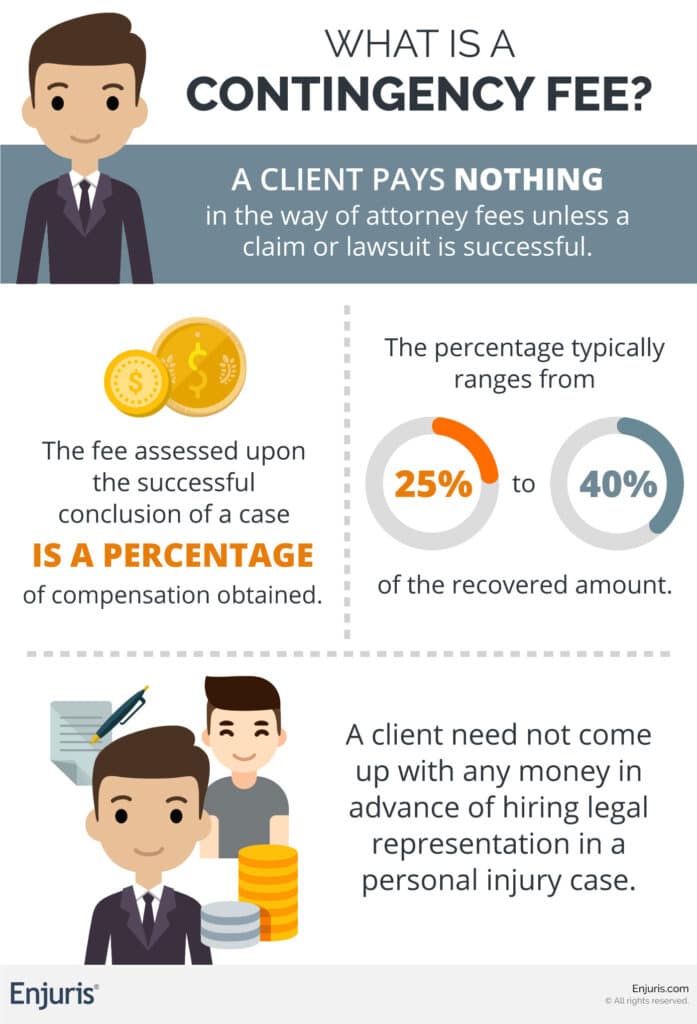
The most common type of fee arrangement in a personal injury case is a contingency fee arrangement.
In a contingency fee arrangement, your lawyer agrees to accept a fixed percentage of the money you recover. If you don’t recover any money (either through a verdict or settlement), you don’t owe your lawyer a penny for the work they performed on your case.
To put it another way, under a contingency fee arrangement, the lawyer’s fees are contingent on winning the case or obtaining a settlement.
Although it’s uncommon, some attorneys use a hybrid fee arrangement that includes a fee based on the lawyer winning the case and the lawyer’s fixed hourly rate.
What percentage do lawyers take in a contingency fee arrangement?
The exact percentage an attorney takes under a contingency fee agreement can vary, but it typically ranges from 20 to 40 percent of the recovered amount.
A number of factors may influence the percentage, including:
- The attorney’s experience
- The attorney’s reputation
- The geographic location of the case
- The complexity of the case
- The risk involved
- The case’s time limitations
There are a couple of legal limitations on contingent fees. First, all states have statutes preventing attorneys from charging “unreasonable fees.” Every state is different, but most courts consider the following factors when deciding whether a fee is unreasonable:
- The time and labor required
- The novelty and difficulty of the questions involved
- The fee customarily charged in the locality for similar legal services
- The amount involved and the results obtained
- The time limitations imposed by the client or by the circumstances
- The nature and length of the professional relationship with the client
- The experience, reputation and ability of the lawyer
If a fee is deemed “unreasonable,” the court may sanction the attorney and require the attorney to reimburse the client.
Second, a number of states cap the percentage attorneys are allowed to take in a contingency fee arrangement. In Florida, for example, contingency fee arrangements for malpractice cases are capped at 30 percent of the initial $250,000 recovered and 10 percent of any amount that exceeds $250,000.
Find out the personal injury and workers’ compensation contingency fee limitations in your state.
Do I really pay nothing if I don’t win?
It’s important to keep in mind that fees are different from costs. Even in a contingent fee arrangement, the client is typically expected to pay litigation costs regardless of whether they recover any money.
Common litigation costs include:
- Court filing fees
- Costs for obtaining medical records
- Expert witness fees
- Deposition costs
A lawyer in a contingency fee case might agree to front litigation costs and seek reimbursement at the end of the case (win or lose). Other attorneys will require clients to pay these costs as the case progresses.
When you hire an attorney, the attorney will provide you with a representation agreement. It’s important to read the representation agreement carefully before you sign it.
A representation agreement should clearly outline the terms of the fee arrangement, including the percentage that the attorney will take if the case is successful, how litigation costs will be handled, and what happens if you decide to change attorneys partway through the case.
Don’t be afraid to ask questions about the representation agreement. If you want more time to read the representation agreement, ask to take it home so you can look it over fully before signing.
What are my options if I have a fee dispute with my attorney?
Just like every other professional field, there are a few bad apples in the legal profession who may engage in unethical or illegal billing. If you have concerns about your attorney’s billing practices (perhaps your attorney stated that they would take 20 percent in the representation agreement but are demanding 30 percent after the settlement), the first step is to have an honest conversation with your attorney. You may be mistaken, or your attorney may have made an honest mistake. Sometimes a simple, civil conversation is all it takes to get things back on track.
If you’re still unable to resolve a fee dispute after an honest conversation, it’s time to reach out to another party for help. Here are a couple of places to look:
- Your state bar association: Most state bar associations have an attorney fee dispute service. In most cases, the state bar will help you resolve your problem through a free or low-cost arbitration process.
- Other counsel: You may need to reach out to another attorney for help recovering the money you’re owed. The attorney may be able to negotiate a settlement, or you may end up having to sue your former lawyer.
A contingency fee arrangement can be a lifeline for victims of personal injury accidents. By understanding the ins and outs of contingency fees, you can seek justice and compensation regardless of your financial situation.