Find out about Mississippi car accident laws and insurance requirements
A car accident can be devastating — or a minor inconvenience. Either way, how you recover damages is based on the Mississippi fault system and insurance laws. Here’s everything you need to know about handling a Mississippi car accident.
The Chippewa Indians are responsible for the name “Mississippi”, which means “large river.” The Native American tribes Choctaw, Chickasaw and Natchez were among the first inhabitants of the state now known for its bluegrass music, comfort food, and southern charm. Most of all, the Magnolia State is known for the beautiful trees that are abundant throughout.
Mississippi is bordered by the Gulf of Mexico to the south, Tennessee to the north, Alabama to the east and Louisiana and Arkansas to the west. The western border between states is the Mississippi River, which is the second-longest river in the nation.
But whether you’re Mississippi born and bred, or if you’re passing through for work or leisure, it’s good to know the lay of the land. The main highways in Mississippi are I-55, which runs north/south through the state; I-20, which runs east/west from Vicksburg through Meridian; and I-59, which runs south from Meridan to the Louisiana border near the Gulf.
Aside from knowing the major highways and which direction you’re traveling, it’s also important to know Mississippi car accident laws. Regardless of the slow pace of life in the Deep South, accidents happen and it’s good to know how the state assigns liability, what your options are for financial compensation if you’re injured, and what steps you should take after a crash to protect your rights.
Mississippi car accident laws
Mississippi is an at-fault state
Also known as a “tort” state, this means that the person who is at fault for causing an accident is responsible for paying the costs associated with the accident.
Putting this into perspective, you’d think that the tailing driver is always at fault in a rear-end collision—but that’s not always true. If the driver in front fails to signal before a turn or slams on the brakes without a valid reason and they’re hit from behind, it could be the front driver’s fault.
Mississippi is a pure comparative negligence state. That means the plaintiff (injured person) can recover damages, but they are reduced according to the plaintiff’s percentage of fault. In most instances, even though the defendant might have clearly caused the accident, the plaintiff might have had an opportunity to avoid the accident if they had acted differently in the moment.
For instance, if the defendant crossed the double-yellow line into the plaintiff’s lane, could the plaintiff have swerved out of the way if they’d reacted more quickly? If the defendant made a left turn and hit the plaintiff, who was approaching from their left, could the plaintiff have braked a moment sooner and avoided the collision?
These are the types of questions insurance companies and the courts will answer as they assess who is liable and for what percentage of the accident. If the court determines that the defendant was 80% liable and the plaintiff was 20% liable, then the plaintiff may collect 80% of their assessed damages.
Since Mississippi is a pure comparative negligence state, even if the plaintiff is more at fault than the defendant, they can still collect damages.
Since determining fault can be subjective and based on interpretation of evidence, the amount of damages you receive can be largely based on the quality of your negotiations with the insurance company or your arguments in court. That’s why hiring a skilled and experienced Mississippi car accident lawyer can be your best bet for ensuring that you receive the full amount of compensation.
Mississippi car accident statute of limitations
Each state has a set of statutes of limitations, which are deadlines by which a lawsuit must be filed. Mississippi allows you to file a car accident lawsuit within three years from the date of the crash. This is the same if you’re filing a wrongful death claim for a family member who died in an accident, except that the deadline begins to run on the date of the person’s death (so, if they died a week after the accident, it would begin on that date).
However, this applies only to civil personal injury lawsuits—not insurance claims. Your insurance policy sets forth the amount of time you have to make a claim, and it’s likely much, much sooner than three years. You might only have days to weeks after a crash to make a claim, or you could lose the ability to use insurance.
If you’ve been in an accident, your first priority is to seek medical treatment. Your second is to make a report to the insurance company. Even if you aren’t sure if you’re going to use insurance for the damages (i.e. if you might decide to pay out of pocket), a report is different from a claim. Make the report right away, and figure out the logistics of the claim later, if you need to. You also should report to your own insurance company so they can pursue your claim with the at-fault driver’s insurance company.
Mississippi accident reporting requirements
If the accident results in injury to or death of any person, or if property damage is estimated at $500 or more, you’re required to report the accident immediately to the local police department. If the accident is outside an incorporated municipality in Mississippi, the driver must report it to the nearest sheriff’s office or Mississippi Highway Patrol state.
Mississippi car insurance requirements
A Mississippi driver must carry either paper or electronic proof of insurance in the following minimum liability coverage amounts:
- $25,000 for injury or death of one person in an accident;
- $50,000 for injury or death for all people in an accident; and
- $25,000 for property damage per accident.
You always have the option to choose higher coverage amounts. Some people choose this because if they cause an accident and the damages exceed their policy limits, they will be responsible for the difference in costs.
Liability insurance applies to the victims’ injuries if you cause an accident, but it does not cover your own injuries or property damage. You can discuss supplemental coverage with your insurance company when you purchase a policy.
If you drive without insurance, you can be convicted of a misdemeanor. You could receive a $500 fine and your driver’s license could be suspended for up to one year.
What to do after a Mississippi car accident
- Call 911. Your first call should be to emergency responders. Whether the accident is minor or serious, call the police. Tell dispatch whether or not an ambulance is needed, but request that the police respond to the scene either way.
- Move your car out of traffic if possible. Sometimes the position of cars relative to each other helps determine how a crash happened. Before moving your car (or before the other driver moves theirs), take several photos of various angles of the scene in order to preserve evidence. If the cars aren’t blocking traffic, leave them where they are after a crash. Only move the car if it’s preventing the flow of traffic.
- Obtain information from other drivers. Make sure to get the necessary information from each involved driver. A police report should include most of it, but also you want to have a copy to provide to your lawyer.
Try to write down or photograph the following information:
- Driver’s name and driver’s license number
- Driver’s full contact information, including address, phone, and email
- Vehicle registration and insurance information
- License plate number
- Make, model, and color of each car involved in the accident
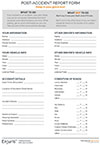 Accident Report Form
Sample post-accident report form to keep in your glove box - fill out at the scene or as soon as you can after a car accident
Download in PDF format
- Gather evidence. As mentioned above, photos of the scene and obtaining contact information from witnesses can make or break your case. You can never get too much. Not every photo or every witness account will be relevant, but there might be things that your lawyer sees that do matter that you don’t realize. Let your lawyer determine what’s important and what’s not.
- Notify your insurance company. A “report” is not the same as a “claim.” Your insurance company likely requires you to report an accident within a certain period of time. But even with your own insurance company, don’t say anything that would indicate fault. Stick to basics — when and where the accident took place, and who was involved. Don’t give permission for them to record a statement.
When to call a Mississippi personal injury lawyer
If you’ve been involved in a Mississippi car accident, it could be worthwhile to seek the guidance of an experienced, qualified, compassionate personal injury lawyer.
Whether you were the at-fault driver or not, lawyers aren’t just for lawsuits. They negotiate insurance settlements, too.
Why is this important?
Your insurance adjuster is not on your side—even though it might seem like they are. Remember this: Yes, you are their customer if it’s your own insurance policy. But the customer isn’t always right. The insurance company makes a profit when it pays out less in settlements than it earns from premiums. The insurance adjuster’s job is to get you to accept the smallest payout possible to close your file. They’re not trying to help you, they’re trying to save their employer money.
Your lawyer only earns money if you do. Most personal injury lawyers work on a contingency basis, which means they earn a percentage of your insurance payout or damage award. The more you receive, the more they earn. Their incentive is to get you the most money possible.
Your lawyer can help you minimize your amount of fault in a crash, ensure you’re getting enough of a settlement to cover your costs, and analyze your future needs to cover those, as well.
Still not finding what you need?
Check out our other articles on motor vehicle accidents in Mississipi.
Did you know that car accident law varies by state?












Hurt in a car crash? You may find these resources helpful



A personal injury lawyer helps individuals who have sustained injuries in accidents to recover financial compensation. These funds are often needed to pay for medical treatment, make up for lost wages and provide compensation for injuries suffered. Sometimes a case that seems simple at first may become more complicated. In these cases, consider hiring an experienced personal injury lawyer. Read moreNeed a lawyer?

What does an injury lawyer do?