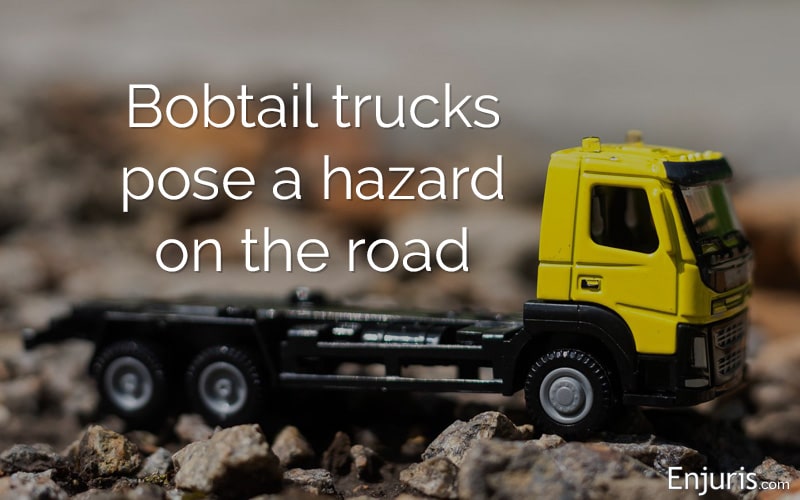
You might think a bobtail truck isn’t risky on the road because it’s not carrying heavy cargo—but think again. These trucks carry some risks that a loaded semi-truck doesn’t.
You’ve definitely seen a bobtail truck.
You might not have realized they had a name.
A “bobtail” is a semi-truck or large cab that is disconnected from its long trailer or cargo hitch. Often, a bobtail truck will travel to or from picking up or dropping off a load.
To be clear, bobtailing is different from deadheading. Deadheading is when a truck hauls an empty trailer or platform, while the bobtail is the back end that remains supported by wheels, that protrudes from the rear of the cab.
See? If you’re not a truck driver, you’ve probably already learned some new lingo today. But what you might not know yet is why bobtailing can be dangerous and how you can avoid an accident if you’re a driver sharing the road with a bobtail truck.
Bobtail truck hazards
We’ve all been behind an 18-wheeler on the highway and watched as its cargo load appears to wobble precariously—or maybe you’ve even seen one roll over.
And it might seem safer when the truck isn’t towing its heavy load, different hazards are important to keep in mind as a car driver in its proximity.
A bobtail truck is much heavier than a passenger vehicle, even though it’s without its cargo load. The engine of a semi-truck is up to six times larger than a car engine, and a bobtail is typically 24 feet long and 13.5 feet tall.
One problem is that a semi-truck is designed to have most of its weight on its front wheels so that when it’s hauling a heavy trailer, it is balanced more evenly. But then, when the truck doesn’t have its trailer, the weight is front-loaded and it handles very differently. The bobtail truck can’t brake as hard as a truck with a load because the rear wheels have less traction. A bobtail truck requires more distance to reach a full stop than a truck with a load.
When driving a bobtail truck, the majority of the weight is over the front wheels. These wheels are designed more for steering than braking, which means a bobtail truck is more likely to skid on a curve or sudden turn.
It’s not against the law to drive a bobtail truck but most drivers have less experience bobtailing than driving a truck with cargo, even though the bobtail requires more skill and expertise.
Bobtail truck collisions with passenger vehicles
The Federal Motor Carrier Safety Administration (FMCSA) reports that bobtail trucks account for about 5% of truck crashes per year. In a recent year, that amounted to 248 fatal crashes and more than 2,500 accidents.
While those numbers sound small in the aggregate, just one accident can devastate an individual victim or family. Because of the uneven weight distribution, a bobtail truck presents a high risk for rolling over onto a smaller car or could push a small car into an oncoming traffic lane. That’s why occupants of passenger vehicles tend to fare worse and comprise a disproportionate number of fatalities and serious injuries in a truck accident.
Who is liable for a bobtail truck accident?
Liability, or fault, is always an important question in any auto accident. Depending on the state where you live or where the accident takes place, determining who caused the accident could be crucial for receiving compensation.
Liability always depends on the facts and circumstances of the accident. But the most likely parties who could be at fault include:
- Truck driver. The driver is required to use reasonable care to drive in a way that avoids harm to other road users and individuals in the nearby vicinity.
- Other drivers. Like the truck driver, any driver has a duty to drive responsibly and avoid creating a situation that could be harmful to another person.
- Trucking company. As an employer, the trucking company is expected to minimize risks associated with trucking, particularly because it’s an inherently dangerous activity. Before sending a driver out on the road, the trucking company should be certain that they are properly trained and experienced to handle a bobtail truck, have met all regulations for maximum driving hours and rest breaks, and that the weather conditions and other factors are as safe as possible.
- Mechanics and contractors. Often, routine maintenance is performed by independent contractors or other service providers. It’s the trucking company or owner’s responsibility to make sure that the truck is maintained on the proper schedule, but the maintenance technicians need to be sure that the truck is roadworthy as a bobtail.
Why should you seek immediate medical treatment after a bobtail truck accident?
You might think that an accident left you uninjured, but it’s still important to seek a medical evaluation.
- Your physical and emotional health are important. You might not have symptoms of injury immediately after a crash; sometimes whiplash, head injuries, and other conditions appear days or weeks later. You might also be in shock, which could cause you to fail to notice certain symptoms in the immediate aftermath.
- Medical records are a crucial part of your legal proceeding. If you don’t receive an immediate medical assessment, it could be difficult to prove that your injuries are related to the crash. The insurance company or defendant could argue that your injuries are part of a pre-existing condition, or that they developed after or separately from events related to the accident. That would limit the amount of compensation you can receive.
- The defense might argue that you worsened your own injuries. By doing nothing, you could aggravate an injury. Defense lawyers or the insurance company could allege that by failing to seek medical treatment, you made your injury worse and therefore are not entitled to the amount of compensation your treatment actually costs.
How to prevent a bobtail truck accident
The primary way to prevent any type of truck accident is to make sure that the driver is properly trained and experienced in bobtailing before heading out on the road. It’s also important that the driver and employer follow all relevant safety regulations to protect against drowsy driving. That means following regulations for the required amount of sleep, length of breaks, and number of road hours of permitted driving.
However, there are things a passenger driver can also do to avoid being involved in any type of truck accident:
- Allow more space when following a truck than you would with a passenger car. A larger vehicle limits your visibility of what’s ahead, including slowed or stopped traffic, construction, or other hazardous travel conditions. By leaving plenty of space between your vehicle and the truck in front of you, you have more opportunity to react if you need to make a sudden stop or swerve.
- Leave space when passing in front of a truck. A bobtail truck is much heavier than a passenger car, which means it requires more distance to stop, and its weight imbalance adds to this issue. If you can’t pass with plenty of room, then stay in your lane.
- Stay out of a truck’s blind spot. There’s a little trick to help you know if you’re in a truck’s blind spot: look at the truck’s side mirrors. If you can’t see the truck driver’s face in the mirror, the truck driver can’t see you. It’s safer to pass a truck on the driver’s side, since they have a much wider blind spot on the passenger side.
- Be careful where you pull over on the highway. If you need to pull off the highway in between exits, try to find a wide shoulder or a designated pull-off spot. Many accidents happen because a car is pulled over and sideswiped by a passing truck that swerves a little onto the shoulder.
- Remember that a bobtail truck is difficult to maneuver, especially around sharp turns. If you need to judge a truck’s speed as it approaches an intersection or how much space it will need to clear a turn, always allow more room, rather than less. Assume that the truck is moving faster than you think it is and requires most of the intersection to make a turn.
- Never play “chicken” with a truck. If you think a truck is going to try to pass you or get in front of you, let it. The highway isn’t a time to be “right” or faster, even if you think you have the right of way. Even if you don’t want to allow the truck to get in front of you, do it anyway. Not doing so can have deadly consequences.
- Pass quickly. Only pass a truck when you can see that there’s space ahead to do so swiftly. You don’t want to linger in the lane beside a truck for any longer than necessary. Tire blowouts and rollovers happen frequently and you definitely don’t want to be alongside a truck if one of these events happens.
- Be predictable. This is important in any driving situation, but especially when it comes to proximity to large trucks. Use signals clearly so that a truck driver can see what you intend to do and can adjust their own driving accordingly. Never change lanes or turn without using your signals.
- Avoid distracted driving. Highway and interstate driving, in particular, can be long and boring. But don’t let yourself become too fatigued or distracted while driving. Just remember — the other drivers are bored, too. Plan your trip before you leave so that you have good music, audiobooks, podcasts, or whatever you like for entertainment already queued up. Don’t be fiddling with your phone, or even the car radio, while driving. If you need to change things up, wait until you get to a rest area or find a safe place to pull over — or have a designated passenger “co-pilot” do it for you. If you begin to feel tired, take a break. Don’t wait until you start to nod off, because then you’re already in a dangerous situation.
- Anticipate weather conditions. Storms can happen anywhere, and sometimes they pop up fast. Bad weather creates dangerous driving conditions. You can set a weather app on your phone to alert you if a dangerous storm is coming your way. If one does happen quickly, head for the nearest exit and wait it out.
If you’ve been involved in an accident with a bobtail truck—or any truck or other vehicle—you can and should contact a personal injury lawyer near you. Some states follow contributory negligence laws that reduce your compensation if you are found to share liability for an accident. It’s important that your lawyer can review the evidence as soon as possible in order to determine fault, minimize your liability, and ensure that your insurance settlement offer is the full amount to meet your needs for current and future treatment and related expenses.
See our guide Choosing a personal injury attorney.