Learn what to do if you’re injured on a construction site
Construction sites are some of the most dangerous places to work in America. Roughly 1 in every 5 work-related deaths occur in the construction industry.
In Texas, roughly 200 people die in construction-related industries every year.
Construction accidents present unique legal challenges, as a workers’ compensation claim, wrongful death claim, or personal injury lawsuit may be appropriate depending on the circumstances surrounding the accident.
Let’s take a closer look at construction accidents in the Lone Star State.
What causes construction site accidents?
Construction zones are inherently dangerous environments. What’s more, Texas has historically been plagued by safety-compliance issues in the construction industry.
Though just about anything can cause a serious accident on a construction site, there are 4 common causes that account for more than half of the total construction deaths across the country. These causes (known as the “fatal four”) are:
- Falls
- Being struck by an object
- Electrocutions
- Getting caught in or between equipment
In addition to the “fatal four,” other causes of serious injury or death for construction workers include:
- Faulty equipment
- Accidents involving large trucks or machinery
- Lack of safety equipment (goggles, gloves, etc.)
- Failure to follow state safety regulations
- Improperly lifting heavy objects
Shockingly, Texas had more fatal occupational injuries due to cranes as the next 3 states combined from 2011—2017, according to the United States Bureau of Labor and Statistics.
It’s not just construction workers that risk being injured by something on a construction site. Bystanders also run the risk of being seriously injured or killed due to a construction site accident.
The most common construction accident injuries for bystanders include:
- Being hit by a vehicle. Construction vehicles are large and can cause serious truck accidents.
- Ruptured eardrum. Loud noises are an everyday part of construction, but they can cause eardrum ruptures for unsuspecting bystanders.
- Slips and falls. Building materials or tools that have been left in the area surrounding the construction site can cause slip and fall injuries.
- Hazardous materials. Construction workers often handle toxic chemicals. If not properly handled or stored, they can cause serious injury. In addition, inhaling the dust or smoke from a construction site can cause damage to the eyes or lungs.
- Falling objects or debris. When debris falls, there isn’t much time to warn others or get out of the way. These falling objects can include tools, construction materials, or falling scaffolding.
 Post-Accident Journal Form
Sample accident journal/diary to help you document the effect on your daily life
Download in PDF format
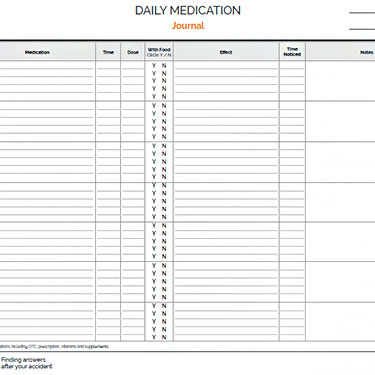 Medication Log Sheet
Printable daily medication log template helps you track your medicines and side effects
Download in PDF format
 Damages/Expenses Worksheet
Damages worksheet to track expenses for your injury claim (medical treatment, property damage, lost wages, prescriptions)
Download in PDF format
Legal remedies for injured construction workers in Texas
In most cases, there are 2 potential legal remedies for construction workers injured on the job.
Filing a workers’ compensation claim
The Texas Workers’ Compensation Act was passed in 1993. Workers’ compensation is a type of insurance purchased by employers and designed to compensate employees injured while working.
Unlike most states, employers in Texas are not required to carry workers’ compensation insurance.
If your employer does carry workers’ compensation insurance, your injury will be covered so long as it was sustained in the course and scope of employment. To put it another way, you’re only covered if you were injured while carrying on your employer’s business (including work-related travel).
What does it mean to be covered?
It simply means that you can receive the following benefits (each of which is limited by statute):
- Medical benefits (medical expenses associated with the injury)
- Income benefits (lost wages due to missing work as a result of the injury, including temporary income benefits, impairment income benefits, supplemental income benefits, and lifetime income benefits; the kind you receive depends on the type and severity of your injury)
- Death benefits (pays a part of the family’s lost income for workers killed)
How do you get compensated through worker’s compensation?
Below are the general steps to file a workers’ compensation case in Texas.
- Report the injury to your employer. Workers’ compensation in Texas is regulated by the Texas Department of Insurance. The law states that you have 30 working days after the construction site injury to report it to your employer. You must provide notification in writing with DWC Form-041; a verbal communication to your boss doesn’t cut it. If you have been hospitalized with severe injuries, one of your family members can inform your employer in writing.
- Get medical attention. Your employer should have a list of healthcare professionals that are covered under their workers’ compensation insurance. If your company doesn’t give you a list of healthcare providers, select your own. At this point, it’s best to talk with a worker’s compensation attorney because the healthcare provider will be a critical voice when determining what benefits you’ll ultimately receive.
- Your employer reports the injury to the insurance company. Texas law states that your employer has 8 days to tell the insurance company about your injuries.
- Insurer pays or denies your claim. The company’s insurance company evaluates the claim. They will either provide an admission of liability or they will deny the claim (this is also called a “notice of contest”). Common reasons for a claim to be denied include: insufficient information about the accident, or the insurance company thinks the accident wasn’t related to work.
If your workers’ compensation claim is denied, talk to a Texas workers’ compensation attorney. Denials can be appealed, and an attorney is critical to winning an appeal.
Filing a third-party lawsuit
If your employer doesn’t carry workers’ compensation insurance (i.e., is a non-subscriber), you can file a personal injury claim against the employer. A personal injury lawsuit is also appropriate if a third-party caused your injury.
Keep in mind that filing a lawsuit and winning a lawsuit are 2 different things. When it comes to workers’ compensation, Texas is a “no-fault” state. This means you can file a workers’ compensation claim and receive benefits without having to prove that your employer did anything wrong.
This is NOT the case when it comes to filing a personal injury lawsuit.
To win a personal injury lawsuit, you generally have to prove that the third party was negligent. This means proving that:
- The employer or third party owed you a duty of care
- The employer or third party breached that duty of care, and
- The employer or third party’s breach was the legal cause of your injury.
Construction accidents are common, serious, and complex. If you or a loved one has been injured in a construction accident, use our free online directory to locate an experienced Texas attorney who can handle your claim.
Did you know that construction accident law varies by state?











Need a lawyer?

What does an injury lawyer do?
A personal injury lawyer helps individuals who have sustained injuries in accidents to recover financial compensation. These funds are often needed to pay for medical treatment, make up for lost wages and provide compensation for injuries suffered. Sometimes a case that seems simple at first may become more complicated. In these cases, consider hiring an experienced personal injury lawyer. Read more