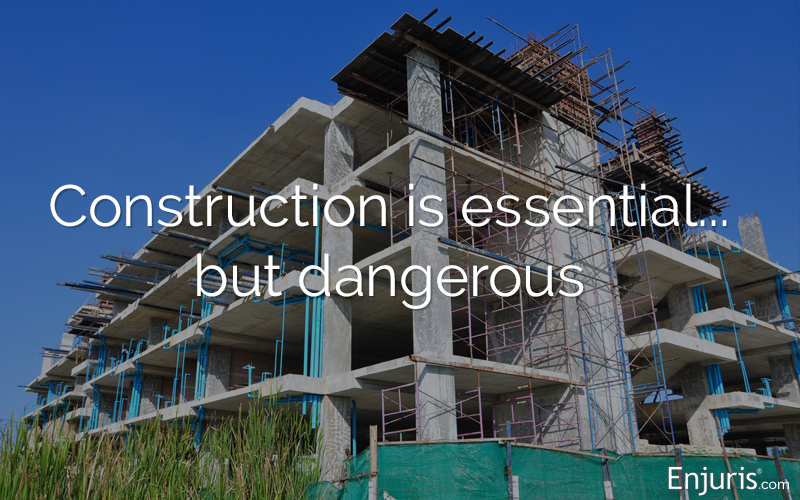
Hard hats are important, but they can’t protect from every danger. Know what to do and where to file a claim if you’re injured in a construction accident.
There’s no job that’s completely free of injury risk. Even if your job mainly consists of answering the phone or performing data entry, there’s always a chance that you can trip and fall over a phone or computer cord, drop a box or item on your foot, take a spill from a chair you didn’t know was broken, or suffer some other kind of injury… even if you work at home.
But a construction site is more dangerous than most workplaces.
According to data released by the Bureau of Labor Statistics, construction is the highest-risk injury based on the number of workplace fatalities. In 2017, there were nearly 1,000 construction-related fatalities nationwide, or 9.5 per 100,000 full-time equivalent workers.
In 2018, the total number of workplace injuries in the construction industry in North Carolina was 2.5 per 100,000 workers. Of those, 1 per 100,000 involved days where the person couldn’t be at work and 0.6 per 100,000 where the worker needed a job transfer or restriction.
Construction injuries covered by workers’ compensation
Workers’ compensation is a system that protects both an employer and an employee when an injury happens.
When you file a workers’ compensation claim, you need to show that your injury happened while you were on your work site or performing a work-related task. Even if the injury was caused because you made a mistake, you’re still eligible for workers’ compensation.
This benefits the employee because it strips away the layer of a personal injury lawsuit that often is the biggest barrier to recovering damages — proving negligence. The employer is presumed to be responsible for your safety at work.
It also benefits the employer. Because your employer is required to maintain workers’ compensation insurance for each employee, the company generally can’t be sued for work-related injuries. In other words, workers’ compensation is your only remedy for a work injury. As such, it covers the costs of your medical expenses and lost wages related to the injury.
What if I work as an independent contractor for a construction company?
Even if you’re considered an independent contractor for tax purposes (i.e. you’re issued a Form 1099 rather than a W-2), there are still instances where a company would be required to provide workers’ compensation benefits.
This often happens in construction, because most work is contract-based and a company might hire workers with a particular set of skills for a specific job or project.
There’s a simple test that a court will apply to determine if someone is an independent contractor for workers’ compensation purposes. In general, if you’re working on the employer’s schedule and at their direction, using their materials and supplies, and following their lead for how the project must be completed, you’re entitled to workers’ compensation coverage. The North Carolina Industrial Commission evaluates eligibility on an individual basis.
North Carolina workers’ compensation benefits
If you are indeed eligible for workers’ compensation, the benefits available include:
- Costs for medical treatment. Any medical treatment related to a work-related injury can be covered under workers’ compensation. This includes surgeries, doctor or hospital visits, prescription medications, assistive devices, therapies, and any other medical expenses.
- Compensation for lost wages. Your benefits should equal two-thirds the amount of your wages prior to the accident if you’re unable to return to work while recovering from the injury, up to a maximum amount set by the state.
- Mileage and vocational services reimbursement. This covers your travel related to medical treatment, along with vocational services to assist you in returning to work, job placement, or retraining if you are unable to return to your previous job.
- Death benefits to the survivors of a person who dies from a work-related accident or illness. A deceased worker’s dependents can receive death benefits, along with funeral and burial costs. Survivor benefits are two-thirds of the workers’ average weekly wage for up to 500 weeks. They are provided to a person who is wholly dependent on the deceased worker, including a spouse or minor child. If there are no dependents, the benefit is paid to the next of kin as a lump sum payment. In North Carolina, workers’ compensation covers up to $10,000 of a deceased worker’s funeral and burial costs.
Personal injury lawsuits arising from construction accidents and injuries
Is my construction accident injury ever a personal injury lawsuit and not covered by workers’ compensation?
Yes, there are circumstances when a construction accident injury might be best resolved through a personal injury lawsuit.
Some construction accidents happen because a worker is using defective or faulty equipment or tools. For example, if a scaffold doesn’t hold the weight it’s meant to hold, or you fall because a safety harness breaks, or your safety goggles shatter when they shouldn’t and you’re blinded, then a product liability lawsuit might be more appropriate than a workers’ compensation claim.
Product liability is the type of lawsuit you’d file if your injury is the result of a defect in a particular item. It could be the result of 1 of 3 types of defects:
- Design defect, where the item cannot perform the way it’s designed and is dangerous when used in the way it was intended.
- Manufacturing defect, which is an item that would be safe when used correctly but some sort of failure in the manufacturing process resulted in it causing harm.
- Failure to warn, which is when the instructions or labeling that accompany a product do not provide the correct warnings or specifications for the user to safely manage the item.
Each of these defects is a negligent act or omission on the part of the manufacturer of the item or device that caused the injury.
Common construction accident injuries
- Falls. Falls from scaffolding, roofs, ladders, or other high places account for 34% of work-related fatalities among construction workers.
- Caught-between/struck-by. Workers can become caught in heavy machinery or between a vehicle and a stationary object, which can cause severe injury including crushing.
- Electrocution. Even non-electrical workers can be in contact with exposed wires on a construction site. A mild shock or fatal electrocution can happen near power lines or an unfinished electrical system.
- Overexertion. If you’re on a construction crew that works outside in hot or humid conditions, heatstroke, frostbite and overexertion can be a problem because of the long hours, fatigue, and dehydration.
- Falling objects. Even if your feet are firmly planted on the ground, an object or tool can fall from above and cause head or brain injuries.
- Exposure to chemicals or toxins. As a construction worker, you might be exposed to asbestos, lead, mold, radiation, or other toxins in the workplace. Long-term exposure might not affect you immediately, but you could develop health effects over time from breathing in these substances. North Carolina workers’ compensation insurance covers health conditions that occur as a result of chemical exposure at work.
- Elevator shaft accidents. Elevator shafts can be dangerous, whether from falling or being crushed by a falling elevator. This is especially prevalent in the mining industry.
- Gas leaks, fires, explosions. These occurrences happen on construction sites, and they can be fast and deadly.
- Crane, hoist, and forklift accidents. Improper training, operator error, equipment defects or inadequate maintenance can lead to accidents.
- Falls
- Struck by an object
- Electrocution
- Caught between objects
Construction site injuries to visitors or passers-by
It’s less likely for a person to be injured on a construction site if they’re not there for work. This is because most construction sites are clearly marked, barricaded, and closed off to people who aren’t approved to work there.
But sometimes there’s construction inside a building, on a roadway, or in another place that you need to pass by or through. If you’re injured because of a trip-and-fall, a fall into a hole, being hit by a falling object, or any other injury on a construction site where you were permitted to be, you might be able to sue the construction company for personal injury.
A person, company, or public (i.e. government) agency may be responsible for maintaining the property to be free from foreseeable hazards. This area of law is called premises liability.
What to do if you’re injured in a construction accident
If you’ve been injured, your first priority is to seek medical treatment. It’s never a good idea to delay medical treatment because some conditions can become more severe if left untreated.
Second, determine how you’re going to make a claim for compensation — whether it’s through the workers’ compensation system or as a personal injury claim — and know the statutes of limitations that apply — A statute of limitations is the time frame you have in which to file a claim.
If you’re submitting a North Carolina workers’ compensation claim, however, you must immediately inform your employer of your injury. You should submit a Form 18 to the North Carolina Industrial Commission within 30 days, and you must file your claim within 2 years of the injury.
You also might consider finding a lawyer near you who can assist with your claim.
Whether it’s a workers’ comp claim or a personal injury lawsuit, things can get complicated quickly. Your lawyer will advise you on how to file a claim, what you should demand for damages, and what you can realistically expect as a resolution.

NC Delays and Denials for Workers’ Comp Claims
Recent NCIC data shows more late filings, rising denials, and slower claim responses in North Carolina workers’ compensation cases.
See our guide Choosing a personal injury attorney.