
One of the cornerstones of workers’ compensation benefits is that they should be a quick way to receive the funds you need to cover your costs from a work-related injury. Although it’s the objective of the North Carolina Industrial Commission (NCIC) to administer benefits efficiently under the state Workers’ Compensation Act, some injured workers face frustrating delays, claim denials, or protracted appeals. Recent data and legal commentary suggest insurers and employers are increasingly pushing back on claims, especially when causation, medical issues, or employment status are disputed.
For instance, the North Carolina Rate Bureau indicated in a recent “State of the Market” report that NC workers’ compensation carriers are facing changing dynamics that include loss costs, policy rates, and regulatory pressure. The insurer market data suggest that the carriers are feeling real financial pressure, which is going to be passed down to the insured and, ultimately, the beneficiaries.
In some cases, delay tactics like extra paperwork, slow investigation, or ambiguous denials, point to a strategy of stalling benefits rather than outright denials. This effectively forces injured workers into longer wait times, financial stress, or low-value settlements. For injured North Carolina workers, this means even a clearly compensable injury might require vigilance. Documentation, timely reporting, prompt medical care, and legal representation are all ways to avoid getting caught in a “delay trap.”
How do workers’ compensation delays and denials happen?
Here are examples of tactics used by insurers to delay or deny a claim:
Excessive document requests
A common delay tactic in a workers’ compensation claim is requiring excessive documentation. An injured worker could be asked for unnecessary medical records, redundancies, additional statements, or duplicates. This creates an endless loop of paper shuffling, which slows the process considerably. It can even cause an injured employee to drop their claim altogether.
Delayed investigations
An insurance company is required to investigate a workers’ compensation claim to determine whether it’s valid. There are situations when the investigation is deliberately delayed, which results in a delay to the claimant in receiving their benefits. The employer or insurer might say it needs additional time to review medical records, interview witnesses, or take other steps to determine exactly how the injury happened.
Validity questions
There are three basic facts required for a workers’ compensation claim:
- The accident happened at work or while engaged in tasks related to your job;
- the accident or exposure resulted in actual injury or illness; and
- the injury or illness cost you money for medical treatment, lost wages, or related expenses.
Some insurers will scrutinize whether the injury actually happened at work, if it is actually related to tasks for the employee’s job, and whether it was as severe as the injured worker claims. The insurer might allege that the injury did not actually happen at work. Or it might say the injury resulted from preexisting conditions, which would mean it’s less compensable through workers’ compensation. The injured employee would bear the burden of seeking medical documentation that links their injuries to the workplace.
Independent medical examination (IME) conflicts
The insurer will typically request an IME by an approved provider to verify the severity of an injury. However, this is also sometimes a tactic to slow the approval process. North Carolina workers’ compensation law allows an insurer to require an IME, but if the examining provider questions previous medical results or requests multiple appointments, this can have a significant impact on the timing of the approval. There’s also the issue that an IME can be interpreted in a way that’s most favorable to the insurer, but if the claimant disputes the findings, it can further delay the claim. An injured employee may obtain a second opinion from their own treating physician to counter the IME report and allow for the process to move forward.
Lowball settlement offers
An insurer might gamble on your desperation. In other words, if an injured worker has already endured a lengthy delay in receiving benefits, the insurer might offer a too-low settlement in the hope that the worker will accept it just to have something that’s more than nothing. If the claimant is struggling financially, this is going to seem like a tempting offer. But what it doesn’t offer is security and deserved compensation for future or ongoing medical needs. A claimant does not need to accept a lowball offer; they may negotiate or pursue a hearing.
Communication delays
We’ve all experienced the frustration of contacting a business and not getting a call back. But when you’re waiting for your workers’ comp benefits to pay your bills, this can escalate from mere annoyance to infuriating. Failure to communicate can impact a worker’s ability to learn their claim status, have questions answered, or be approved for medical treatment. This can also result in accepting a lowball claim because the worker could feel as though they have no choice but to accept benefits to move forward with their treatment.
Are denials and delays increasing for injured North Carolina workers?
The NCIC doesn’t publish precise denial-rate statistics, but there are metrics that seem to indicate this. For example, the NCIC Annual Report for 2023-2024 said that timely carrier responses fell year-over-year. 57% of carriers filed a Form 60/61/63 on time (or within the notice period) in that year; this percentage decreased by nearly 5% to 52% in 2024-2025. Delays of these forms (for denial, pay-without-prejudice, and admission) indicate a greater initial push-back—denials or reserving the right to deny—and fewer outright acceptances. In that same period, late filings doubled.
What can you do as an injured worker to help your claim?
- Report the injury immediately, in writing, including the date, time and location.
- Seek prompt medical treatment, document the injury thoroughly, and maintain consistent medical records.
- File claims and forms on time, and don’t rely on your employer or its insurer to act on your behalf.
- Maintain documentation of communications, including emails, phone calls, medical bills, and employer correspondence.
- Consult a workers’ compensation lawyer early in the process, especially if your employer denies liability, refuses treatment, or there is a dispute over causation.
- If your claim is delayed or denied, file a Form 33 (request for hearing) with the NCIC without waiting for anything further.
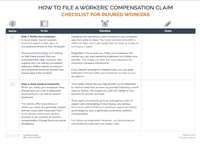 Workers’ Compensation Checklist
Download this checklist for injured workers to learn how to file a workers’ comp claim and track your progress.
Download in PDF format
Delays and denials in workers’ compensation claims are not just bureaucratic frustration—they can fundamentally affect an injured worker’s recovery, income, and justice. In North Carolina, where procedures and deadlines are strict and insurers may use delay as leverage, being proactive is essential. Protect your rights by reporting quickly, documenting thoroughly, and considering legal support early. These delay tactics (extra paperwork, slow investigation, ambiguous denials) also point to a strategy of stalling benefits rather than outright denials in some cases—effectively forcing injured workers into longer wait times, financial stress, or low-value settlements.

What the Poe Hall Lawsuit Means for NC Workers
The NC State Poe Hall toxic exposure lawsuit raises critical questions about occupational disease claims and workers’ compensation limits in North Carolina.