
Learn how to recover damages following a catastrophic injury in the Hoosier State
Indiana teenager Steven Hahn was driving home from work when he was involved in a minor accident. As Steven exited his car to exchange insurance information with the other driver, he was hit by a semi-truck.
As a result, Steven lost his right leg.
“It could have been much worse,” Steven’s sister said. “He could not be here or he could be in a vegetative state. I just take it as a blessing.”
Though many amputees feel fortunate to be alive, their injuries are usually life-changing.
Let’s take a closer look at amputation injuries in the Hoosier State.
What’s the difference between amputation and disfigurement?
The terms “amputation” and “disfigurement” are often used interchangeably, but they don’t mean the same thing:
- The term amputation refers to the removal of all or part of a limb or extremity.
- The term disfigurement refers to an injury that impairs a person’s appearance. Disfigurement injuries include amputations, but also includes things like severe burns that result in permanent scarring.
Legally speaking, there’s very little difference between amputation and disfigurement. In this article, we’ll focus on amputations, but the information is applicable to other disfigurements.
How common are amputations?
Roughly 1.9 million people are living with amputations in the United States.
What’s more, the number of amputations in Indiana has been trending upwards for several years and the number of amputations per year is expected to double by 2050.
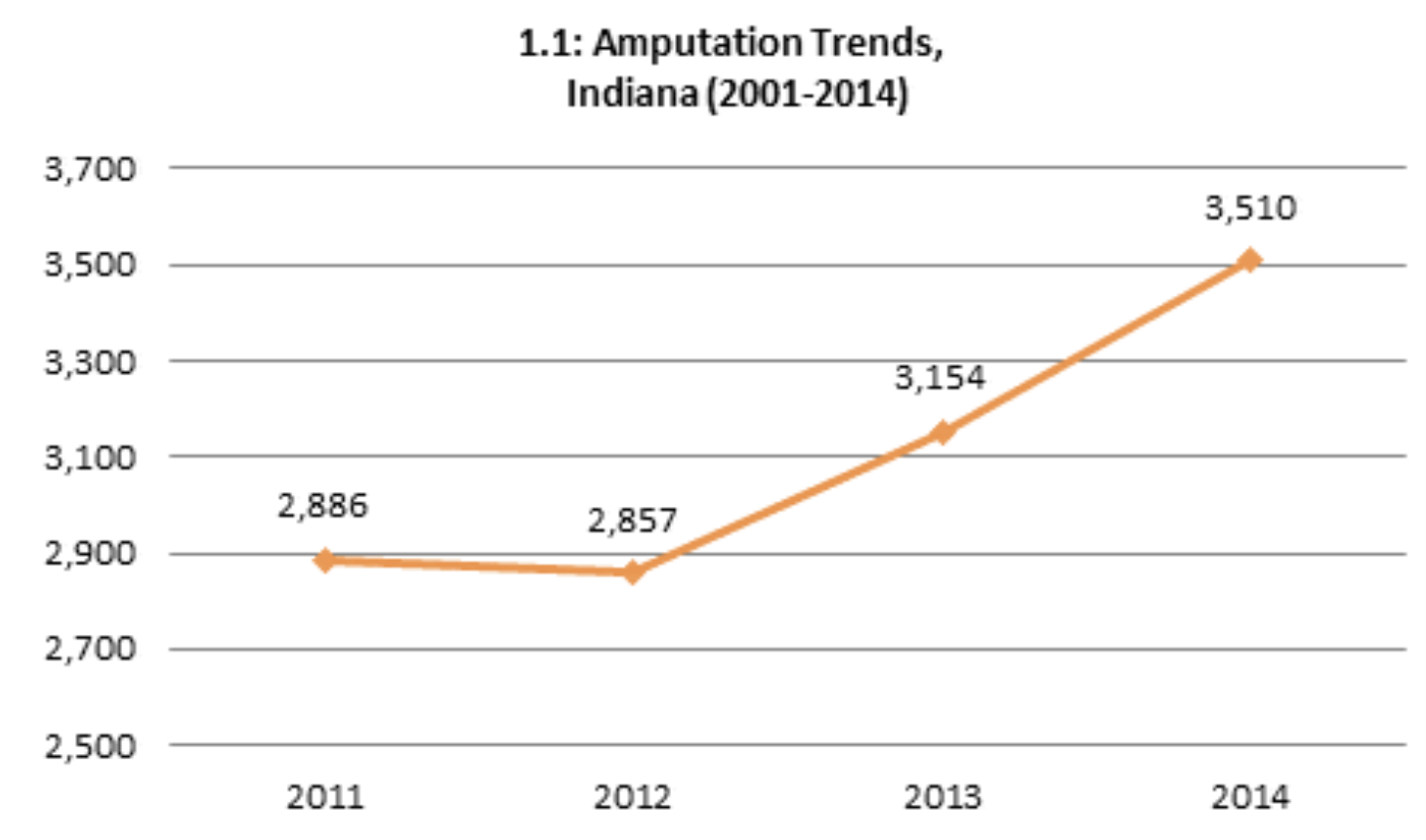
All sorts of accidents can lead to an amputation injury. Some of the most common include:
Legal theories that support an amputation injury lawsuit
If your amputation was the result of someone else’s carelessness, you may be able to recover damages through a personal injury lawsuit based on negligence.
In Indiana, a plaintiff proves negligence by establishing 3 elements:
- The defendant owed the plaintiff a duty of care,
- The defendant breached the duty of care, and
- The breach was the proximate cause of the plaintiff’s injuries.
Most amputation lawsuits are based on negligence. However, your lawsuit may be based on an intentional tort if someone purposely caused your injury, or it may be based on strict liability if your injury was caused by an unreasonably dangerous product.
Kimberly Ragsdale v. K-Mart corporation
Kimberly Ragsdale was operating a push-type lawnmower in Indianapolis when the chute became clogged with grass.
Kimberly lifted the guard chute and placed her right hand in the chute in order to remove the clogged grass. In doing so, Kimberly’s fingers came in contact with the moving blade of the mower, resulting in the amputation of three fingers on her right hand.
Nancy filed a product liability lawsuit against the manufacturer of the lawnmower. In her complaint, Kimberly alleged that the manufacturer failed to include an adequate warning about the blades.
The Indiana trial court ruled that the danger posed by the moving blade was an “open and obvious danger,” and the manufacturer had no duty to warn Kimberly about open and obvious dangers.
What happens if your amputation injury occurs while you’re at work?
Every year, hundreds of Hoosiers suffer disabling amputations as a result of workplace accidents.
The Occupational Safety and Health Administration (OSHA) has concluded that most workplace amputations occur because of unguarded machinery and the lack of adequate training and procedures to safeguard employees.
Some of the machines most likely to cause amputations include:
- Mechanical power presses
- Power press brakes
- Powered conveyors
- Printing presses
- Roll-forming machine
- Roll-bending machine
- Food slicers
- Meat grinders
- Meat-cutting band saws
- Drill presses
- Milling machines
- Shears
- Grinders
If you suffer an amputation as a result of a workplace accident, you’ll most likely file a workers’ compensation claim. Workers’ compensation is a form of insurance that pays financial benefits to people injured while on the job. In Indiana, the vast majority of employers are required to carry workers’ compensation insurance.
Unlike a personal injury lawsuit, there’s no need to prove that someone was careless or otherwise at fault for your injury in order to receive compensation. You simply need to prove that your injury occurred while you were performing a work task.
What damages can you recover from an amputation injury lawsuit?
Even the most minor amputations result in significant medical expenses. Severe amputations may prevent you from working in the future or may require full-time care.
Fortunately, amputees can recover both economic and non-economic damages in Indiana:
- Economic damages are intended to compensate you for the monetary losses associated with your injury. Economic damages include medical expenses, lost wages, and other out-of-pocket expenses.
- Noneconomic damages are intended to compensate you for the non-monetary consequences of your injury. Noneconomic damages include the pain and suffering you may experience as a result of your injury.
Additionally, punitive damages, which are intended to punish a defendant, may be available if the defendant’s conduct was intentional or grossly negligent.
Resources for amputation survivors
Amputation injuries can be life-changing. The following list of resources can help you with the physical, emotional, and financial challenges ahead:
- Amputation Coalition
- Indiana Centers for Independent Living
- Indiana Vocational Rehabilitation Services
- Indiana Disability Rights
- Indiana amputee support groups
See our guide Choosing a personal injury attorney.