Whether you’re at fault or a victim, it’s important to know how Idaho handles a crash
Idaho is called the “Gem State” because of its mining of gemstones like jasper, opal, garnet and quartz, but it’s actually more well-known for its potato farming. Idaho has been famous for its potatoes for centuries, and ⅓ of all potatoes grown in the U.S. are from Idaho.
Idaho’s top industries include food production, aerospace, tourism and outdoor recreation. That means there’s a lot of traffic flow, both intra- and interstate.
Idaho was home to nearly 2 million people in 2021, according to the U.S. Census Bureau. It has almost that many registered vehicles, with the 1.9 million figure representing an increase between 2015 and 2020.
Unsurprisingly, monthly averages through Idaho show the highest traffic concentration around Boise; just over the border from Spokane, Washington; around Twin Falls; and Pocatello.
So, with all those cars, trucks and buses, there are bound to be a few collisions.
Idaho car accident statistics
The Insurance Institute for Highway Safety reports that in a recent year, there were more than 17.4 million vehicle miles traveled in Idaho.
There were 188 fatal crashes that resulted in 214 deaths, which totals 11.6 deaths per 100,000 people. That calculates to 1.23 deaths per 100 million vehicle miles traveled—which is a little better than average. It’s No. 30 out of the 50 states; the U.S. average is 1.34 deaths.
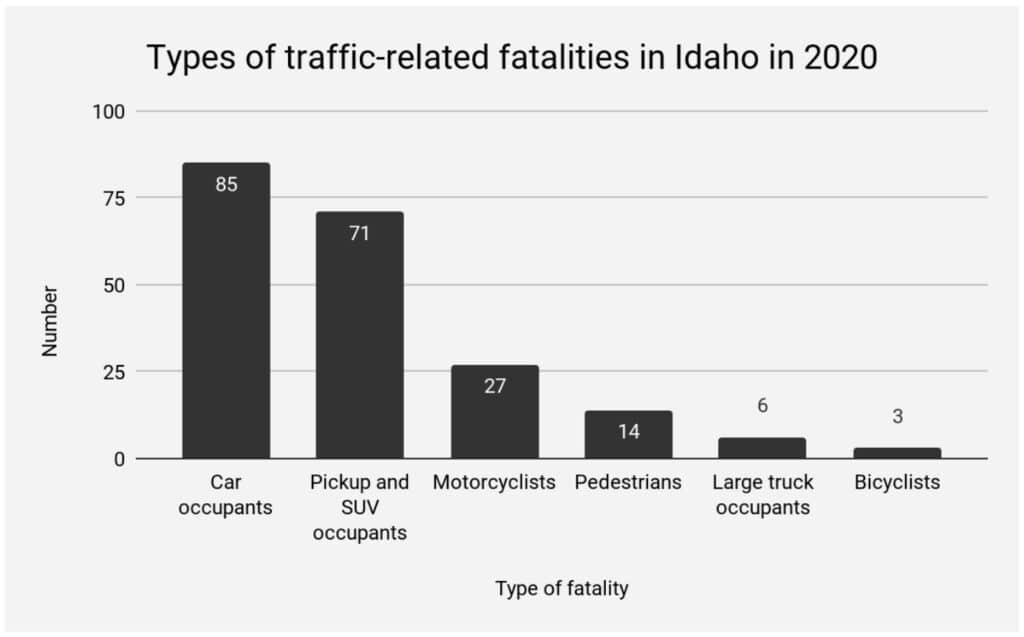
Of the fatalities recorded in Idaho in 2020, the greatest number were car occupants and the fewest were bicyclists.
Idaho car accident laws
When it comes to car accidents, you first want to consider what medical treatment you need for your injury. Then, you think about who covers the cost… whether it’s you, the other driver, or insurance.
Idaho is a “fault” state. That means the person responsible for causing the accident pays for the injured people’s costs related to the crash.
Personal injury law is based on the theory of making the plaintiff (injured person) whole. The law protects the injured person by restoring them to the financial condition they would be in if the accident hadn’t happened.
How is fault determined in an Idaho car accident?
The parties’ insurance companies will review the evidence around the crash, including police reports, weather conditions, personal factors (for instance, if a driver was under the influence of drugs or alcohol, or was texting or otherwise distracted), road conditions, witness statements, camera surveillance if possible, and any other sources that provide information about how the accident happened.
Idaho modified comparative fault rule
Each state follows one of four comparative negligence rules. In Idaho, you’re subject to the modified comparative fault rule (also known as the 50% Rule).
In order to recover any damages for a personal injury, you must be less than 50% at fault.
Here’s how it works:
Plaintiff Polly lived in a residential development off South Maple Grove Road in Boise. She was enrolled at the College of Western Idaho and needed to meet a classmate at the Ada County Center Pintail Building. She was driving due north on S. Maple Grove Road to her destination and had to cross the busy intersection at W. Overland Road.
As she was passing through the intersection, Defendant Dorothy blew through the red light and sideswiped Polly’s car. Polly suffered serious injuries.
The investigation found that although Dorothy was definitely the person who caused the accident, Polly apparently was reaching for something in the back seat at the time of the crash (as reported by a witness who was a passenger in the car in the next lane).
The court found that Dorothy was 85% liable for the crash and Polly was 15% liable. Even though Polly didn’t cause the accident, if she had not been distracted, she could have avoided it and seen Dorothy heading toward her fast enough to brake and miss a collision.
Therefore, if her damages were $100,000, Polly’s award is reduced by 15%. She can recover $85,000.
However, if Polly had been found 51% liable for the crash, she would not have been able to recover any damages.
Idaho car insurance requirements
Your first recourse after an accident is to make an insurance claim against the at-fault driver’s policy.
You also need to report it to your own insurance company. If the at-fault driver’s insurance doesn’t cover your full expenses, you’d then turn to your own insurance before filing a lawsuit. Alternately, if the at-fault driver’s insurance company isn’t cooperative or willing to provide the coverage you deserve, your insurance company will pursue an appropriate settlement from their insurance company.
Idaho is a 25/50/15 state.
Insurance requirements are:
- $25,000 for bodily injury coverage per person
- $50,000 for bodily injury coverage per accident
- $15,000 for property damage liability
A basic Idaho insurance plan includes $25,000 of uninsured/underinsured motorist coverage per person and $50,000 per accident. You are permitted to waive this coverage (though it’s probably wise to keep it).
Idaho personal injury statute of limitations
If you need to file a personal injury lawsuit, you must do so within two years from the date of the crash. If it’s a property damage-only claim, you have up to three years.
However, it’s important to distinguish between an insurance claim and a personal liability lawsuit.
You should file your insurance claim as soon as possible after the accident. Insurance companies have their own requirements for timing a claim and often, they are very short (within a few days). Failure to file within that time could cause the insurance company to deny your claim.
Other Idaho traffic laws
- Every driver and passenger is required to wear a seatbelt while riding in a car in Idaho. Every child age six or younger must be in a child safety restraint seat.
- The Idaho hands-free device law permits a driver to use an electronic device only in hands-free mode. A driver is not permitted to touch the device for any reason, including while at a red light.
- The Idaho Open Container Law prohibits a driver or passenger from drinking or possessing an open container of alcohol (including beer, wine or liquor) in a vehicle. If you need to transport unsealed alcohol, it must be in the trunk or behind the last upright seat in a vehicle that does not have a trunk.
As in every state, Idaho prohibits driving under the influence of alcohol or drugs. You’re not permitted to drive if your blood alcohol content (BAC) is 0.08 or higher. If you’re under 21, your BAC needs to be 0.02 or lower.
What to do after a car accident to preserve
your legal rights
If you’re in a car accident in Idaho, there are a few ways to protect your right to a claim.
After any car accident, the first priority is to check on your own physical condition, your passengers, and any other individuals involved.
Don’t try to get out of the car, evaluate the accident, or obtain information unless you’re in a condition to do so. If you need to remain in the car and wait for emergency help, that’s what you should do. Your safety and physical condition come first.
Here are 5 steps you should take after a crash:
- Call 911. Your first call should be to emergency responders. Whether the accident is minor or serious, call the police. Tell dispatch whether or not an ambulance is needed, but request that the police respond to the scene either way.
- Move your car out of traffic if possible. Sometimes the position of cars relative to each other helps determine how a crash happened. Before moving your car (or before the other driver moves theirs), take several photos of various angles of the scene in order to preserve evidence. If the cars aren’t blocking traffic, leave them where they are after a crash. Only move the car if it’s preventing the flow of traffic.
- Obtain information from other drivers. Make sure to get the necessary information from each involved driver. A police report should include most of it, but also you want to have a copy to provide to your lawyer. Try to write down or photograph the following information:
• Driver’s name and driver’s license number
• Driver’s full contact information, including address, phone, and email
• Vehicle registration and insurance information
• License plate number
• Make, model, and color of each car involved in the accident
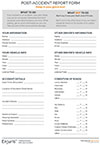 Accident Report Form
Sample post-accident report form to keep in your glove box - fill out at the scene or as soon as you can after a car accident
Download in PDF format
- Gather evidence. As mentioned above, photos of the scene and obtaining contact information from witnesses can make or break your case. You can never get too much. Not every photo or every witness account will be relevant, but there might be things that your lawyer sees that do matter that you don’t realize. Let your lawyer determine what’s important and what’s not.
- Notify your insurance company. A “report” is not the same as a “claim.” Your insurance company likely requires you to report an accident within a certain period of time. But even with your own insurance company, don’t say anything that would indicate fault. Stick to basics — when and where the accident took place, and who was involved. Don’t give permission for them to record a statement.
When to call an Idaho car accident lawyer
Since Idaho laws are strict regarding fault and insurance coverage, it would be best to call a lawyer as soon as possible after your accident. You can easily jeopardize your ability to recover any damages by inadvertently admitting fault (or a portion of fault), and you don’t want that to happen. By hiring an attorney right away, you can direct any correspondence with your insurance company or the other driver’s insurance company to the lawyer. Your lawyer’s job is to protect your interests to the best of their ability.
Did you know that car accident law varies by state?












Hurt in a car crash? You may find these resources helpful



Need a lawyer?

What does an injury lawyer do?
A personal injury lawyer helps individuals who have sustained injuries in accidents to recover financial compensation. These funds are often needed to pay for medical treatment, make up for lost wages and provide compensation for injuries suffered. Sometimes a case that seems simple at first may become more complicated. In these cases, consider hiring an experienced personal injury lawyer. Read more
Common car accidents