

The weather is changing.
I don’t need to tell an Alabaman how hot the past several summers have been—heat indices higher than 105℉ for weeks at a stretch are now the norm. If you work outside, this is even more of a challenge, and there are some places that are especially hazardous—roofing decks, road crews, poultry plants, and warehouses that can have an “indoor” temperature that’s even higher than outdoors are all sweltering hot workplaces in the summer.
What you might not know is that the federal rule meant to address this issue has stalled, the enforcement program behind it has expired, and—most importantly for your claim—even a confirmed Occupational Safety and Health Administration (OSHA) violation does not automatically get your heat illness covered under Alabama workers’ compensation.
We’ll talk about this gap, and what you can do if you suffer an Alabama workplace heat injury.
What’s the federal rule for heat injuries under OSHA?
OSHA published its proposed Heat Injury and Illness Prevention standard on August 30, 2024. The comment period closed in January 2025, followed by informal public hearings. The post-hearing comment period closed that October. At present, there is no target date for a final rule on the federal regulatory agenda.
Meanwhile, the OSHA National Emphasis Program (NEP) on outdoor and indoor heat hazards expired on April 8, 2026 and has not been replaced. This initiative drove roughly 7,000 heat-related inspections between April 2022 and December 2024.
However, there is one part of the OSH that survives: the General Duty Clause ( § 5(a)(1) of the OSH Act). This requires employers to furnish a workplace “free from recognized hazards that are causing or are likely to cause death or serious physical harm.” OSHA can and does cite heat exposure under this rule.
How does this affect Alabama?
Alabama has no state OSHA plan; federal OSHA covers private-sector workplaces through its Birmingham- and Mobile-area offices. There is no state-level heat standard that fills the gap, like it does in California or Washington.
Second, because Alabama doesn’t have a state plan, most state and federal employees are outside federal OSHA’s jurisdiction entirely.
The gap: OSHA enforcement is not workers’ compensation
An OSHA citation against your employer is evidence of an unsafe workplace. It is not proof that your heat illness is compensable. An OSHA penalty is paid to the government, not to the injured worker.
Alabama workers’ compensation is a separate system that has its own test for causation, and heat cases are where that test, itself, is tested.
The two-part causation test in Alabama
Ex parte Trinity Industries, Inc., 680 So. 2d 262 (Ala. 1996) is a landmark decision that clarified the evidentiary standards for legal and medical causation in Alabama workers’ compensation claims.
The two-part causation test is as follows:
- Legal causation: Performing your job duties exposed you to a “danger or risk materially in excess of that to which people are normally exposed in their everyday lives.”
- Medical causation: This specific exposure “was in fact a contributing cause of the injury.”
When it comes to heat-related illness, the insurance carrier will attack the first prong directly: Everyone in Alabama is hot in August, so where is the excess risk?
The answer is in the specifics. For example:
- Measured heat index at the work site
- Radiant load from asphalt or metal roofing
- Workload intensity
- Protective clothing or respirators
- Hours without shade or rotation, and
- Whether you were newly hired or returning from time off without acclimatization.
These facts are what separate a roofer from a person walking to their car.
The second prong is a little higher hurdle. This one quietly decides these cases.
Ala. Code § 25-5-81(c) provides that a court’s decision rests on a preponderance of the evidence, except for “injuries which have resulted from gradual deterioration or cumulative physical stress disorders,” which are compensable “only upon a finding of clear and convincing proof.”
The statute defines clear and convincing proof as evidence that produces “a firm conviction as to each essential element of the claim and a high probability as to the correctness of the conclusion.” This is a higher standard than preponderance.
This is a lot of legal parsing, but what does it really mean? In a heat injury case, this could be a characterization dispute. A legal characterization fight is an argument over how to classify a legal issue or fact—when a person collapses because of heat stroke at work, this is an accident and is judged according to a preponderance of the evidence.
Preponderance is the standard of proof in most civil lawsuits; it means the claim is more likely to be true than not true. The evidence must show a greater than 50% chance that the claim is correct.
However, when an insurance carrier reframes the same injury as cumulative dehydration or gradual heat strain that builds across a shift or season, it could argue into the higher standard—if there’s a kidney injury, cardiac event, or heat exhaustion that progresses over time (i.e. days), and it’s labeled an “accident,” or “gradual deterioration,” it can determine the outcome before the medicine is even considered.
What about personal health conditions?
Insurance carriers also have been known to argue that a heat illness is personal (idiopathic), rather than occupational. They might blame age, weight, blood pressure medication, diuretics, or drinking (even though it was when you were not working).
Alabama caselaw has an answer for this.
If an employee was able to perform the job duties before the injury, no preexisting condition is deemed present [Cagle v. Brock & Blevins, Inc., 723 So. 2d 65 (Ala. Civ. App. 1998)].
What should you do if you suffered a heat injury at work in Alabama?
- Report your injury in writing, immediately. An Alabama injury typically must be reported within five days of the incident, and in not more than 90 days.
- Seek emergency treatment. Be sure the treating provider includes “heat exposure at work” in your medical chart, not just “dehydration,” or similar.
- Photograph the site, note the temperature and your hours, and identify any coworkers who were present.
- File an OSHA complaint if the conditions were unsafe, but understand that it runs parallel to your claim—not instead of it.
If you suffered a heat-related injury on an Alabama job site, contact my office right away. We’ll work with you to explore your options for workers’ compensation benefits.
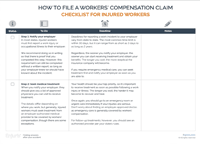 Workers’ Compensation Checklist
Download this checklist for injured workers to learn how to file a workers’ comp claim and track your progress.
Download in PDF format