
Find out how to receive compensation after an on-the-job injury
The average person will spend 90,000 hours at work over their lifetime. With all that time spent at work, workplace accidents and injuries are bound to happen.
Almost every state requires certain employers to carry workers’ compensation insurance for the purpose of providing benefits to employees who become injured on the job.
The Alabama Workers’ Compensation Act, which was enacted in 1919, regulates workers’ compensation throughout the state. In this article, we’ll provide an overview of the Alabama Workers’ Compensation Act by providing answers to common questions.
What is workers’ compensation?
Workers’ compensation (sometimes called “workers’ comp”) is a form of insurance that provides financial benefits to employees who are injured on the job.
There are 2 important things to understand about workers’ compensation:
- Workers’ compensation is an exclusive remedy. In other words, by accepting workers’ compensation benefits, you waive your right to sue your employer for your workplace injury (in most cases).
- Workers’ compensation is a no-fault insurance system. This means that injured workers can receive benefits regardless of who’s at fault for their injury.
Although this article is about Alabama’s workers’ compensation system, you should know there are federal workers’ compensation programs that cover federal employees, such as the Federal Employers’ Liability Act (FELA).
Does your employer carry workers’ compensation insurance?
The Alabama Workers’ Compensation Act requires almost all employers who regularly employ 5 or more employees (full or part-time) to have workers’ compensation coverage.
Employers who are exempt from carrying workers’ compensation coverage are as follows:
- Employers in the business of constructing single-family, detached residential dwellings
- Employers of domestic employees (e.g., housekeepers)
- Employers of farm laborers
- Employers of casual employees (e.g., temporary workers performing work that is not part of the employer’s regular business)
Employers who need to carry workers’ compensation coverage have 3 main ways to meet the requirement:
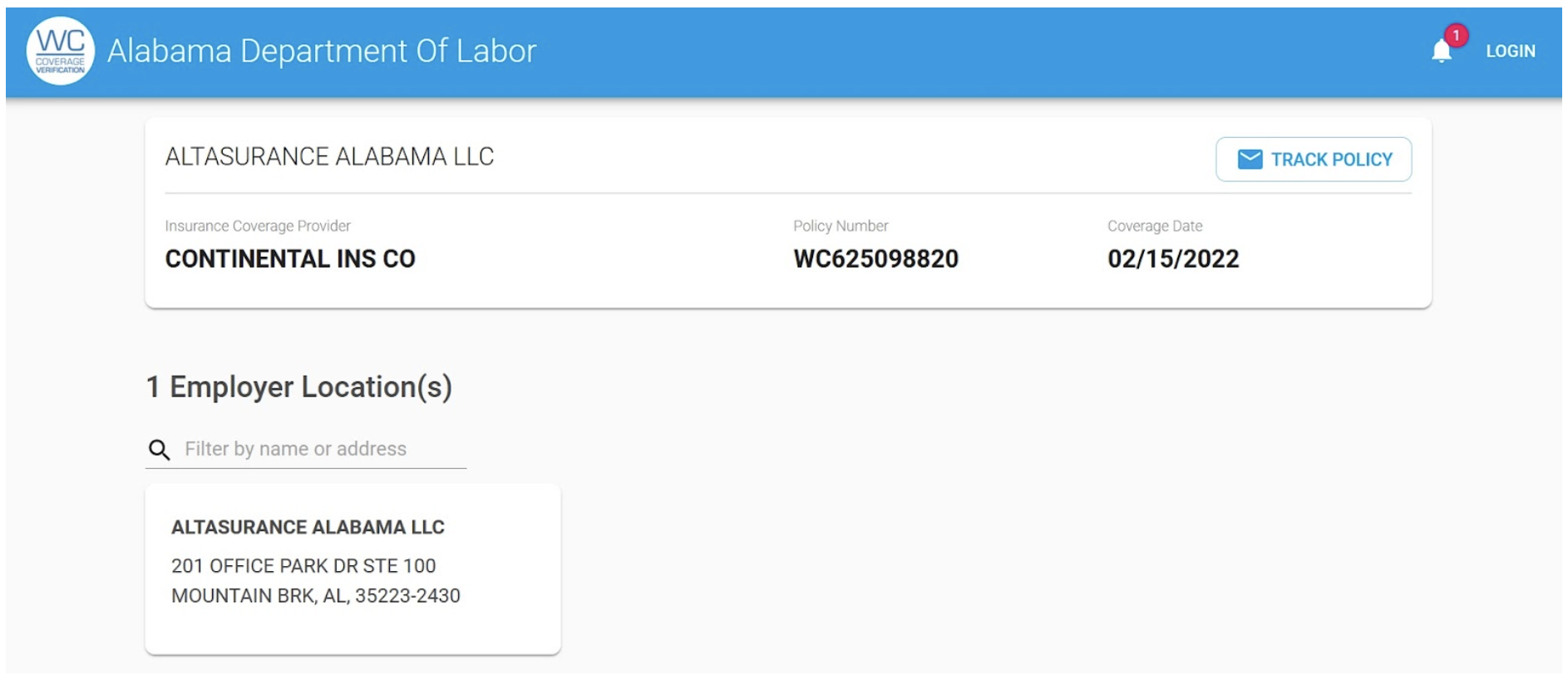
To determine whether your employer carries workers’ compensation coverage, use the Alabama Department of Labor’s verification tool. You can type in the name of your employer and find out whether they have active workers’ compensation insurance—as well as the name of the insurer and the policy number.
Is your injury covered by workers’ compensation insurance?
All injuries and illnesses (other than those that are foreseen or self-inflicted) are covered by workers’ compensation insurance as long as the injury or illness arose out of your employment.
An injury arises out of your employment if:
- There is a relationship between the employment and the accident,
- The injury occurs while the employee is fulfilling the duties of their employment or is engaged in something incidental to their duties,
- The injury occurs at a place where the employee may reasonably be, and
- The injury occurs within the period of employment.
An injury is NOT considered to have arisen out of your employment if it occurred at work but would have occurred anywhere. For example, if you have a heart attack at work due to high cholesterol, you probably won’t receive workers’ compensation benefits because the heart attack did not necessarily arise strictly out of your employment.
Along these lines, mental-health issues are generally NOT covered in Alabama unless it can be proven that the stress related to the job was a substantial contributing factor to the onset of the illness (as is sometimes the case with 1st responders).
Workers’ compensation covers both traumatic work injuries and occupational work injuries:
- Traumatic work injuries are those that result from a 1-time accident at work (e.g., suffering a back injury as a result of a fall from construction scaffolding).
- Occupational injuries occur over a period of time (e.g., such as repetitive movement injuries).
How do you file a workers’ compensation claim in Alabama?
The workers’ compensation claims process can be confusing, and your employer may not be as helpful or accommodating as you would like.
If you’re injured at work, it’s important to complete all of the following steps to file a claim:
- Report the accident. Alabama law requires that you report your workplace injury to your manager or supervisor within 5 days of sustaining the injury. Although you may think your employer is aware of the injury, it’s a good idea to provide written notice within 5 days to avoid any confusion.If you miss the 5-day deadline, you should still provide notice as soon as possible. In some cases (for example, cases in which you were physically or mentally incapacitated during this period), this 5-day deadline can be extended (although if you provide notice more than 90 days after your injury, your claim will be denied regardless of your situation).
- Seek medical attention. In Alabama, your employer selects the doctor who will treat your condition, so be sure to check in with your employer right away to find out where you can go for treatment.
- File a First Report of Injury Form. Once you report your injury, it’s your employer’s responsibility to file a First Report of Injury Form. This form includes information about your injury and how it occurred. It also includes information about your wages. If your employer refuses to file the form, you should contact an Alabama workers’ compensation attorney or the Alabama Workers’ Compensation Ombudsman Program.
How long do you have to file a workers’ compensation claim?
It’s a good idea to file a workers’ compensation claim as soon as possible. The sooner you file a claim, the sooner you can receive compensation to help you through this difficult time in your life. What’s more, filing a claim sooner than later helps ensure relevant evidence is still available to help support your claim.
Regardless, all claims for compensation will be forever barred unless they’re filed within 2 years from the date of the accident.
What benefits does workers’ compensation provide?
In Alabama, injured workers can receive the following workers’ compensation benefits:
- Reasonable and necessary medical expenses (doctor visits, hospital bills, prescriptions, crutches, prosthetics, etc.)
- Wage loss benefits
- Death benefits for certain dependents
Wage loss benefits are calculated according to the nature of the injury, with injuries falling into 1 of 4 categories:
| Temporary partial disability (TPD) |
Temporary total disability (TTD) |
Permanent partial disability (PPD) |
Permanent total disability (PTD) |
|---|---|---|---|
| If you’re able to return to part-time or light-duty work while you’re recovering but earn less than your normal wages, you may be eligible for temporary partial disability (TPD) benefits. TPD benefits are two-thirds of the difference in your average weekly wages (subject to an ever-changing statutory maximum).
TPD benefits are paid when you return to work and cannot exceed 300 weeks. |
If you’re temporarily unable to work, you may be eligible for temporary total disability (TTD) benefits. TTD payments are two-thirds of your average weekly wages (subject to an ever-changing statutory maximum).
There is no maximum number of weeks that TTD may be paid. |
If you suffer a permanent injury but are still able to work in some capacity, you may be eligible for permanent partial disability (PPD) benefits. Your award will be based on the permanent impairment rating assigned to you by your doctor, as well as a state schedule that lists degrees of impairment based on the loss of use of certain body parts.
PPD benefits cannot exceed 300 weeks. |
If you’re totally and permanently disabled (i.e., you’re unable to obtain gainful employment), you may be able to receive two-thirds of your average weekly wages (subject to an ever-changing statutory maximum).
There is no maximum number of weeks that PTD benefits may be paid. |
Death benefits are determined by multiplying the employee’s average weekly earnings prior to the accident by 50 percent (if the employee has 1 dependent) or by 66 (two-thirds) percent (if the employee has 2 or more dependents). If the deceased employee has no dependents, the employer shall pay a 1-time lump sum payment of $7,500 to the deceased worker’s estate within 60 days of their death.
Additionally, the employer shall pay $6,500 toward the burial expenses of the deceased.
If any installment of compensation is not paid within 30 days after it becomes due, the injured employee is entitled to an additional amount equal to 15 percent of the amount due.
What happens if your claim is denied?
If your workers’ compensation claim is denied, you can appeal the decision. Unlike most states, Alabama does not have a court process available to hear workers’ compensation disputes. Instead, you have a couple of options:
- File a lawsuit with the Alabama district court, or
- Attempt to resolve the dispute with the help of the Ombudsman
Regardless of which route you choose, it’s a good idea to hire an attorney to help you through the process.
Third-party claims
Generally speaking, injured workers are prohibited from filing personal injury claims against their employers. Instead, injured workers must file workers’ compensation claims.
However, an injured worker may be able to file a personal injury lawsuit against a third party (anyone other than their employer or colleague) if the third party’s negligence contributed to or caused the injured worker’s accident.
For example, if you’re a delivery driver injured in an accident with a drunk driver, you can file a workers’ compensation claim and a personal injury lawsuit against the drunk driver. Practically speaking, the third-party lawsuit will cover any damages that aren’t already covered by the workers’ compensation claim.
How do you find a workers’ compensation attorney?
From filing a claim to calculating your compensation to appealing a decision, the workers’ compensation system is notoriously difficult to navigate.
Fortunately, there are Alabama attorneys who have spent their lives guiding injured workers through the system and helping them reach the best possible outcome.
You can find an experienced Alabama workers’ compensation attorney using our free online directory.
Need a lawyer?

Have you lost a loved one in a preventable accident?
Wrongful death lawsuits are particularly difficult because in the face of such a tragedy, families and loved ones must pick up the pieces of their life despite their grief and soldier on through the legal system, meeting each deadline and acting like it’s any other lawsuit. These are usually filed by husbands, wives, children, parents and siblings of the deceased with the help of a legal representative. Read more