
Lawyers are often ridiculed for their apparent aversion to plain English. To some people, it seems like lawyers are speaking a foreign language. This overly-technical language even has a name: “legalese.”
Though many have advocated for the abolishment of legalese (including the Harvard Business Review, among other publications), there are 2 fundamental legal terms that are here to stay and it’s in your best interest to know what they mean and how they’re used.
These two words are: plaintiff and defendant.
So what is a plaintiff and what is a defendant?
What’s the difference between a plaintiff and a defendant?
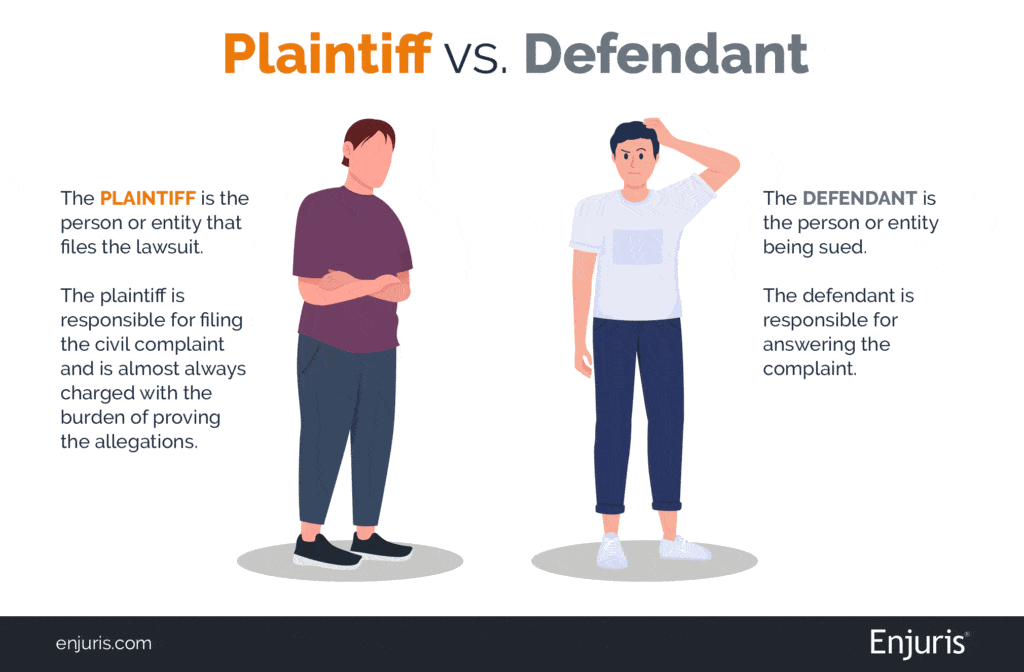
In a civil case, the person or entity that files the lawsuit is called the plaintiff. The person or entity being sued is called the defendant.
Let’s look at an example.
John is stopped at a red light. Linda is driving behind John and texting on her cell phone. As a result, Linda doesn’t see John’s car and she rear-ends him. John is seriously injured and he files a car accident lawsuit against Linda to recover additional damages that aren’t covered by insurance. In this example, John is the plaintiff and Linda is the defendant.
Because the plaintiff files the lawsuit, the plaintiff is responsible for drafting the complaint. The “complaint” is the first document filed in court for the case. The complaint states the factual and legal basis for the plaintiff’s claim. A copy of the complaint is served to the defendant and the defendant is required to file an answer. The “answer” is simply the defendant’s response to each allegation in the complaint.
How can you distinguish the plaintiff from the defendant just by looking at a complaint or hearing a case name?
The plaintiff is generally named first in the case caption and the defendant is named second.
Here’s a quick example:
Oliver Brown v. Board of Education of Topeka
In the above example, “Oliver Brown” is the plaintiff and “Board of Education of Topeka” is the defendant.
How can I remember the difference between a plaintiff and a defendant?
If you’re involved in a lawsuit, you’re likely thinking about a million different things at once. So, how are you supposed to remember which party is the plaintiff and which is the defendant?
The word “plaintiff” comes from the Old French word “plaintive,” which means to express or suffer woe – generally an accurate description of a plaintiff!
The word “defendant” contains the word “defend,” which is exactly what a defendant is doing.
The burden of proof belongs to the plaintiffs
One of the critical differences between a plaintiff and defendant in a civil case is that the plaintiff is generally charged with the burden of proving the allegations.
In other words, if John sues Linda for car accident damages since she was texting and driving, it’s not up to Linda to prove that she wasn’t driving distracted. Rather, it’s John’s responsibility (or burden) to prove that Linda was in fact distracted.
The specific burden of proof (sometimes called the “evidentiary standard”) depends on the type of case. In most civil cases, the plaintiff must prove their case by a “preponderance of the evidence.” This means the plaintiff must show that a particular fact or event was more likely than not to have occurred.
In some civil cases, the plaintiff must prove their case by “clear and convincing evidence.” This is a higher standard and requires the plaintiff to prove that a particular fact is substantially more likely than not to be true.
Other terms to know
There are a couple of common situations where the parties involved in a civil lawsuit are referred to as something other than plaintiff and defendant.
- Appeals. When a case is appealed, the terms “plaintiff” and “defendant” are seldom used. An appeal is a written petition to a higher court to modify or reverse a decision of a lower court. The party that appeals a ruling (regardless of whether it’s the plaintiff or defendant) is called the “appellant.” The other party responding to the appeal is called the “appellee.”
- Bankruptcy. The terms “plaintiff” and “defendant” aren’t used in bankruptcy cases. Instead, the person filing the bankruptcy is called the “debtor” and the party filing a claim against the debtor is called a “creditor.”
- Counterclaims. If a defendant is sued by a plaintiff, the defendant can turn around and assert a claim against the plaintiff. This is called a “counterclaim.” In this situation, the defendant may be referred to as the “counter-claimant” or “counter-plaintiff.” Similarly, the plaintiff may be referred to as the “counter-defendant.”
- Self-defense claims. In cases involving civil liability for self-defense, a defendant who acted in self-defense may still face a lawsuit if the plaintiff claims the response was excessive or unjustified. Here, the defendant remains the “defendant,” but the case hinges on whether their self-defense actions expose them to civil liability for damages.
It’s not always easy to follow along with what a lawyer is saying. A good attorney will take the time to explain legal terms so that you have a good understanding of what’s going on in your case. Read more about how to choose the right lawyer for your case.
See our guide Choosing a personal injury attorney.