Who can you sue if you’re injured in an accident involving an 18-wheeler?
Whether you spend most of your time driving on the congested roads in Portland or the open highways in Eastern Oregon, you’ve undoubtedly found yourself sharing the pavement with an 18-wheeler.
Oregon’s large commercial trucks carry more than $215 billion worth of goods through the state every year. What’s more, 1 out of every 17 people in Oregon works in the trucking industry.
Commercial truck accidents are generally more complicated than car accidents when it comes to recovering damages.
Let’s take a closer look at large truck accidents in Oregon.
Oregon truck accident statistics
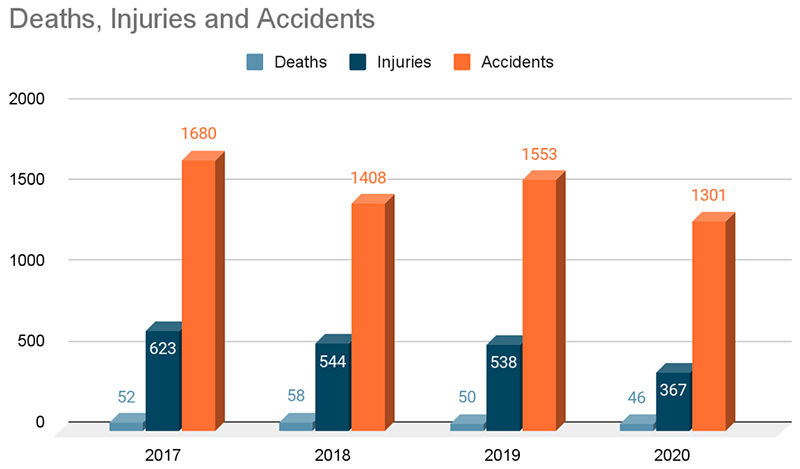
There were 218,052 car accidents in Oregon from 2017-2020. In comparison, there were 5,942 large commercial truck accidents during that same period.
On average, large commercial truck crashes occur 0.76 times per million vehicle miles traveled, according to the Oregon Department of Transportation (ODOT). A fatal truck accident occurs 0.025 times per million vehicle miles traveled.
Common causes of truck accidents
Trucks accidents happen for many of the same reasons car accidents happen. For example:
- Aggressive driving
- Poor road conditions
- Poor weather
The Federal Motor Carrier Safety Administration (FMCSA) and the National Highway Traffic Safety Administration (NHTSA) conducted the Large Truck Crash Causation Study (LTCCS) to examine the reasons for serious crashes involving large trucks.
The study first looked at critical events (the event that put the vehicle on a course that made the collision unavoidable) and determined that the 3 most common critical events that led to truck crashes were:
- Running out of the travel lane (32%);
- Vehicle loss of control due to traveling too fast for the conditions, cargo shift, vehicle system failure, poor road conditions, or other reasons (29%); and
- Colliding with the rear end of another vehicle in the truck’s travel lane (22%).
The study also looked at associated factors (the conditions present at the time of the crash) and found that the top 10 associated factors in large truck crashes were:
- Brake problems
- Traffic flow interruptions
- Prescription drug use
- Traveling too fast for the conditions
- Lack of familiarity with the roadway
- Roadway problems
- Required to stop before the crash (traffic control device, crosswalk)
- Over-the-counter drug use
- Inadequate surveillance
- Fatigue
According to witnesses, the two truck drivers were engaged in a cat-and-mouse game.
At one point, James steered into the eastbound lane in an effort to pass Jonathan. Jonathan then sped up in order to prevent James from getting back into the westbound lane.
Meanwhile, Sarah Allison was heading east on U.S. 20 when she saw James coming straight toward her in the eastbound lane. Although she attempted to swerve out of the way, the two vehicles collided and Allison was killed instantly.
The family of Sarah Allison filed a wrongful death lawsuit against both truck drivers and their employers. The lawsuit argued that the truckers engaged in “reckless, outrageous, dangerous, criminal, and negligent conduct.”
U.S. District Judge Patricia Sullivan allowed the jury to award damages beyond Oregon’s wrongful death cap of $500,000 by applying the law from Sarah’s home state of Idaho, which sets no limitations on noneconomic damages in wrongful death cases.
The lawyer for Sarah Allison said he hoped the substantial verdict would send a strong message to trucking companies to train their drivers and hold them responsible.
Federal and state laws governing truck accidents in Oregon
Federal laws govern the commercial trucking industry throughout the United States. These laws largely establish the standards that trucking companies and drivers must meet.
The vast majority of federal laws governing commercial trucking can be found in Title 49 of the Code of Federal Regulations and cover things like:
- Maximum vehicle weight
- Transportation of hazardous materials
- Drug and alcohol testing
- Licensing requirements
- Inspections
- Emergency signal equipment
- Use of hand-held devices (they’re strictly prohibited)
Driver fatigue is one of the biggest causes of commercial truck accidents. According to an FMCSA study, approximately 13% of commercial vehicle drivers who crash are fatigued.
In an effort to combat driver fatigue, federal laws were established to limit the hours of service.
| Hours-of-service limitations for commercial motor vehicle drivers | ||
|---|---|---|
| Work | Property-carrying vehicles | Passenger-carrying vehicles |
| On-duty | Maximum 14 consecutive hours on-duty following 10 consecutive hours off-duty | Maximum 15 hours on-duty following 8 consecutive hours off-duty |
| Driving time | Maximum 11 hours of driving during the 14-hour on-duty period | Maximum 10 hours of driving following 8 consecutive hours off-duty |
| Weekly | Maximum 60 hours on-duty in any period of 7 consecutive days (if the vehicle operates every day) or maximum 70 hours on-duty in any period of 8 consecutive days (if the vehicle doesn’t operate every day) | Maximum 60 hours on-duty in any period of 7 consecutive days (if the vehicle operates every day) or maximum 70 hours on-duty in any period of 8 consecutive days (if the vehicle doesn’t operate every day) |
Unfortunately, truck drivers don’t always follow the federal hours-of-service limitations.
According to one ODOT study, 25 percent of commercial truck drivers in Oregon are too tired to drive legally.
Oregon has adopted the Federal Motor Carrier Safety Administration Regulations, meaning even local trucking companies and truck drivers that only operate in Oregon must comply with virtually all federal trucking regulations.
How do I recover damages in an Oregon truck accident case?
To recover damages in an Oregon truck accident case, you need to prove that someone other than you was at fault for the accident (or at least partially at fault).
In most truck crash cases, proving that someone was at fault for the crash requires establishing the elements of negligence.
You can read more about establishing negligence here, but the quick and dirty version is this: You need to establish that the defendant breached their duty to exercise reasonable care (for example, running a red light or driving while intoxicated) and this breach was the actual and legal cause of your accident.
Parties that may be negligent in a commercial truck accident include:
- The truck driver
- The owner of the truck
- The company that leased the truck from the owner
- The manufacturer of the truck or truck components
- The person who loaded the ship’s cargo
Oregon’s shared fault rule
Just because you were partially at fault for your truck accident, doesn’t necessarily mean you can’t file a personal injury lawsuit and recover damages.
Oregon follows the modified comparative fault rule. This means that the plaintiff’s damages are reduced by their percentage of fault. In other words, if a jury considers you 10 percent at fault, the damages you’re awarded will be reduced by 10 percent. If the plaintiff is considered more than 50 percent at fault for their accident, the plaintiff is barred from recovering ANY damages.
Statute of limitations for Oregon truck crashes
Oregon limits the amount of time an injured person has to file a lawsuit following a truck accident. In most cases, this time limit (known as the statute of limitations) is 2 years.
If you fail to file your lawsuit within the 2-year statute of limitations, you will be forever barred from filing a lawsuit based on the accident.
What damages are available in an Oregon truck accident case?
Unsurprisingly, large commercial trucks tend to cause a lot of damage when they crash.
The average size of a commercial truck is 72 feet long, 13.5 feet tall, 8.5 feet wide and nearly 80,000 pounds.
Fortunately, Oregon allows truck accident victims to recover the following damages:
- Economic damages represent the monetary losses caused by an accident (medical expenses, lost wages, property damage).
- Non-economic damages represent the non-monetary losses caused by an accident (pain and suffering, loss of consortium)
- Punitive damages are intended to punish a defendant and are typically only available if the plaintiff can prove that the defendant acted “with a reckless and outrageous disregard for the health, safety, and well-being of others.”