When to call a lawyer for your New Jersey workers’ compensation claim
The largest companies doing business in New Jersey include Johnson & Johnson, Amazon, Prudential Financial Inc., CVS Health, Quest Diagnostics, Bank of America, Bristol Myers Squibb, Lockheed Martin, ADP, AT&T, Hackensack University Medical Center, United Airlines and others.
The U.S. Census reported that as of 2021, there were 4.098 million people in New Jersey’s workforce, which is about half of the state’s 9.2 million population. The state’s gross domestic product at that time was $629.83 billion and the state average was $75,245 per capita personal income.
New Jersey is also home to the largest cargo port on the East Coast and is the No. 1 state for broadband access. Its largest industries include financial services, transportation and logistics and life sciences.
While these industries are vastly different from one another, they have one thing in common: People can be injured at work regardless of where they work or the type of job. If you’re injured at work, you can receive benefits through workers’ compensation insurance—it doesn’t matter what type of job or what type of injury, as long as it happened while you were performing duties for your job. In fact, there are certain circumstances when you could get workers’ comp benefits even if you work from home.
What is workers’ compensation?
Workers’ compensation insurance provides benefits to a New Jersey employee who is injured at work.
Each state has a workers’ compensation law, but they apply it a little differently. Therefore, if you’ve received workers’ comp in another state, it might not be the same as how it works in New Jersey.
The basics:
Workers’ compensation is a no-fault system of insurance.
It’s designed to ease the burden on the injured worker because you don’t need to prove that your injury resulted from your employer’s negligence or that there was liability. Proving fault can be a lengthy process and the law intends for there not to be any barriers to a worker receiving benefits quickly.
Workers’ compensation benefits the employer, too. You can’t file a personal injury lawsuit against your employer for an injury covered under workers’ compensation. Therefore, the employer will not be subject to time-consuming, costly and potentially reputation-damaging lawsuits for employee injuries.
Proving your claim for New Jersey workers’ compensation benefits
Since fault isn’t in the equation, there are just a few factors to prove that you’re entitled to benefits under New Jersey workers’ compensation:
1. The injury is a result of your job or being at work. This can present in a couple of ways. You could become injured simply by doing your job—perhaps you accidentally hit your thumb while hammering in a nail. Maybe you somehow got stapled while collating papers (ouch!). Things happen, and if you can show that you were doing an activity for your job at the time you got injured, you can claim workers’ compensation benefits.
But what if you were at work but not doing work? For example, you were walking to the break room and you tripped over a phone charger cord that someone had carelessly left on the floor in the hallway? No, walking to the break room isn’t part of your job, but you were at your workplace at the time when the injury happened and that makes it eligible for workers’ compensation insurance.
2. You weren’t at work but you were doing work. Your job might take you off-site or away from your main workplace. Perhaps you travel to clients’ homes or offices, or you work on a variety of construction sites. Now that so many people work from home regularly, there could be no “home base” location but you travel to where you need to go for meetings or appointments.
If you’re injured while engaged in duties related to your job while at an off-site location, that injury can also be covered by NJ workers’ compensation.
3. The injury is the result of a task or condition at your job, but developed gradually over time. If your job involves heavy lifting, twisting, being on your feet most of the time, or any other physically demanding activity that involves repetitive or straining motion, you might have an injury that’s not the result of a specific accident but that develops slowly. These types of musculoskeletal injuries (like carpal tunnel or neck or back pain, for example), are also covered under workers’ compensation.
The other way a compensable illness can develop over time is from a toxin, chemical or other type of environmental exposure at work. These are called occupational diseases, and they refer to respiratory, hearing or vision impairments, cancers and other types of illnesses that result from exposure. These types of illnesses might not have symptoms for years or decades after exposure.
4. The injury cost you money. Specifically, workers’ compensation reimburses you for medical treatment and wage loss. If your injury didn’t require medical treatment or time off from work, you would not be eligible to receive compensation.
New Jersey workers’ compensation benefits
New Jersey has a seven-day waiting period before you can collect workers’ compensation benefits. After the seven days, you can begin to receive temporary disability benefits. There is no waiting period for permanent disability or medical benefits.
An injured New Jersey employee can receive the following benefits:
Medical treatment
This would include any necessary and reasonable medical treatment, which includes future medical care related to the injury, like physical or occupational therapies or anticipated surgeries. The employer and insurance carrier are permitted to designate medical providers.
Temporary total disability benefits
This is applicable to someone who is unable to work at all for more than seven days, retroactive to the the first day of lost time. The benefit is 70% of the average weekly wage up to a statutory maximum. These continue until you can return to work, reach maximum medical improvement or are at the statutory 400-week maximum.
Permanent partial disability benefits
An employee who is severely injured might not be able to return to work in the same role or capacity as before their injury. Benefits are paid weekly based on functional loss.
Permanent total benefits
If you’re unable to work at all, you can receive weekly benefits that are provided for 450 weeks. If you remain completely disabled, the benefits can continue past that time. This is based on 70% of your average weekly wage up to the statutory maximum.
Death benefits
Dependent survivors can receive 70% of the worker’s wage on a weekly basis, in addition to funeral expenses up to $3,500.
What if your claim for NJ workers’ compensation is denied?
There are a few typical reasons why your claim could be denied:
- The injury was outside the scope of your employment
- The injury was actually a pre-existing condition unrelated to work
- The injury is less severe than the claim indicates, and you’re able to return to work
- The medical care you’re seeking is unrelated to your injury or not necessary for treatment
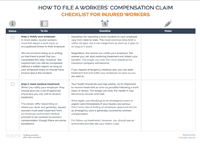 Workers’ Compensation Checklist
Download this checklist for injured workers to learn how to file a workers’ comp claim and track your progress.
Download in PDF format
However, if you feel that your claim was improperly denied, you should call a NJ workers’ compensation attorney.
Your attorney will review the evidence and your claim and help establish what you’re entitled to for compensation. They can negotiate with the insurance company or your employer and appeal the decision if necessary.
Did you know that workers' compensation law varies by state?












Need a lawyer?

The basis for personal injury law is fairly straightforward:
If you’re injured because of someone’s negligence, then you’re entitled to recover for your financial losses related to the injury.
The premise for the workers’ compensation system is similar:
Your employer is required to have specific insurance that provides benefits if you’re injured at work.