Everything you need to know from filing a claim to appealing a denial
The two most popular occupations in Nevada are laborers and freight, stock, and material movers; both jobs have a high rate of worker injury.
Of course, you can be injured in any type of occupation. In the late 1980s, Switchboard operators at a Circus Circus Hotel in Reno, Nevada, became ill when carbon monoxide leaked into the switchboard office located in the basement of the hotel.
Fortunately, Nevada requires most employers to carry workers’ compensation insurance for the purpose of providing benefits to injured workers.
In this guide, we’ll take a look at workers’ compensation in Nevada, including how to file a claim and what steps you can take if your claim is denied.
Understanding workers’ compensation in Nevada
Workers’ compensation is a type of insurance that provides financial benefits to employees who are injured on the job. Before we go any further, there are three important things you should understand about Nevada’s workers’ compensation claims:
- Workers’ compensation is an exclusive remedy. If you’re eligible to receive workers’ compensation benefits, you waive your right to sue your employer for your workplace injury in almost all situations.
- Workers’ compensation is no-fault insurance. You can receive workers’ compensation benefits regardless of who’s at fault for your injury (so long as your injury wasn’t intentionally self-inflicted).
- Workers’ compensation benefits are not automatic. In order to receive workers’ compensation benefits following an injury, there are several steps that you and your employer must take.
The full version of the Nevada Workers’ Compensation Act (sometimes called the “Nevada Industrial Insurance Act”) can be found in Chapter 616A of the Nevada Revised Statutes.
How to find out whether your employer carries workers’ compensation insurance
The good news is that the vast majority of Nevada employers are required to carry workers’ compensation insurance. More specifically, all employers with one or more employees are required to carry workers’ compensation insurance.
The bad news is that there are several exemptions. For example:
• Workers engaged in casual labor for less than 20 days on behalf of an employer are exempt. Casual labor is defined as work that’s not in the usual business of the employer (for example, an accounting firm that hires a gardener to restore their grounds).
• Domestic workers (house cleaners, nannies, etc.) are exempt.
• Workers (other than construction workers) who are brought into Nevada on a temporary basis and who are insured in another state are exempt.
To find out if your employer carries workers’ compensation coverage, contact your local workers’ compensation agency.
Is your injury covered by workers’ compensation insurance?
Most injuries and illnesses are covered by workers’ compensation insurance so long as the injury or illness arose out of your employment.
Your injury arose out of your employment if:
• There’s a relationship between your employment and your accident;
• Your injury occurred while you were fulfilling the duties of your employment;
• Your injury occurred at a place where it was reasonable for you to be; and
• Your injury occurred within your period of employment.
To put it more simply, your injury or illness must have occurred because of your job. If you fell off scaffolding while working construction, your injuries will almost certainly be covered. On the other hand, if you suffer a heart attack due to high cholesterol while working as a receptionist, you probably won’t receive workers’ compensation benefits.
Some types of mental health conditions (such as Post Traumatic Stress Disorder (PTSD)) are covered in Nevada, but to receive benefits, you typically have to prove that:
• Your mental health condition was caused by extreme stress in the time of danger;
• The primary cause was an event that arose out of and during the course of your employment; and
• The stress was not caused by your layoff, termination, or disciplinary action taken against you.
Workers’ compensation covers both traumatic work injuries and occupational work injuries:
• Traumatic work injuries are those that result from a 1-time accident at work (for example, suffering a back injury as a result of a fall from construction scaffolding).
• Occupational injuries occur over a period of time (for example, repetitive movement injuries.
How to file a workers’ compensation claim in Nevada
Just because you suffered a compensable injury at work doesn’t mean you’ll automatically receive workers’ compensation benefits.
In order to receive workers’ compensation benefits in Nevada, you need to take the following steps:
• Notify your employer. You must notify your employer in writing of your injury within seven days of suffering the injury. It’s a good idea to send a copy of the notice via certified mail with return receipt requested so that there’s no confusion or dispute over when your employer received notice.
• Fill out Form C-4. You must fill out Form C-4 (Employee’s Claim for Compensation/Report of Initial Treatment) and have a medical provider sign and date it within 3 business days of receiving treatment and within 90 days of sustaining your injury. Your medical provider is responsible for sending a copy to your employer and the insurer. It’s a good idea to get a copy for your own records.
The workers’ compensation insurer must accept or deny your workers’ compensation claim within 30 business days of receiving Form C-4.
Most attorneys offer free initial consultations. Although you don’t need an attorney to file a workers’ compensation claim, it doesn’t hurt to meet with an attorney following a work injury to make sure you’re taking the proper steps.
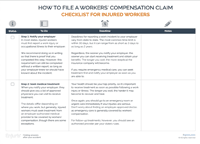 Workers’ Compensation Checklist
Download this checklist for injured workers to learn how to file a workers’ comp claim and track your progress.
Download in PDF format
What benefits does workers’ compensation provide to injured Nevada workers?
In Nevada, injured workers can receive the following workers’ compensation benefits:
• Reasonable and necessary medical expenses (doctor visits, hospital bills, prescriptions, crutches, prosthetics, etc.),
• Wage loss benefits, and
• Death benefits for certain dependents
The specific amount of wage loss benefits you can receive depends on the nature of your injury:
• Temporary total disability (TTD). If you’re temporarily unable to work, you may be eligible for TTD benefits. TTD benefits are calculated as ⅔ of your average monthly wage prior to your injury (subject to a statutory maximum that changes every year).
• Temporary partial disability (TPD). If you’re able to return to part-time or light-duty work while you’re recovering but earn less than your normal wages, you may be eligible for TPD benefits. TPD benefits are the difference between your pre-injury average weekly wages and your post-injury weekly wages (subject to a statutory maximum that changes every year).
• Permanent total disability (PTD). If you’re totally and permanently disabled, you may be able to receive monthly payments at your TTD rate until you’re no longer disabled.
• Permanent partial disability (PPD). If you suffer a permanent injury but are still able to work in some capacity, you may be eligible for PPD benefits. These benefits start when your TTD benefits end and continue for five years or until you turn 70, whichever happens later. The specific amount depends on the percent of impairment that your doctor assigns.
In the event of a fatal work injury, the surviving spouse and dependent minor children may be entitled to monthly benefits (usually at the TTD rate). Funeral expenses up to $10,000 will also be paid.
Can I appeal a workers’ compensation decision in Nevada?
If your workers’ compensation claim is denied or you don’t agree with the amount of benefits offered, you can appeal the decision through the Nevada Department of Administration (NDOA).
Here’s what the appeals process looks like:
• Hearing Officer review. The first step in the appeals process is to request a hearing in front of a Hearing Officer. To do so, fill out the Hearing Request form and mail it (along with a copy of your denial letter) to the address listed at the top of the form.
You have 70 days from the date you receive the denial letter to file a Hearing Request form.
An informal hearing will be scheduled within 30 days of your request. During the hearing, the Hearing Officer will listen to both sides, review any evidence submitted by the parties, and make a decision.
• Appeals Officer review. To appeal the Hearing Officer’s decision, fill out the Request for Hearing Before Appeals Officer form and mail it (along with a copy of the Hearing Officer’s decision) to the address listed at the top of the form within 30 days of receiving the Hearing Officer’s decision.
The Appeals Officer hearing is more formal than the hearing in front of the Hearing Officer. If you don’t have legal representation, you can request free legal representation through the Nevada Attorney for Injured Workers (NAIW) program.
• Nevada court system. If you’re unhappy with the Appeals Officer’s decision, you’ll have to file a Petition for Judicial Review with a Nevada District Court within 30 days of the Appeals Officer’s decision.
Third-party claims in Nevada
Generally speaking, injured workers are prohibited from filing personal injury claims against their employers. Instead, injured workers must file workers’ compensation claims.
However, an injured worker may be able to file a personal injury lawsuit against a third party (anyone other than their employer or colleague) if the third party’s negligence contributed to or caused the injured worker’s accident.
For example, if you’re a delivery driver injured in an accident with a drunk driver, you can file a workers’ compensation claim and a personal injury lawsuit against the drunk driver. Practically speaking, the third-party lawsuit will cover any damages that aren’t already covered by the workers’ compensation claim.
To learn about all of your legal options, schedule an initial consultation with an experienced workers’ compensation attorney. The following form can help you prepare for your initial meeting:
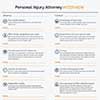 Personal Injury Attorney Interview Sheet
Worksheet with questions to ask a personal injury attorney to help determine if he or she will be a good fit for your case
Download in PDF format
Did you know that workers' compensation law varies by state?












Need a lawyer?

The basis for personal injury law is fairly straightforward:
If you’re injured because of someone’s negligence, then you’re entitled to recover for your financial losses related to the injury.
The premise for the workers’ compensation system is similar:
Your employer is required to have specific insurance that provides benefits if you’re injured at work.