A car accident injury lawyer can help minimize your liability and maximize compensation after a crash
The Hawaii Department of Transportation reports that the top contributors to Hawaii traffic-related fatalities are driving under the influence, speeding, and distracted driving.
What do each of these have in common? They are preventable. That means that of the nearly 100 people who lost their lives in Hawaii accidents in a recent year, many didn’t have to die.
People think of Hawaii as beaches and sand dunes, but they don’t consider how many busy roads and highways cross the islands. Interstate H-1 is the longest highway in the state, located on O’ahu. It begins near the Campbell Industrial Park and continues to the Kahala district of Honolulu.
Hawaii has four interstates in total: H-1, H-2, H-3 and H-201. The reasons why a state made up of islands has an interstate highway system is to facilitate shipping and commerce, and to move military units and vehicles in an emergency. The maximum speed on any road in Hawaii is 60 miles per hour.
You might be familiar with Hawaii’s most famous ride, the Hana Highway. This roadway follows the coast of Maui along state highway 360 and can take you to cliffs, waterfalls, rainforests, beaches, and villages between Hana and Kahului.
Regardless of whether you choose to travel Hawaii interstates or local roads to get to work, home, or your favorite tourist destination, no state—regardless of how picturesque—is immune to traffic accidents.
Whether you live in, work in, or visit Hawaii, it’s important to know about traffic laws and liability in the Aloha State.
Hawaii traffic accident statistics
There were 94 traffic fatalities in Hawaii in 2021, and 85 in 2020. Fortunately, this number has decreased from 108 in 2019. The five-year average for the number of Hawaii traffic fatalities has been around 103 over the past several years.
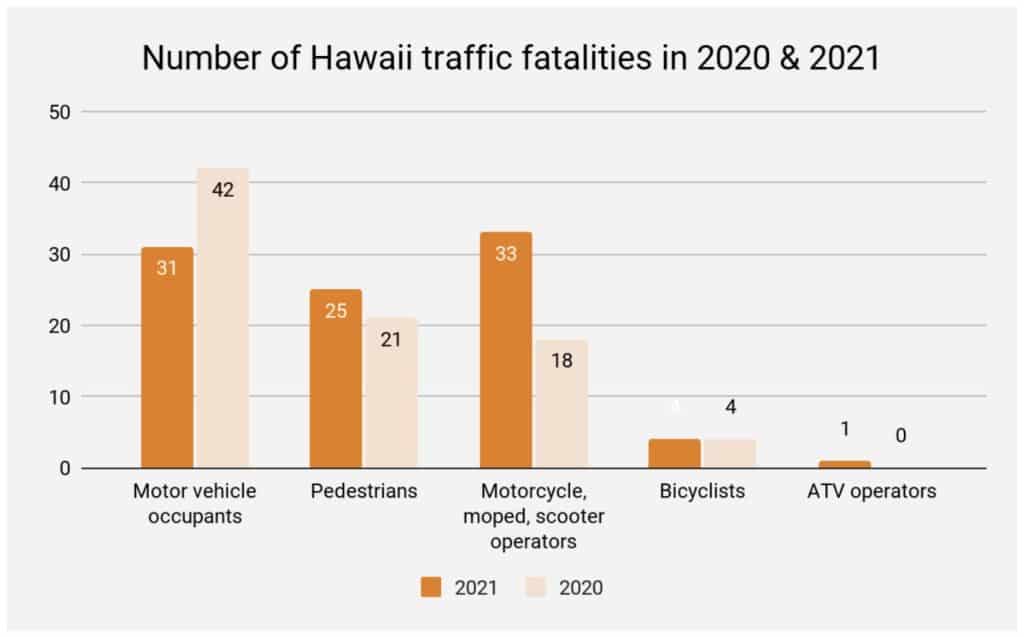
The number of serious injuries reported in Hawaii traffic accidents averages around 427 per year.
Hawaii is home to just over 1.2 million registered vehicles. Of those, 98% are private and commercial vehicles and 2% are publicly owned.
Only Maine, Delaware, North Dakota, Rhode Island, Wyoming, Alaska, Vermont and the District of Columbia have fewer registered vehicles than Hawaii.
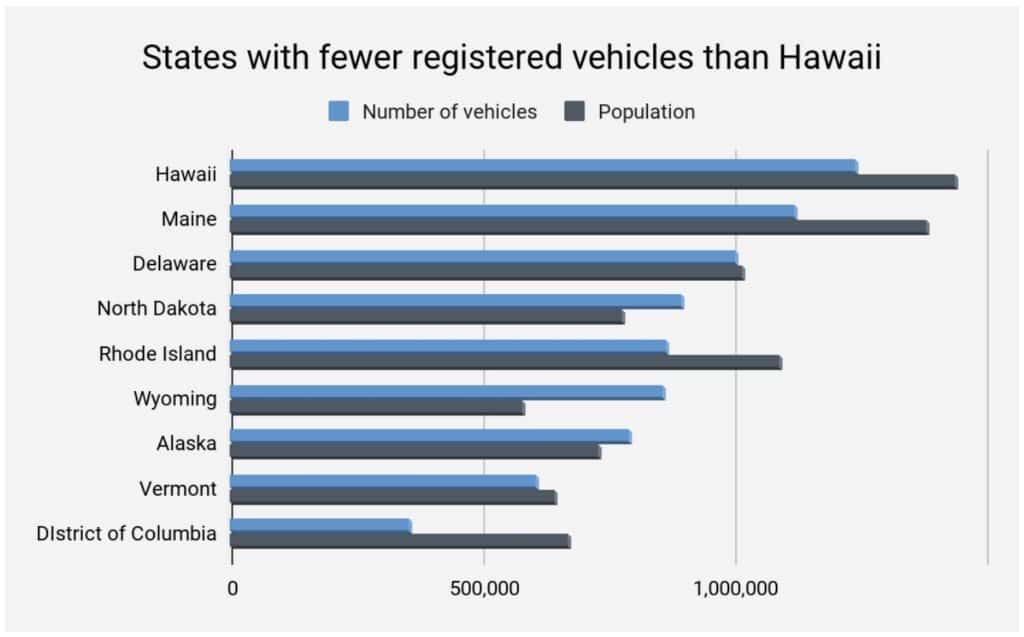
Unsurprisingly, the numbers of registered vehicles in a state tend to correlate with the state’s population. However, South Dakota, New Hampshire and Montana have more registered vehicles but a smaller population than Hawaii.
Hawaii car accident liability laws
Each state is either a “fault state” (or “tort state”) or a no-fault state. Hawaii is a no-fault state, which means a driver who is involved in a car accident would turn to their own insurance company to pay costs related to the accident (including their passengers’ injuries) up to the limit of their personal injury protection (PIP) benefits. The only reason there can be lawsuits for a Hawaii car accident is if there were severe personal injuries.
Hawaii car insurance requirements
Hawaii law requires the following minimum automotive insurance:
- $10,000 per person for personal injury protection (PIP) for medical and rehabilitative costs for driver and passengers;
- $20,000 per person or $40,000 per accident bodily injury liability; and
- $10,000 per occurrence property damage liability if you are the at-fault driver.
You may select optional collision and comprehensive coverage, uninsured and underinsured motorist coverage, wage loss, alternative care (such as faith healing or acupuncture), death and funeral benefits, PIP deductible and PIP managed care.
You are required to have auto insurance in all 50 states, though each state has slightly different requirements. Hawaii requires that your vehicle is insured and you carry an insurance identification card in your vehicle at all times.
If you were seriously injured and cannot receive full coverage from your insurance policy, you can file a personal injury lawsuit against the at-fault driver if you meet one of the following conditions:
- Your injuries exceed your PIP limit;
- Your injuries include significant permanent loss of a body part or function, you suffered permanent and serious disfigurement, and it resulted in mental or emotional suffering; or
- Someone was killed in the accident.
If you meet one or more of these criteria, you could file a personal injury lawsuit against the at-fault driver. This allows you to claim damages for non-economic losses like pain and suffering or mental distress, in addition to your economic costs for medical treatment.
Hawaii comparative negligence rule
Hawaii follows a modified comparative fault rule (otherwise known as the 51% Rule). Each state follows one of four rules that sets forth how liability can be shared between parties to an accident.
Even if you didn’t cause an accident (i.e., you’re not the at-fault driver), it’s possible that you could have responded in a way that would have avoided the crash. For instance, if the other driver was speeding and crossed a double-yellow line, causing a head-on collision, it’s clearly their fault. But if the crash investigators find that you should have or could have seen the other driver in time to swerve out of the way, you might be partially liable.
The insurer or court will assign a percentage of fault to each party. In the scenario above, the other driver could be 90% liable and you might be 10% liable.
The Hawaii modified comparative fault rule says you must be less than 51% at fault in order to recover any damages.
What to do after a Hawaii car accident
1. Stop, remain at the scene, and exchange information with involved parties
The Hawaii Driver Exchange of Information Law (HI Code § 291C-14) sets forth a duty to give information and render aid. A driver involved in a collision that results in injury or death to a person or damage to a vehicle or other property is required to provide the following information to all other parties:
- Driver’s name, address, and the vehicle’s registration number
- Display their driver’s license or permit to the other driver(s) upon request.
A driver must also provide reasonable assistance to any person injured in the accident. This includes carrying of or arranging for the injured person to be transported to a hospital or medical office for treatment.
If the injured person is not in a condition to receive information, and if there is not a police officer present, the driver of any other involved vehicle must report the collision and relevant information to the nearest police officer.
Failure to stop at the scene of a collision that results in serious bodily injury or death could be a class B felony, and the driver’s license or permit will be revoked. There will also be a $500 fine and other penalties. (HI Code § 291C-12)
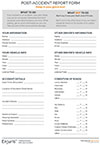 Accident Report Form
Sample post-accident report form to keep in your glove box - fill out at the scene or as soon as you can after a car accident
Download in PDF format
2. Notify police
You must notify the police “by the quickest means of communication” if there was injury, death, or property damage over $3,000. (HI Code § 291C-16)
You can be subject to fees of $100 or higher if you fail to promptly notify police of an accident. It’s also often to your benefit to have a police report from the scene.
3. Seek medical treatment
It’s always important to seek a medical evaluation after any collision, regardless of how minor it might seem.
This is because there are some injuries that might not display symptoms for days or weeks after the accident; if that happens, it would be more difficult to prove that the injury is related to the accident.
You can visit a hospital emergency department, urgent care, or your own primary care provider.
4. Collect evidence at the scene
You’re not an accident reconstruction investigator, but you might try to think like one. If possible, take photographs of the conditions at the scene—this might include weather conditions, position of street signs or signals, road conditions, property damage, or other things that could be relevant to determining how the accident happened.
You should also take names and contact information for anyone who could have witnessed the accident. You don’t have take a statement or anything like that (that’s the police’s job). But sometimes a well-meaning bystander will stay at the scene of an accident until help arrives and then leave, and you don’t want to lose their perspective by being unable to track them down later.
If the accident happened near homes or businesses, you can also inquire about whether there’s surveillance video footage that might have captured the incident.
5. Notify the insurance companies
A report is different from a claim. It’s essential to make a report as soon as possible after a crash. If you decide later to pay for damages out of pocket, rather than making an insurance claim, that’s okay. But if you neglect to report the accident, the insurance company might deny your claim if you need to make one.
You should also notify the at-fault driver’s insurance company if you intend to file an injury or property damage claim.
Finally, whether you’re trying to negotiate an insurance claim or you need to file a personal injury lawsuit, you might want to call a Hawaii car accident lawyer. Your lawyer can advocate for the financial recovery you need, assist with negotiations, and limit your liability for a crash.
Did you know that car accident law varies by state?












Hurt in a car crash? You may find these resources helpful


Need a lawyer?

What does an injury lawyer do?
A personal injury lawyer helps individuals who have sustained injuries in accidents to recover financial compensation. These funds are often needed to pay for medical treatment, make up for lost wages and provide compensation for injuries suffered. Sometimes a case that seems simple at first may become more complicated. In these cases, consider hiring an experienced personal injury lawyer. Read more
Common car accidents