
Learn what legal options exist when a loved one is killed in a large truck accident
If your loved one is injured in a large truck accident in Texas, they may be able to file a personal injury lawsuit and receive compensation for their injuries.
But what if the unthinkable happens and your loved one is killed in a fatal truck accident?
Large trucks can weigh up to 80,000 pounds and stretch more than 60 feet. This large size and weight means truck accidents are often fatal. In fact, although total traffic fatalities have gone down in the United States over the last couple of years, large truck fatalities have actually increased.
In this article, we’ll take a look at the legal options that exist for family members of those killed in large truck accidents in Texas.
Fatal truck accident statistics
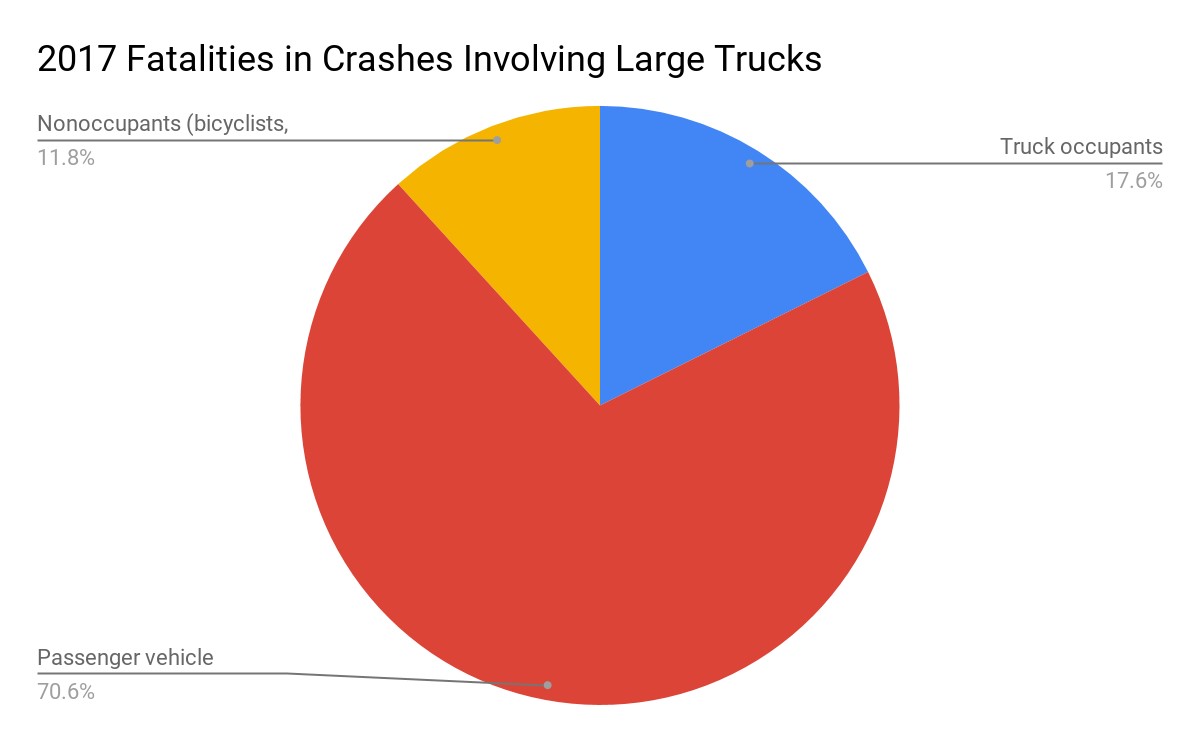
According to the National Highway Transportation Safety Administration (NHTSA), 4,761 people were killed in crashes involving large trucks (trucks with a gross vehicle weight greater than 10,000 pounds) in the United States in 2017.
Of all the people killed, only 18% were truck occupants. The vast majority of people killed were occupants of other vehicles.
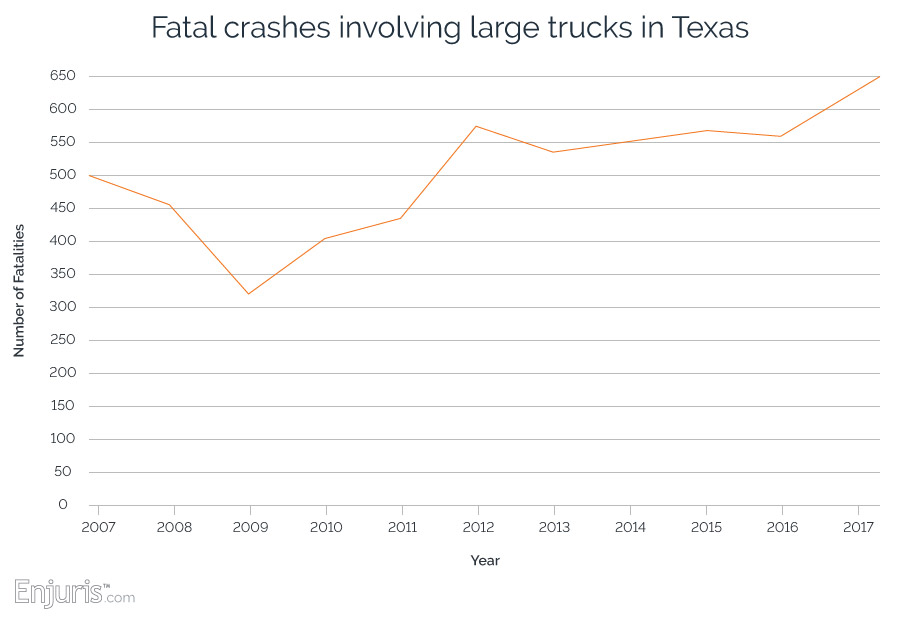
For the last decade, Texas has led all states with respect to deaths involving large trucks, and that number has been trending upward.
Causes of fatal truck accidents
Drivers of large trucks face challenges that drivers of other cars don’t.
For example, large trucks have more blind spots than cars. In addition, it generally takes a large truck 2 times longer to stop than it takes a regular-size car.
Here are some of the common causes of fatal truck accidents caused by truck drivers:
- Driver fatigue
- Speeding
- Ignoring traffic regulations
- Improperly loaded cargo
- Lack of training and safety programs for drivers
- Improper maintenance
- Distracted driving
Of course, fatal truck accidents can be caused by passenger vehicles as well.
Common causes of fatal truck accidents caused by passenger vehicles include:
- Following too closely
- Aggressive driving
What is a wrongful death claim?
When a person is killed as a result of another party’s negligent or wrongful act, certain members of the victim’s family can file a wrongful death claim in order to receive compensation.
In the case a fatal truck accident, the spouse or other relative of the person killed can file a lawsuit against the at fault driver or company for damages.
Frequently asked questions about fatal truck accident claims in Texas
Wrongful death claims remain a bit of a mystery to most people. Let’s take a look at some frequently asked questions.
Who can file a wrongful death claim in Texas?
Under Texas law, the only people who can file a wrongful death action are the:
- Surviving spouse of the deceased
- Children of the deceased (including legally adopted children)
- Parents of the deceased (including adoptive parents)
This means that siblings and grandparents of the deceased are not allowed to file wrongful death claims in Texas.
What must be proven?
When an eligible family member files a wrongful death claim, they step into the shoes of the deceased. This means the family member must prove liability just as the deceased would’ve had to prove liability if they had survived the truck accident.
For example, if the deceased person was killed by an unsecured load, the eligible family member would have to prove the elements of negligence (i.e., the truck driver or trucking company owed the deceased a duty, the driver or company breached the duty by failing to properly secure the load, and the failure to secure the load caused the accident).
What damages can be recovered under a wrongful death claim?
The last thing you’re thinking about after losing a loved one is a lawsuit. But, while no amount of money can replace the loss of a loved one, filing a wrongful death claim can ensure that you and your family are financially cared for so that you can focus on grieving and healing.
In Texas, wrongful death damages include:
- Funeral/burial expenses
- Medical costs for past treatment
- Loss of future projected income and earnings
- Loss of companionship/consortium (spouse)
- Loss of love and care (children/dependent)
- Pain and suffering
In some Texas fatal truck accident claims, punitive damages are available. Punitive damages may only be recovered when a wrongful death is caused by a willful act or omission, or by gross negligence. The purpose of punitive damages isn’t to compensate the family, but to punish the wrongdoer.
Importantly, damages recovered in a wrongful death action aren’t subject to the debts of the deceased. In other words, if the deceased died with debts, the money you recover in a wrongful death action can’t be collected by debt collectors.
How are damages divided among family members?
When damages are awarded in a Texas wrongful death case, they’re divided among the surviving family members in proportion to the injury they suffered as a result of the untimely death.
Typically, these proportions are determined by the judge or jury after testimony from the surviving family members and other witnesses.
When do I have to file a Texas wrongful death case?
Texas requires that all wrongful death lawsuits are filed within 2 years of the deceased’s death.
If your loved one has been killed in a fatal truck accident, don’t waste any time finding and meeting with an experienced Texas personal injury attorney to discuss your options.
 Personal Injury Attorney Interview Sheet
Worksheet with questions to ask a personal injury attorney to help determine if he or she will be a good fit for your case
Download in PDF format
Sources
National Highway Traffic Safety Administration, 2017 Fatal Motor Vehicle Crashes
National Highway Traffic Safety Administration, Traffic Safety Facts
Texas Legislature, Title 4, Chapter 71, Texas Civil Practice and Remedies Code
See our guide Choosing a personal injury attorney.