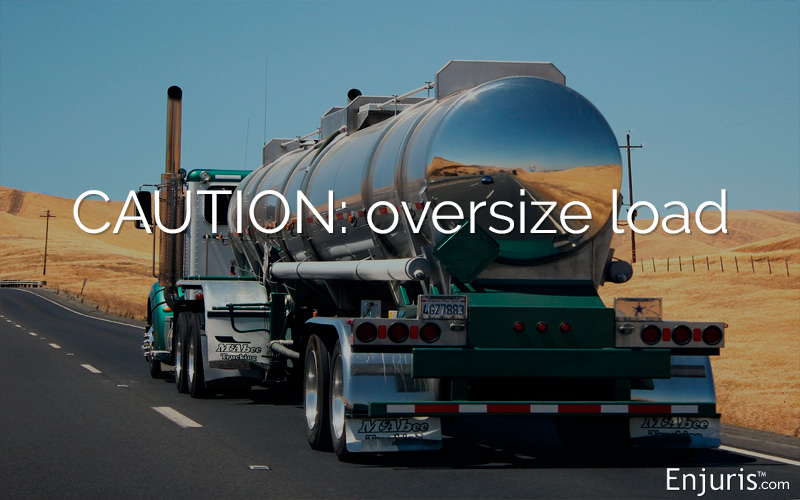
What happens when a commercial truck accident is caused by unsecured freight?
Imagine this:
You’re driving down the Southwest Freeway in Sugar Land, Texas. All of a sudden, the remains of slaughtered cattle come loose from the 18-wheeler driving in front of you.
It sounds like the set of a horror movie.
But for several Texas drivers on their way to work, there was no need to imagine this scenario. A Double D Trucking employee failed to properly secure his cargo and the result was a highway full of animal waste.
Fortunately, no one was hurt and hazmat crews from the Texas Department of Transportation cleaned up the waste without further incident. Not all unsecured-load accidents are as harmless though.
Fortunately, if you’re injured because of an unsecured load in Texas, there’s a good chance you’ll be able to recover compensation for damages.
Types of accidents caused by unsecured loads
In Texas, roughly 1,200 crashes are caused by unsecured loads every year. Unsecured-load accidents don’t all look the same.
Common examples include:
- Vehicles struck by falling objects
- Vehicles that strike non-fixed objects on the road
- Vehicles that crash while attempting to avoid objects
The seriousness of the accident can vary considerably depending on the characteristics of the cargo load. For example, a truck carrying improperly secured fuel presents a significant fire hazard. A truck transporting other vehicles creates a significant hazard due to the weight of the load.
However, even cargo that doesn’t weigh much can be deadly if it falls off a truck. According to the US Department of Transportation, an object that weighs 20 pounds and falls from a truck traveling 55 miles per hour has the striking pressure of a half-ton.
Federal regulations for cargo loads
The Federal Motor Carrier Safety Administration (FMCSA) sets numerous rules and regulations for the proper security of a truck’s cargo. Their general rule states:
“Cargo must be firmly immobilized or secured on or within a vehicle by structures of adequate strength, dunnage (loose materials used to protect cargo) or dunnage bags (inflatable bags intended to fill the space between articles of cargo or between cargo and the wall of the vehicle), shoring bars, tie downs, or a combination of these.”
Trucks aren’t to be loaded beyond the available means of securing that load. Additionally, any cargo that could easily roll or move around inside the trailer must be secured in a way that prevents movement.
State regulations for cargo loads
In addition to the federal regulations for securing cargo, truck drivers in Texas must comply with the state regulations.
Like the federal regulations, Texas requires that all truck drivers transporting loose material ensure that the material is covered and firmly secured at the front and back or else completely enclosed.
The failure to do so is a misdemeanor and punishable by a fine of up to $400.
Liability for accidents caused by unsecured cargo loads
As with any other trucking accident, victims have the right to sue for compensation if negligence is the cause of their unsecured-load accident.
What’s more, if a truck driver violates a state or federal law, negligence per se might apply. When negligence per se applies, a plaintiff doesn’t need to prove all 4 elements of negligence. Rather, they only need to prove that the truck driver violated the law and that the violation caused the accident.
When it comes to unsecured-load accidents, several parties can be held liable depending on the circumstances, including:
- Truck drivers. Truck drivers could be held liable if they fail to make sure their truck’s load complies with federal and state laws.
- Trucking companies. Trucking companies can be held liable if they fail to properly train drivers in securing cargo loads. In addition, trucking companies may be held liable through the doctrine of respondeat superior.
- Truck manufacturers. Sometimes a product defect is the cause of the unsecured load. For example, a defective tie down might come loose, causing the load to fall from the truck. If this happens, the manufacturer might be liable.
Damages that can be recovered in an unsecured-load accident
If it’s determined that the truck driver or some other party was responsible for the unsecured-load accident that caused your injuries, you’re entitled to compensation.
In Texas, you can receive both economic and non-economic damages in a personal injury lawsuit.
These damages may include:
- Medical bills (past and future)
- Pain and suffering
- Lost wages (past and future)
- Property damage
Additionally, if your loved one was killed in an unsecured-load accident, you may be entitled to compensation for funeral expenses, loss of income, and loss of companionship. To recover these damages, you’ll need to file a wrongful death lawsuit.
Tips for avoiding unsecured-load crashes
The good news is that unsecured-load accidents can often be avoided.
“Road debris can be extremely dangerous but all of these crashes are preventable,” said Jurek Grabowski, research director for the AAA Foundation for Traffic Safety. “Drivers can easily save lives and prevent injuries by securing their loads and taking other simple precautions to prevent items from falling off the vehicle.”
To properly secure a load, you should:
- Maintain your vehicle
- Tie down loads with rope, netting, or straps
- Tie large objects directly to the vehicle or trailer
- Cover the entire load with a sturdy tarp or netting
- Don’t overload the vehicle
- Always double-check the load to make sure it’s secure
- Ask yourself whether you would be comfortable if your loved one was driving behind you
- Follow all federal and state laws
To avoid an unsecured-load accident, other drivers on the road should:
- Continually search the road at least 12-15 seconds ahead to help avoid falling cargo
- Always try to maintain open space on at least 1 side of your vehicle in case you need to swerve around an object
- If you see you’re unable to avoid debris on the roadway, safely reduce your speed as much as possible before making contact
- Avoid tailgating
Sources
KPRC Houston, Highway Reopens after Animal Waste Spill
Texas Legislature, Title 7 of the Transportation Code
Federal Motor Carrier Safety Administration, Cargo Securement Rules
See our guide Choosing a personal injury attorney.