Who’s liable when a child is injured playing a sport?
Youth sports are associated with a number of mental health benefits. According to the United States Department of Health and Human Services, children and adolescents who participate in sports generally have:
- Higher levels of self-esteem
- Reduced risk of suicide
- Improved life skills, such as goal setting, time management, and work ethic
- Improved social skills, such as teamwork, leadership, and relationship building
- Improved concentration, memory, school attendance, and academic performance
Some of these benefits were probably on your mind when you first strapped a football helmet on your kid or tied their softball cleats.
But youth sports have risks, too.
In this article, we’ll look at youth sports injuries and the legal remedies that may be available if your child is injured.
Youth sports participation statistics
Youth sports are extremely popular in the US.
According to a study conducted by the Sports & Fitness Industry Association (SFIA), 71.8% of children ages 6-12 played a team or individual sport in 2018. Although more boys play sports than girls, the difference is relatively small.
Tweet this
Children from high-income homes are more than 3 times as likely to participate in youth sports as children from low-income homes. This isn’t surprising when you consider that every year families spend approximately $693 per child for each sport they play.
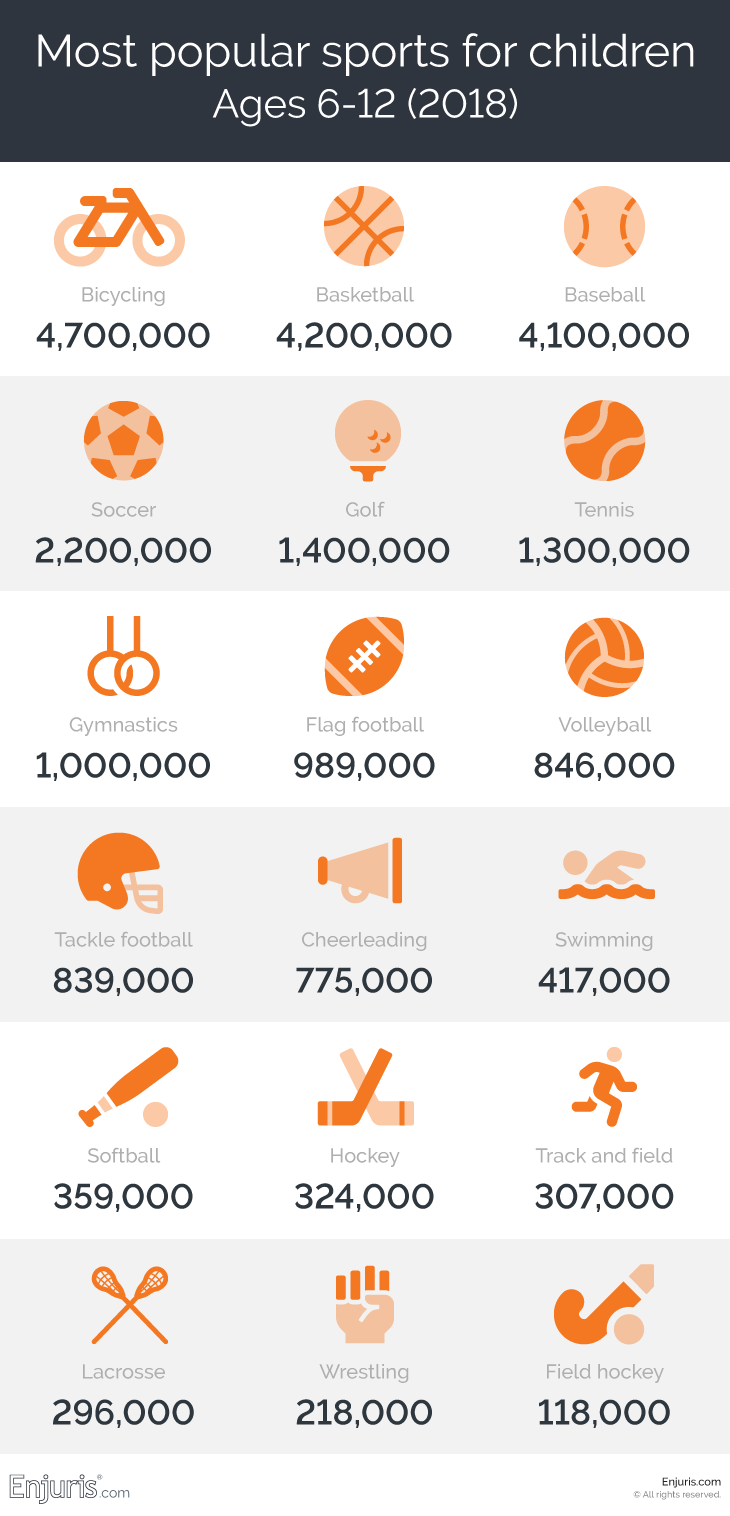
Most popular sports for children ages 6-12 (2018)
View Full Size Get the Code Use this graphic on your site
Use this infographic on your site
We encourage people to use our infographics, with proper attribution. Just copy and paste the code below to use this infographic on your site. If you need help, let us know!
<a href="https://www.enjuris.com/personal-injury-law/youth-sports-injuries/" target="blank"><img src="https://www.enjuris.com/infographics/2020/infographic-popular-children-sports-2018.gif" alt="Youth sports injuries statistics" title="Enjuris.com: Youth Sports Injuries and Liability" style="width: 100%; max-width: 730px; display: block; margin: 15px auto;" /></a>
Source: Aspen Institute: Trends and Developments in Youth Sports 2019
Common youth sports injuries and statistics
According to Stanford Children’s Health Hospital, more than 3.5 million children (ages 14 and younger) get hurt every year playing sports and participating in recreational activities.
Though not all of these injuries are serious, more than 775,000 children are treated in hospital emergency rooms for sports-related injuries each year. What’s more, sports and recreational activities contribute to approximately 21% of all traumatic brain injuries among children in the U.S.
The type of injury a young athlete is likely to suffer varies depending on their chosen sport. Serious shoulder and elbow injuries are more common among young baseball players, whereas young football players are more likely to suffer head injuries.
Here are some common youth sports injuries:
- Shoulder dislocations. Younger athletes are more prone to shoulder dislocation than older athletes because their shoulder joints are looser.
- Growth plate fractures. Growth plate fractures are particularly common among gymnasts.
- Muscle sprains. A muscle sprain is a stretch or tear in a ligament. Among youth athletes, muscle sprains most commonly occur in the ankle.
- Muscle strains. Muscle strains involve an injury to a muscle or the band of tissue that attaches a muscle to a bone. Muscle strains can occur in any sport, though the location varies.
- Osteochondritis dissecans. Osteochondritis dissecans is a condition of the joint when a lack of blood flow causes the bone underneath the joint’s cartilage to die. The condition is common in runners and children participating in sports that require lots of jumping.
- Shin splints. Shin splints are characterized by pain in the shins. Shin splints are common among runners and dancers.
- Torn ACL. A torn ACL is the result of sudden changes in direction or stops and are more common among high school and college-age students than children.
- Sever’s disease. Sever’s disease is a condition that causes heel pain due to stress to the heel’s growth plates. The condition is most common among runners.
- Concussions. Concussions can occur with a blow to the head and can lead to permanent brain damage if untreated. Concussion rates for children under age 19 who play tackle football have doubled over the last decade.
- Traumatic brain injuries. Repeated blows to the head that don’t result in concussions can, over a long period of time, result in long term health issues, including chronic traumatic encephalopathy (CTE).
- Spinal cord injuries. Children who participate in contact sports (such as football and hockey) and sports that could result in a fall from a high distance (such as cheerleading) are more likely to suffer spinal cord injuries.
- Death. Although death is rare, the leading cause of death from a sports-related injury is a brain injury.
Who’s liable for a youth sports injury?
In order to recover damages for a youth sports injury, you’ll have to show that someone other than your child was responsible (or at least partially responsible) for your child’s injury. In many cases, there are multiple parties who may be liable.
Let’s look at an example:
Billy is pronounced dead an hour later as a result of a head injury.
Who’s liable?
In the above example, there are a number of potentially liable parties, including:
- The WYFA and the YMCA for failing to implement a league-wide concussion protocol
- The coaches for failing to remove Billy from the game
- The doctor who gave Billy the okay to play in the game following the initial injury
- The player who hit Billy after the whistle blew the play dead
- Billy for lying about his headaches
Can a parent be sued for the intentional or negligent acts of their child?
In most cases, youth sports participants haven’t yet reached the age of majority (18 in most states). As a result, youth sports participants simply don’t have the assets to satisfy a judgment against them.
This begs the question: Can you sue the parents of a minor who injures someone through an intentional or negligent act?
All states have parental responsibility laws that govern when a parent can be held liable for the intentional or negligent acts of their child.
For example, parents in California can be held liable for the willful (i.e., intentional or reckless) misconduct of their minor children. In Oklahoma, parents can only be held liable for the criminal acts of their children.
Most states cap the amount of damages that can be recovered when suing a parent. To stick with California as an example, the Golden State limits the amount of recoverable damages to $25,000.
As you can see, there are often several potential defendants when a youth sports injury occurs. Your lawyer can help you determine who should be sued.
Possible causes of personal injury action
In most youth sports injury cases, the appropriate cause of action will be negligence. In other words, the plaintiff will need to prove:
- The defendant owed the plaintiff a duty of care. In most cases, the defendant owes the plaintiff a duty to exercise “reasonable care.” In certain situations, the defendant owes the plaintiff a more specific duty of care.
- The defendant breached the applicable duty of care. The defendant might breach the applicable duty of care by, for example, failing to remove a player from a game despite obvious signs that the player suffered a concussion.
- The plaintiff was injured as a direct result of the breach. The defendant’s breach must be the cause of the plaintiff’s injuries.
Other legal causes of action that might be appropriate in a sports injury case include:
- Product liability. A product liability claim might be appropriate if a product (such as a balance beam or baseball bat) was defective or lacked proper warnings.
- Medical malpractice. A medical malpractice claim might be appropriate if a doctor failed to properly diagnose a condition or gave improper advice.
- Wrongful death. A wrongful death claim might be appropriate if the youth suffered a fatal injury. Wrongful death claims can be filed by certain family members of the deceased, and are intended to compensate family members for the loss of a loved one.
During a youth soccer practice, James Coleman jumped up and grabbed the crossbar of the soccer goal. The soccer goal wasn’t anchored to the ground and, as James held onto the crossbar, the goal tipped toward him and the crossbar fell on his face. James suffered multiple severe facial fractures which required surgery and the placing of 3 titanium plates in his face. James sued the organization that ran the youth soccer league under the theory of negligence. The youth soccer organization asserted the defense of contributory negligence. During the trial, the youth soccer association argued that the organization had no duty to anchor the goal and, regardless, the condition of the goal was open and obvious. James Coleman argued that players commonly hang from soccer goals and that his actions should have been anticipated and expected by the organization. James further argued that anchoring goals is a standard safety practice in youth soccer.
Ultimately, the jury held that both the youth soccer organization and James Coleman were partially responsible for the accident. Under Maryland’s pure contributory negligence rules, James Coleman was barred from recovering any damages.
Common defenses in youth sports injury cases
There are 3 defenses that are commonly raised in youth sports injury cases:
- Assumption of the risk. The “assumption of the risk defense” says that a plaintiff who voluntarily participates in a sports activity is owed no duty of care with respect to the obvious risks associated with the activity. However, liability attaches where the defendant intentionally injures or engages in reckless misconduct beyond the scope ordinary contemplated for the activity. For example, if you get hit with a pitch while at the plate during a baseball game, you can’t sue anyone for your injuries because getting hit with a baseball is an inherent risk associated with the game. On the other hand, if a pitcher picks up a bat and hits you with it, you can sue the pitcher because getting hit with a bat is beyond the obvious risks associated with the game.
- Waiver of liability. Before participating in a sport, you may be asked to sign a waiver of liability for your child. A waiver is simply an agreement wherein a parent releases certain parties (usually the organizing association or school) from any liability related to injuries suffered. Every state treats waivers differently. In some states, waivers are unenforceable. In other states, waivers are upheld if they meet specific requirements.
- Statute of limitations. A statute of limitations specifies how long you have to bring a lawsuit against someone. If you fail to file a lawsuit within the applicable statute of limitations, you’ll be prohibited from recovering any damages. Most states provide that the statute of limitations doesn’t start running until the plaintiff turns 18.
Damages available in youth sports injury cases
If your child plays sports, your health insurance will typically cover some of the expenses caused by a sports injury. What’s more, there are specific “sports policies” that may provide additional coverage with a lower deductible.
Nevertheless, insurance policies rarely cover all of the expenses associated with an injury. Fortunately, in a youth sports injury case, you’re entitled to compensation from the person or entity legally responsible for your injuries. The legal term for this compensation is “damages.” Exactly what damages you can recover varies from state to state, but you can usually recover:
- Past and future medical expenses
- Future lost wages (if the injury limits the youth’s ability to work in the future)
- Property damages
- Pain and suffering
- Emotional distress
Think you have a sports injury claim? Use our free online directory to contact an attorney in your area.
Connect to top-rated lawyers in seconds using our comprehensive national directory
See our guide Choosing a personal injury attorney.