Here’s what to do if you’ve been injured at work
Each state offers workers’ comp benefits, but there’s variation in how it’s handled. Here’s what you need to know if you’re a Pennsylvania worker.
Accidents can happen any time, any place, as we all know. But an accident at work is handled a little differently from a typical accident in any other circumstance.
Typically, if a person suffers an injury from an accident and believes another party is at fault, they can file a personal injury lawsuit. Whether it’s a car accident, slip and fall, toxic exposure, or any other situation, liability would hinge on whether there’s a negligent party. Negligence means a person or entity did not take reasonable care to avoid causing harm to the victim. The victim may file a personal injury lawsuit to recover damages for their financial losses related to the injury.
But when you’re injured at work, this is handled differently.
A work injury becomes a workers’ compensation claim. Instead of making a claim against the liable party or their insurance, you make a claim to your employer’s workers’ comp insurer. One of the major differences between a personal injury lawsuit and a workers’ compensation claim is that to receive workers’ comp benefits, you don’t need to prove that your employer (or anyone else) was negligent.
Pennsylvania workers’ comp is a system of no-fault insurance.
To receive Pennsylvania workers’ comp benefits, you must prove:
- You were at work or engaged in work-related activities during the injury. It does not need to be on-site at your workplace if you were off-site for the purpose of a work-related task or performing a work-related task at the time; or
- The injury wasn’t specifically caused by your work, but it happened at your work site (for example, a slip and fall on a puddle in the workplace bathroom); or
- The injury or illness was related to activities required by your work. This might include exposure to toxic substances; hearing or vision loss; an injury like carpal tunnel, or neck, back, or other muscle or joint strain from repetitive motion or heavy lifting; or other injuries that are not caused by a specific accident, but rather from the work environment or performing certain tasks over time; or
- Pennsylvania workers’ compensation covers a pre-existing condition that was aggravated by work activities. The pre-existing condition does not need to be work-related to be covered. In other words, if your job has aggravated a condition like arthritis or heart disease, the resulting treatment and lost work time would be a covered benefit.
Pennsylvania Workers’ Compensation Act
The Pennsylvania Workers’ Compensation Act provides payment for an injured worker’s medical expenses and wage-loss compensation benefits while they recover until they can return to work. It also pays death benefits to dependent survivors.
Who’s covered?
Every Pennsylvania employer is required to carry workers’ compensation insurance for each employee, which includes seasonal and part-time workers. This also includes nonprofits, unincorporated businesses, and employers who only employ a single person.
There are some workers who are covered by other laws, like federal civilian employees, longshoremen, shipyard and harbor workers, and railroad workers.
Are there restrictions on what injuries are covered by the Pennsylvania Workers’ Compensation Act?
You cannot receive workers’ compensation if the injury was intentionally self-inflicted, if the employee is violating the law (which includes using illegal drugs), or if the injury was caused by intoxication.
If an employee is part of a recognized religious affiliation that prohibits accepting public or private insurance, the employer may request an exemption from carrying workers’ comp for that individual.
Workers’ compensation payment schedule
An employee is eligible for wage loss benefits after they’ve been disabled for more than seven calendar days. They can then receive retroactive payment for those first seven days after they’ve missed 14 days of work. The claim must be filed within three years of the date of the injury.
What occupational diseases are covered under the Act?
As mentioned above, a specific accident-related injury isn’t the only condition that would warrant workers’ compensation benefits. A worker might also suffer from certain illnesses that are recognized as occupational diseases. These include:
- Tuberculosis and hepatitis (for nurses, blood handlers and processors, and related professions)
- Heart and lung disease for firefighters who have more than four years of service
- Pneumoconiosis and silicosis for individuals who have direct contact with or exposure to coal dust
- Lead, mercury, phosphorus, or arsenic poisoning for individuals who are in direct contact with or exposure to these chemicals or their compounds
What to do if you suffer a Pennsylvania work-related injury or illness
- Provide notice
Notify your manager, supervisor, the human resources department, or whoever is in a role to manage this process. Even if you don’t think you’ll require time off from work, provide notice anyway. It can be either in writing or verbal, and you should inquire about whether an incident report is required. - Seek medical treatment
There is a list of designated providers who are approved to treat work injuries. You must treat with one of these physicians for 90 days. If your employer does not have a list of providers, you may use any physician you wish but you need to inform them that it’s a work-related injury. - Wait for a decision from the employer or insurer
Your employer or its workers’ comp insurer will notify you within 21 days whether it agrees that you have a valid claim from having suffered a work injury. You will receive one of two documents:
Notice of Compensation Payable: Describes your injury and current wages. Sets forth what you can expect to receive in benefits.
Notice of Compensation Denied: Denies that you have a work injury. If your claim has been denied, you need to seek guidance from a workers’ compensation lawyer to determine next steps for your appeal. - What if your Pennsylvania workers’ compensation claim is denied?
First, ensure that the insurance company has received written confirmation that your condition is work-related and that your physician has deemed you at least partially disabled as a result. Sometimes insurers issue a denial because they did not have sufficient time to investigate the claim within the 21-day period. However, if they do have all of the necessary information and your claim is truly denied, you can receive an independent medical evaluation and your claim will be reconsidered.
It would be in your best interest to consult a lawyer if you’re denied, because the lawyer can assist in filing a claim petition (i.e. appeal) and the next steps in the process of being provided benefits.
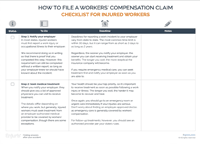 Workers’ Compensation Checklist
Download this checklist for injured workers to learn how to file a workers’ comp claim and track your progress.
Download in PDF format
How much does a Pennsylvania workers’ compensation attorney get paid?
Most Pennsylvania workers’ compensation lawyers only charge a fee if they successfully obtain benefits for your claim. In other words, if you don’t receive benefits, they likely won’t charge for their services.
The Pennsylvania Workers’ Compensation Act allows lawyers to charge no more than 20% of your compensation, except in special circumstances.
Pennsylvania workers’ compensation is an exclusive remedy
Workers’ compensation is an exclusive remedy, which means an injured employee may not choose to file a personal injury lawsuit rather than pursuing a workers’ compensation claim. This benefits both the employee and the employer.
For the employee, it means the no-fault benefits can be administered quickly, without a lengthy legal process involved in proving negligence. This means they can receive benefits faster and have their medical treatment bills and wages covered sooner.
For the employer, it means avoiding a lengthy, time-consuming, and costly litigation process.
The exception is a third-party lawsuit for a work-related injury. If the injury was caused by the negligence of a person or entity other than your employer, you could file a lawsuit against that party, but not your employer. The benefit to this is that if you had severe injuries that include pain and suffering, emotional distress, or other costs outside of medical treatment or wage loss, those damages could be included in a lawsuit but not in a workers’ compensation claim.
Do you need a Pennsylvania workers’ compensation lawyer?
It depends. If your claim is straightforward, there is no question that your injury was caused at work or was work-related, and your benefits are provided with no further medical treatment needed, then you likely don’t. But if you anticipate ongoing medical needs, additional time out of work, future complications, or your claim is not awarded in its entirety, you should call a workers’ compensation lawyer for guidance. Once you accept a benefit award, there is no going back for more—so it’s crucial that you anticipate your future needs and costs. Your lawyer can help determine what they will be and how much compensation you should receive.
Did you know that workers' compensation law varies by state?












Need a lawyer?
What’s the difference between workers’ compensation and personal injury?

The basis for personal injury law is fairly straightforward:
If you’re injured because of someone’s negligence, then you’re entitled to recover for your financial losses related to the injury.
The premise for the workers’ compensation system is similar:
Your employer is required to have specific insurance that provides benefits if you’re injured at work.