Learn how motorcyclists can recover damages following a motorcycle crash in the North Star State
There are more than 230,000 registered motorcycles in Minnesota. The state’s forests, prairies, and lakes offer motorcyclists plenty of spectacular views.
But riding a motorcycle is considerably more dangerous than riding a car. What’s more, there are some important differences between motorcycles and cars with respect to how insurance claims are handled.
In this article, we’ll take a look at motorcycle accidents in Minnesota, including the laws motorcyclists should know about, the options for recovering damages after a motorcycle accident, and how motorcyclists can combat motorcycle bias.
Motorcycle accident statistics
Motorcycle crashes have generally declined over the last decade in Minnesota, although the numbers fluctuate a little based on the length of the “riding season” each year.
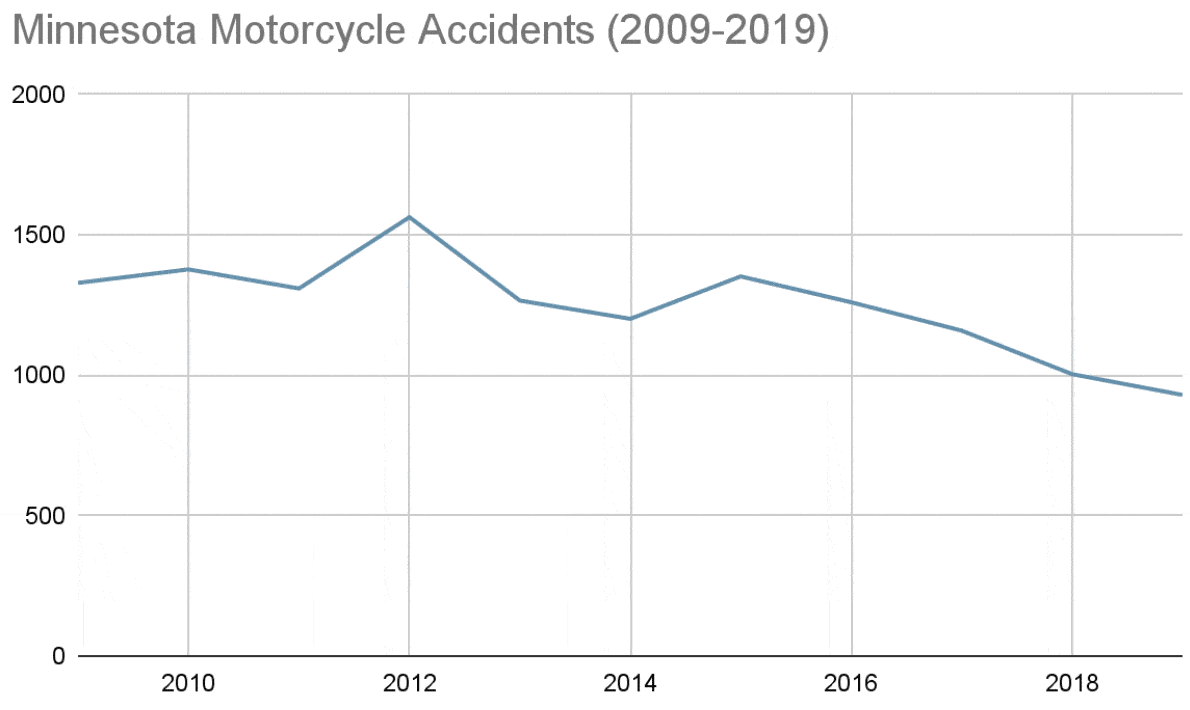
Compared to other states, Minnesota is a pretty safe place to ride your motorcycle. The fatal crash rate per 100,000 registered motorcycles across the country is nearly 60, but it’s 44 in Minnesota.
| Minnesota motorcycle accident statistics (2019) | ||
|---|---|---|
| Motorcyclists injured | Motorcyclists killed | Fatal crash rate (per 100,000) |
| 840 | 44 | 4.6 |
| Source: Minnesota Department of Public Safety (MDPS) | ||
In Minnesota, most motorcycle accidents are the result of colliding with another motor vehicle.
| Minnesota motorcycle crash by collision type (2019) | ||||
|---|---|---|---|---|
| Type | Fatal crashes | Injury crashes | Property-damage only crashes | Total crashes |
| Other motor vehicle | 13 | 313 | 81 | 407 |
| Parked motor vehicle | 2 | 5 | 5 | 12 |
| Pedestrian | 0 | 2 | 0 | 2 |
| Deer | 2 | 49 | 5 | 56 |
| Other animal | 1 | 26 | 0 | 27 |
| Fixed object | 12 | 112 | 9 | 133 |
| Non-collision | 13 | 255 | 25 | 293 |
| Source: MDPS | ||||
Minnesota motorcycle license requirements
You need a motorcycle license endorsement to legally operate a motorcycle in Minnesota.
The first step to obtaining an endorsement is obtaining a motorcycle instruction permit. To obtain a permit, you need to pass a written test at a driver examination station. The test is based on the Motorcycle and Motorized Bicycle Manual. If you’re under the age of 18, you must also complete the Basic Rider Course (BRC).
The motorcycle instruction permit is good for 1 year and you’ll be entitled to practice riding your motorcycle. There are some restrictions when riding a motorcycle with a permit. For example, you cannot carry passengers or ride at night.
Once you have obtained your motorcycle instruction permit and practiced riding your motorcycle, you must visit your nearest DMV and pass both the state written test and the riding skills test.
Motorcycle insurance requirements in Minnesota
Motorcyclists in Minnesota must also carry liability insurance in the following amounts:
- $30,000 for death or bodily injury to 1 person
- $60,000 for death or bodily injury to 2 or more persons
- $10,000 for damage or destruction of property
When you’re involved in an accident while operating your car in Minnesota, you file an insurance claim with your own insurance company to recover damages.
Unlike auto insurance policies, motorcycle insurance policies do not automatically include personal injury protection (PIP).
Consequently, if you’re involved in an accident while operating your motorcycle, you must file an insurance claim or personal injury lawsuit against the at-fault party to recover damages. With that being said, PIP coverage can be purchased separately in some cases.
Do I have to wear a motorcycle helmet in Minnesota?
Minnesota does NOT require helmets for riders who are at least 18 years old. Operators and passengers under the age of 18 must wear a DOT-approved helmet.
Although helmet laws can be (and are) debated, it’s indisputable that helmets save lives.
Data from the National Highway Traffic Safety Administration (NHTSA) suggests that motorcycle helmets are at least 29% effective in reducing fatalities. Unsurprisingly, 24 of 26 states that repealed their universal helmet laws over the last decade experienced an average 25% increase in motorcycle fatalities.
Other Minnesota laws impacting motorcyclists
Most of the laws impacting motorcyclists in Minnesota are found in Chapter 169 of the Minnesota Statutes.
Let’s take a look at the highlights:
| Equipment | Operation |
|---|---|
|
|
Recovering damages after a motorcycle accident in Minnesota
Minnesota motorcycle accidents differ from car accidents in 1 very important regard.
To drive a car in Minnesota, the driver must carry PIP insurance. PIP is a no-fault insurance policy, which means it provides coverage regardless of who’s at fault for an accident.
Accordingly, after a car accident in Minnesota, the driver files an insurance claim with their own insurance company under their PIP policy to recover damages. Only after their insurance is exhausted can they file a claim or personal injury lawsuit against the other driver (assuming the other driver was at fault for the accident).
Motorcyclists, on the other hand, are NOT required to carry PIP insurance. As a result, motorcyclists file an insurance claim or personal injury lawsuit against the at-fault party right off the bat.
Who’s at fault for a motorcycle accident?
The legal theory most often used to hold the at-fault party liable is negligence and it requires the plaintiff to establish 3 elements:
- The defendant owed the plaintiff a duty,
- The defendant breached their duty of care, and
- The breach was the legal cause of the plaintiff’s injuries.
Though motorcycle accidents are usually caused by a motorcyclist or a motor vehicle driver, that’s not always the case. There are a couple of other parties who may be liable for your accident:
- Property owners. Premises liability laws require property owners to maintain their property free of dangerous conditions. If a motorcyclist is injured as a result of a dangerous condition on someone’s property, the property owner may be held liable. This can include government agencies if the motorcyclist was injured due to a pothole or defect on a public road.
- Manufacturers. Product liability laws require that manufacturers avoid letting defective products hit the marketplace. If a motorcyclist crashes as a result of a defective product (such as a defective brake system), the manufacturer of the product may be held liable.
Curtis was charged criminally for failing to use the correct size trailer ball to fasten to the tractor and failing to attach a safety chain.
A civil wrongful death lawsuit is currently pending.
How long do I have to file a motorcycle accident lawsuit in Minnesota?
Minnesota limits the amount of time you have to file a personal injury lawsuit. This time limit is called the statute of limitations. The statute of limitations for most motorcycle accident cases is 2 years from the date of the accident.
What is motorcycle bias and how do I overcome it?
The term “motorcycle bias” refers to the ways in which motorcyclists are thought of by insurance companies, jurors, and judges. In short, many people see motorcyclists as reckless, dangerous, and even immoral individuals.
Unfortunately, even though most of us know stereotypes are far from the truth, you’ll still have to overcome motorcycle bias if you choose to file an insurance claim or personal injury lawsuit.
There are 3 ways to overcome motorcycle bias:
- Obtain evidence. Insurance companies, jurors, and even judges may presume you’re at fault for your accident just because you ride a motorcycle. The best way to overcome this presumption is to present strong evidence to the contrary. After an accident, be sure to collect witness information, take photographs of the scene and any injuries, and seek medical attention.
- Be respectful. Filing an insurance claim or litigating a motorcycle accident can be incredibly frustrating. This is especially true if you sustained a serious injury and are simply trying to recover money to pay your medical bills. No matter how frustrating the situation gets, it’s important to remain respectful when dealing with insurance companies, witnesses, and anyone else involved in the claim.
- Hire an attorney. Motorcycle accident attorneys understand motorcycle bias and how to fight it.
Ready to talk to an attorney about your motorcycle accident claim? Reach out to an experienced Minnesota attorney today using our free online legal directory.
Did you know that motorcycle accident law varies by state?











Need a lawyer?

What does an injury lawyer do?
A personal injury lawyer helps individuals who have sustained injuries in accidents to recover financial compensation. These funds are often needed to pay for medical treatment, make up for lost wages and provide compensation for injuries suffered. Sometimes a case that seems simple at first may become more complicated. In these cases, consider hiring an experienced personal injury lawyer. Read more