
Your bus doesn’t need to crash in order for you to be injured.
Maryland is known for its beaches, hills, parks, wildlife refuges, and mountains.
It’s also home to the first U.S. Naval Academy at Annapolis and was the site of the first station of the Baltimore & Ohio Railroad Company (B&O) in 1830.
Unfortunately, traveling around to take in all that Maryland has to offer might be one of the more dangerous activities you do. Whether you travel by car, truck, bike, train or bus, it’s important to understand what laws apply in the event of an accident. Bus passengers especially need to know about their rights in the event of a collision due to several unique factors.
Maryland bus ridership and accident statistics
Approximately 220,000 people commute from Maryland to Washington, D.C. for work. Marylanders have the longest average commute of U.S. residents, averaging about 32.5 minutes to get to work each day. About 140,000 people commute into Baltimore City, more than half of whom travel from within Baltimore County. (source)
The Maryland Department of Transportation/Maryland Transit Administration (MTA) reports that buses provide between 5 and 6 million rides each month. Ridership naturally ebbs and flows; it tends to be higher during the months when more students are in school and lower during the summer.
Overall, bus travel is extremely safe — much safer than driving your own car. And there are other benefits, too, such as spending less money on gas and maintenance, no parking hassles, and more time to relax, work, or think about other things besides driving.
Still, accidents do happen on occasion, though far less frequently than car accidents.
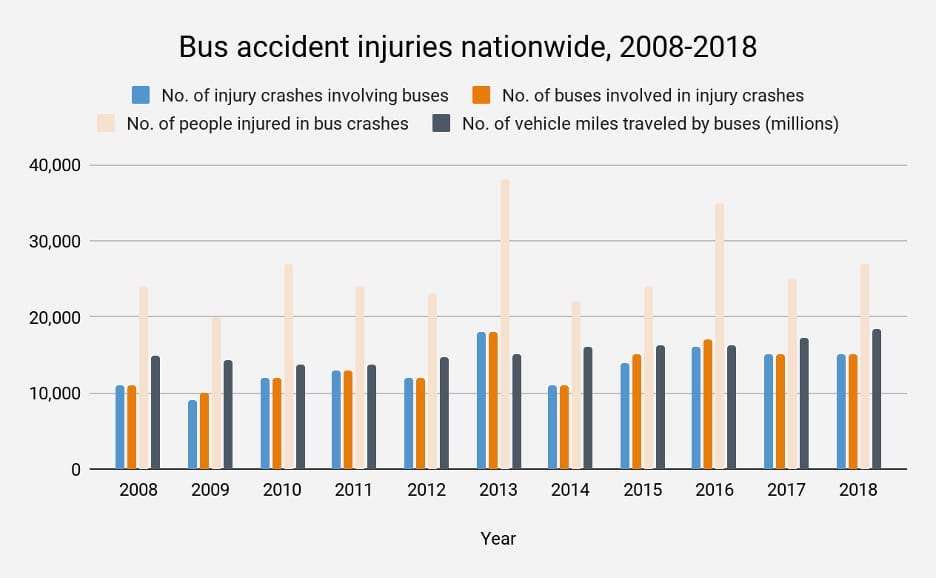
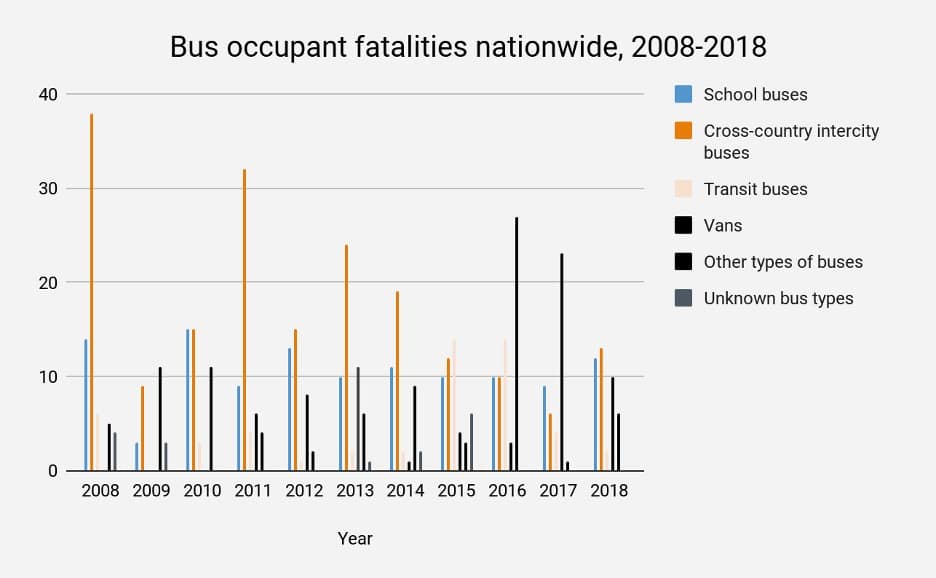
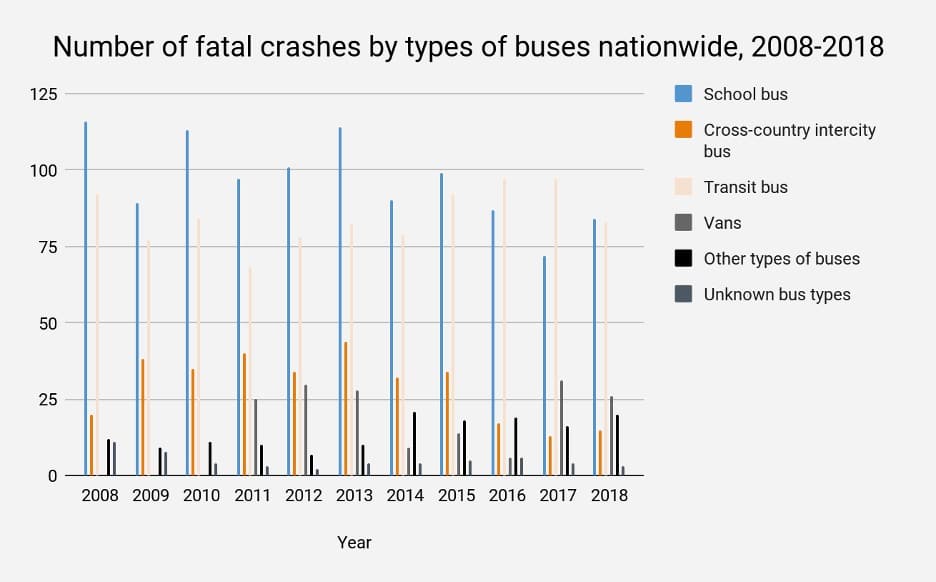
On a national scale, here’s how bus accidents stacked up from 2008-2018, as reported by the Federal Motor Carrier Safety Administration:
Types of bus transportation
The category “buses” encompasses several types of vehicles. These include:
- Public transportation buses (Maryland local bus and commuter bus services)
- Private bus lines (Coach, Megabus, and Greyhound)
- School buses
- Airport and hotel shuttle buses
- Private charter buses
- Tour buses
For the statistics above, the federal government also includes some larger-sized passenger vans as buses.
Bus accident injuries
There are a few ways you could be injured as a result of a bus accident. Crashes are only 1 of them.
Here are some examples of how you could suffer a bus-related injury:
- As a passenger when the bus collides with another vehicle or with a stationary object.
- As a passenger in a slip or trip and fall accident, even if the bus doesn’t crash. This could be while boarding or disembarking the bus or inside the bus (in the aisle, for instance).
- As a pedestrian or bicyclist who is injured in an accident involving a bus.
- As the driver or occupant of another vehicle that interacts with the bus on the roadway.
- As the bus driver.
Any traffic accident can result in an injury that could be very minor or very severe.
Common bus accident injuries
Bus accident injuries might include:
Common causes of bus accidents
Why do bus accidents happen?
A tip-over or rollover is more likely for a bus than a passenger car because of the height and distribution of weight within the vehicle. Adding to this risk is the fact that most bus passengers don’t wear seatbelts and buses don’t tend to be equipped with airbags. So even though bus accidents aren’t as common as car accidents, injuries are often more serious when a bus crashes.
Bus accidents are largely caused by the same factors that cause collisions between passenger cars and trucks, namely:
- Driver distraction or fatigue
- Drunk or impaired driving
- Location difficulties (little room to maneuver, especially in heavily populated or urban areas)
- Bad road conditions and poor weather
- Vehicle equipment defects
- Weight distribution problems (tipping hazard)
- Lack of proper driver training
Compensation for a bus accident injury
The premise of personal injury law is to make a plaintiff whole. While you can’t always be restored to the physical and emotional condition you were in before an accident, the law provides for a plaintiff to be restored financially to the position they’d be in if the accident hadn’t happened.
In other words, the legal system is designed to compensate an injured person for the financial costs associated with the accident. This includes:
- Medical treatment and ongoing therapies
- Lost wages, past and future (including loss of earning capacity)
- Compensation for emotional distress, including pain and suffering and loss of consortium
- Additional expenses related to daily life
- Property loss
But at the heart of any personal injury lawsuit is a determination of who’s at fault (that is, who’s liable) for the accident.
How Maryland determines fault (and why it’s important)
Maryland is an at-fault state.
An at-fault state is also known as a “tort” state. That means the financial costs of an accident or injury are covered by the insurance policy belonging to the person or entity at fault, or liable, for the crash.
This can be complicated in a bus accident because it might not be immediately clear who is at fault.
1. Bus accidents caused by other drivers
If a bus accident is caused by another driver, an injured passenger will have to prove that the other driver was negligent.
To prove negligence in Maryland, the injured passenger must establish that:
- The other driver owed the passenger a duty. All drivers owe all others on the road a duty to drive with a reasonable degree of care.
- The other driver breached their duty. To prove this, the passenger will have to show that the driver failed to drive with a reasonable degree of care. For example: Was the driver distracted, speeding, or driving under the influence of alcohol?
- The passenger was injured as a result of the driver’s breach. The passenger must show that the driver’s actions (such as texting, speeding, or driving under the influence) caused the accident. In other words, if it wasn’t for the driver’s actions, the accident wouldn’t have occurred and the passenger wouldn’t have been injured.
2. Bus accidents caused by bus drivers
If the bus accident is caused by the bus driver, the injured passenger has to prove that the bus driver was negligent. However, negligence is easier to prove when it comes to accidents caused by bus drivers because bus drivers are considered “common carriers” in Maryland. This means that bus drivers owe their passengers the duty to use the highest degree of care (as opposed to a reasonable degree of care).
To prove that a bus driver was negligent, an injured passenger must show that:
- The bus driver owed the passenger a duty. All bus drivers owe their passengers a duty to drive with the highest degree of care.
- The bus driver breached their duty. To prove this, the passenger will have to show that the bus driver failed to drive with the highest degree of care.
- The passenger was injured as a result of the driver’s breach. The passenger must show that the bus driver’s actions caused the accident. In other words, if it wasn’t for the bus driver’s actions, the accident wouldn’t have occurred and the passenger wouldn’t have been injured.
3. Bus accidents caused by the bus manufacturer or bus company
The bus company is responsible for fleet maintenance, driver training and screening, and company operations. If failure to follow any of these responsibilities causes an accident, the bus company would be liable.
When you purchase a car, usually it’s made in a factory by a single manufacturer that builds it from components also made by the same company. For example, if you have a Honda, it’s built with Honda parts.
But trucks and some buses are different.
A bus might have components made by several different companies. So if the accident happened because of brake failure, steering failure, or some other mechanical issue, the bus manufacturer and the manufacturer of the failed system could both be liable.
Common carrier doctrine
In addition, the common carrier doctrine means that the owner or operator of the bus is responsible for the following:
- Injuries caused by the intentional acts of the bus company’s employees, regardless of whether the act was within the actual or apparent scope of the employee’s authority. For example, if the bus driver assaults a passenger, the passenger can sue the owner of the bus and the owner would be held liable even though the bus driver’s actions clearly weren’t within the scope of their employment.
- Injuries from assault or abuse by other passengers or third parties. If the bus driver knows or should anticipate the danger of assault or abuse to a passenger, they have a duty to exercise the highest degree of care to protect the passenger. For example, if a passenger tells the bus driver that someone on the bus threatened them, the bus driver has a duty to protect the passenger (by, for example, removing the threatening party from the bus).
School bus accidents
The Transportation Research Board (TRB) says the school bus is the safest way for students to travel back and forth to school.
“Students are about 70 times more likely to get to school safely when taking a school bus instead of traveling by car.”
– American School Bus Council
In fact, the most dangerous part of the school day “commute” is a student getting to and from the bus stop, and getting on and off the bus.
A school bus is designed with safety features that make them safer than a passenger car. For example, protective seats, high crush standards, rollover protection features, and high visibility can prevent a student from being injured in the event of a crash.
That said, school bus accidents can (and do) happen. Such cases are often highly complex due to the fact that a government agency—typically the local school district—is involved and may be partly or fully liable.
Bus safety and accident prevention tips
What can you do to prevent a bus accident or injury?
While avoiding a crash may be out of your hands as a passenger, bus accidents aren’t limited to just collisions. Often, injuries happen when a rider falls getting on or off the bus, or suffers another injury related to boarding or exiting the bus.
Here are 10 tips to keep yourself safe before, during, and after your bus ride:
- Arrive at the bus stop early or on time so that you’re not running to catch the bus.
- Wait until the bus is fully stopped and the driver opens the door before attempting to board.
- If there are other riders waiting, approach the bus patiently and in an orderly line.
- If you must cross the street, walk on the sidewalk or along the side of the road to a point at least 10 feet in front of the bus so the driver can see you. Wait until the driver motions you to cross.
- Use the handrails when boarding or exiting the bus.
- If you’re wearing loose clothes, bags with drawstrings, backpacks, or other gear, make sure that you’re keeping it close to your body to avoid getting stuck in the bus doors.
- Never walk behind a bus.
- As soon as you exit the bus, walk a safe distance of 10 feet from the bus until it pulls away.
- If you drop something while on a moving bus, don’t attempt to retrieve it. Let the driver know that there’s a loose object on the floor and retrieve it when the bus is stopped.
- If the bus has a seat belt, use it. Encourage your children to wear their seat belts on school buses when available.
Seat belt laws on buses
A federal rule established that after November 2016, all new motor coaches and certain classes of large buses must be equipped with seat belts. The rule doesn’t require seat belts to be retrofitted in buses manufactured before the rule went into effect.
You’re not required by law to wear a seat belt when one is available on a bus, but it’s a good idea to do so anyway.
What to do after a bus accident
The steps you take after a bus accident can mean the difference between recovering all the damages you’re owed and not recovering any compensation. Here’s what you need to do:
- Step 1: Seek medical attention. Your health should be your top priority. Even if you don’t think you were injured, it’s a good idea to see a doctor immediately after an accident. The symptoms of some injuries, including serious internal injuries, may not appear for hours or even days after an accident. What’s more, going to the hospital reduces the chances that the insurance company or defendant will successfully argue that you weren’t really hurt.
- Step 2: Call the police. Most bus drivers in Maryland are required to call the police after an accident. Even so, you should call the police yourself to make sure they’re notified. The police report can be a useful piece of evidence down the road.
- Step 3: Collect driver information. If the police arrive on the scene, they can help you collect this information. Otherwise, you’ll need to get the information yourself. Be sure to write down or take a picture of the pertinent information for all the drivers involved. This includes the driver’s name, contact information, insurance information, and license plate number.
- Step 4: Collect witness information. Bus accidents usually have lots of witnesses. The best time to collect their contact information is immediately after the crash. Though police will often collect this information, they may miss witnesses or fail to add their contact information to the police report.
- Step 5: Preserve evidence. Take pictures of the scene and any damages (including physical injuries).
- Step 6: Contact an attorney. The statute of limitations—or legal deadline to filing a personal injury claim—depends on whether the bus is government-owned or privately owned. To avoid missing this deadline, it’s important to contact an attorney as soon as possible. An experienced personal injury attorney can help you gather evidence, negotiate a fair settlement, and represent you through trial if necessary.
Need help finding the best attorney? You can visit Enjuris’ free law firm directory to locate and contact a Maryland bus accident lawyer for help resolving your claim.
See our guide Choosing a personal injury attorney.