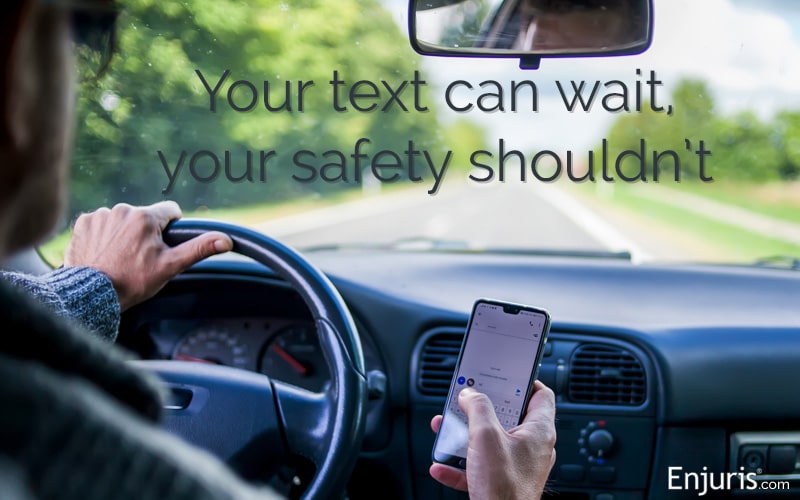
Legal resources for distracted driving accidents in Kansas
This article provides a comprehensive overview of distracted driving laws in Kansas, exploring the penalties for texting and driving, the exceptions to the rule, and the legal recourse available for victims of such accidents.
Distracted driving accidents take the lives of more than 3,000 people in the United States every year, according to the National Highway Traffic Safety Administration (NHTSA).
In this article, we’ll take a close look at what Kansas is doing to curb the number of distracted driving accidents, focusing on how these distracted driving laws may impact victims of such accidents.
What is distracted driving?
The term “distracted driving” refers to any non-driving activity that has the potential to distract a driver from the task of operating their vehicle and thereby pose a risk to the driver and others.
Distracted driving includes, but is not limited to, activities such as:
- Texting or using a handheld mobile device
- Eating or drinking
- Talking to passengers
- Adjusting the car stereo
- Using a navigation system
Most people understand the dangers of texting and driving but choose to do it anyway. One study found that 98 percent of motorists who own cell phones believe texting while driving is dangerous, but 75 percent of them text while driving anyway.
One of the reasons people may text while driving despite knowing the danger is that texting releases a small dopamine boost inside the human brain. According to Dr. Paul Atchley, the small chemical change impairs our judgment and overrides the known dangers of texting while driving.
Kansas law on texting and driving
Kansas law is particularly strict when it comes to texting and driving.
Under Kansas Statute Section 8-15,111, it’s illegal for any person to operate a motor vehicle while using a wireless communication device to write, send, or read a written communication. This prohibition expressly includes texting and emailing.
While this law applies to all drivers, there are some exceptions. These include law enforcement officers or emergency service personnel performing official duties, and drivers receiving emergency, traffic, or weather alert messages.
Penalties for texting while driving in Kansas
If a driver is found guilty of violating Kansas’ distracted driving laws, they may face the following penalties:
| Violation | Fine | License suspension |
|---|---|---|
| First violation | Up to $250 | 30 days |
| Second violation | Up to $500 | 90 days |
Of course, these legal penalties are insignificant when compared to the potential for causing harm—to yourself, your passengers, or other innocent road users. In a split second, a distracted driving incident can result in catastrophic injuries or even death.
Is it illegal to talk on the phone while driving in Kansas?
Kansas’ distracted driving laws only address texting and driving. The vast majority of drivers in Kansas face no limitations when it comes to talking on their cellphones while driving.
The exception is individuals with a learning permit (age range 14-17) who are prohibited from utilizing any form of wireless communication device while behind the wheel. To clarify, these young drivers are not allowed to engage in phone conversations (even on a hands-free device) while driving.
Although it’s not illegal for most drivers in Kansas to talk on the phone while driving, we don’t recommend it.
Using a mobile phone while driving, whether for talking or texting, has been shown to significantly increase the risk of accidents. A study from the University of Utah found that talking on a cellphone while driving can be as detrimental to one’s driving ability as driving under the influence of alcohol. Just like texting, talking on the phone diverts your attention from the primary task of driving, impeding reaction times and cognitive processing.
Distracted driving and personal injury claims
Car accident lawsuits are typically based on the legal concept of negligence.
In Kansas, negligence is defined as “the failure to exercise reasonable care to prevent harm to someone else on the road.” If the plaintiff can prove that the defendant was texting or engaging in some other distracting activity when the accident occurred, they can generally establish negligence.
What’s more, if the defendant received a citation for violating one of Kansas’ distracted driving laws, the defendant will be presumed negligent, and the defendant will have the burden of proving that they didn’t cause the accident. This is referred to as “negligence per se.”
Proving that the other driver was distracted can be challenging. It often requires a thorough investigation and the use of expert witnesses. Evidence such as phone records, witness statements, and police reports can be valuable in these cases.
Learn more about car accidents in Kansas, including how long you have to file a personal injury claim and what types of compensation you can expect to recover.
Steps to take after a distracted driving accident in Kansas
If you’ve been involved in a distracted driving accident, there are several steps you can take to preserve your rights and strengthen a future insurance claim or personal injury lawsuit:
- Seek medical attention. Always seek medical attention after a motor vehicle accident, even if you feel fine initially. Some injuries may not be immediately apparent, and an early medical record can be crucial evidence in a personal injury case.
- Report the accident. Under Kansas Statute Section 8-1604, you’re required to report any accident resulting in injury, death, or property damage over $1,000 to the Kansas Department of Transportation within 10 days of the accident. If a police officer is called to the scene of the accident, there is no requirement to make a report.
- Document the scene. If it’s safe to do so, take photographs of the accident scene, including the vehicles involved, skid marks, and any visible injuries. Gather contact information from any witnesses.
- Consult with a personal injury attorney. A knowledgeable personal injury attorney can help you understand your rights, gather necessary evidence, and negotiate with insurance companies to ensure you receive the compensation you deserve.
- Avoid posting on social media. We live in a world where our lives are documented on our social media platforms, but posting about an accident is almost always a bad idea. Insurance companies and defense attorneys can and will use your social media posts against you.
See our guide Choosing a personal injury attorney.