Here’s how to determine jurisdiction for an injury that happens in the air
If you think about aviation accidents in Washington, D.C., you might recall 2 well-known local air disasters:
- American Airlines Flight 77, which crashed into the Pentagon after being hijacked on September 11, 2001; and
- Air Florida Flight 90, which crashed into the 14th Street Bridge and into the Potomac River on January 13, 1982.
Fortunately, plane crashes are rare.
In fact, though rarely reported, the vast majority of aviation accidents are injuries that happen around or in planes and airports, not actual crashes.
In Washington, D.C., aviation accidents are even more unlikely because there are no airports that are physically located within the District boundaries. However, there are 3 major airports in the D.C. region—including Ronald Reagan Washington National Airport (DCA), Washington Dulles International Airport (IAD) and Baltimore/Washington International Thurgood Marshall Airport (BWI).
Let’s take a look at the types of aviation accidents and what courts have jurisdiction over personal injury claims.
Types of aviation accidents
While there’s a wide range of accidents that could happen when flying, these are the most typical types of airborne incidents that result in injuries:
- Inflight injuries and turbulence
- Runway accidents
- Small plane crashes
- Helicopter or plane tour crashes
- Drone crashes
- Charter plane crashes
- Mid-air collisions
- Plane crashes into a house or building
What is general aviation?
“General aviation” (GA) is the term applied to small planes. This would include any non-commercial flights. Most plane crashes are general aviation accidents. General aviation includes all civilian flying except passenger airlines.
GA aircraft include:
- Single engine
- Multi-engine
- Turbo prop
- Turbo jet
- Rotorcraft
- Experimental (amateur-built)
- Light sport aircraft
Why do small planes crash?
The most common causes of small plane accidents are:
- Pilot error
- Defective runways
- Mechanical failure
- Design defect or failure
- Air traffic control error
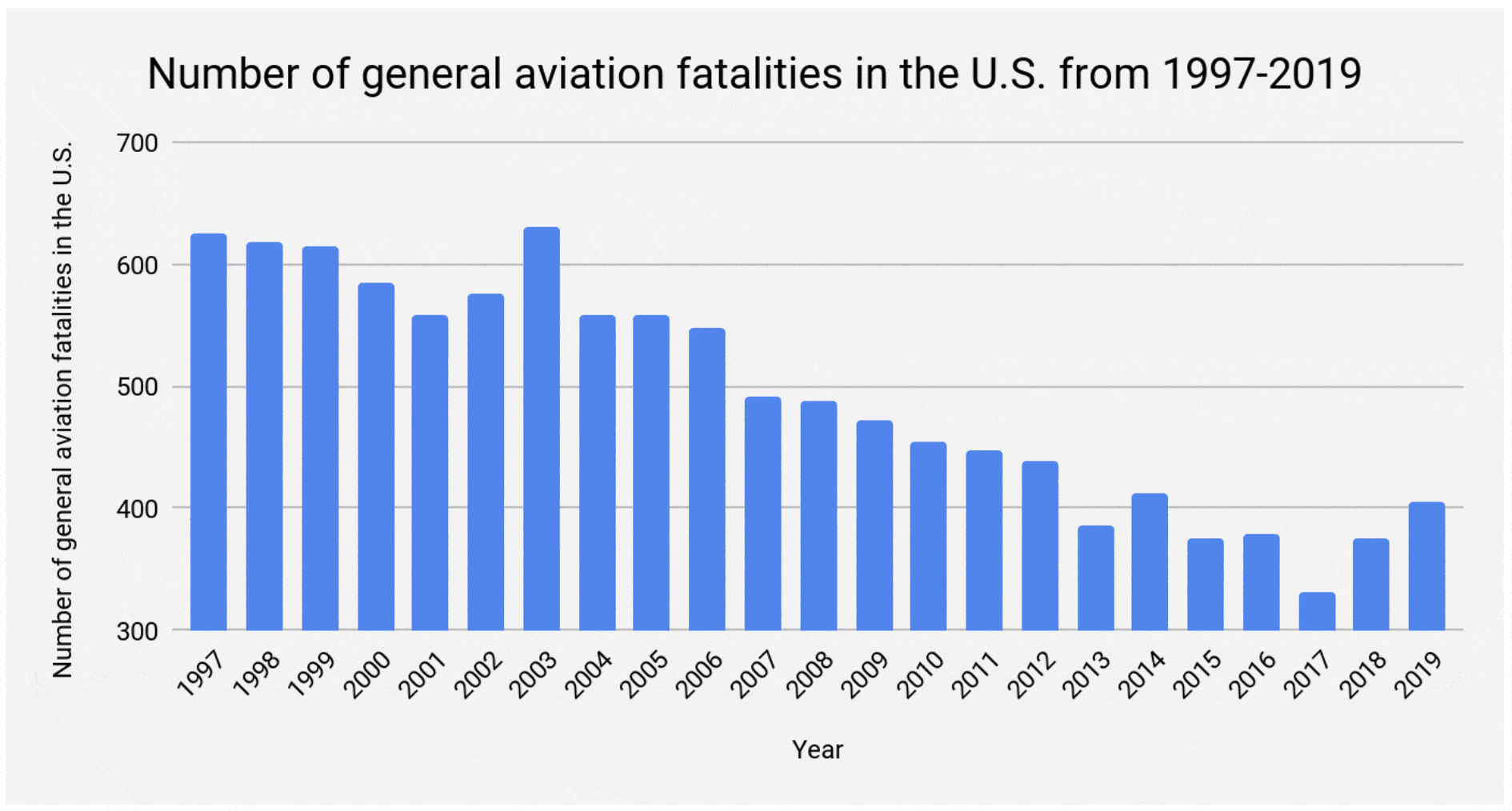
As of this publication, there has not been a fatal U.S. passenger airline crash since February 2009. (source)
By contrast, there have been a number of general aviation fatalities:
Top 10 causes of fatal general aviation accidents
The Federal Aviation Administration (FAA) lists the most common causes of general aviation accidents as follows:
1. Loss of control in flight
There are many reasons why a pilot might lose control. These could include weather, pilot error or inexperience, stalls, or any other condition. Essentially, a loss of control means the plane has deviated from the region in which it can operate safely.
2. Controlled flight into terrain
This is when a plane collides with land, water, or some other obstacle without a signal that the pilot has lost control. This can happen because of a problem with visual contact, pilot disorientation, weather, or procedural mistakes.
3. Engine system component failure
This could happen when all or part of a power plant (including pistons, fans, gearbox, transmission, power plant controls, propellers, and other parts) fail, leaving the plane unable to be controlled.
4. Fuel-related problems
Often, this is not a defect but rather a miscalculation. It could be a miscalculation of the amount of fuel necessary for a trip or not knowing the type of fuel needed for the particular aircraft. Either way, it can lead to engine failure.
5. Unknown
Statistics include records that are kept even when there’s no clear answer to what happened. Sometimes, plane wreckage is not recoverable because it’s in the water, has been destroyed beyond recognition, or evidence is missing for some other reason.
When the FAA or the National Transportation Safety Board (NTSB) can’t determine the cause of an accident, it is classified as “unknown.”
6. Non-power plant component failure
System components failures could include software, databases, maintenance, controls, tail rotor drives, rotorcraft cycles, or parts that separate from the plane.
7. Unintended flight in instrument meteorological conditions
Some weather conditions could force a pilot to refer to instruments to navigate because they lose visibility. That means the pilot is flying under instrument flight rules rather than visual flight rules.
Aviation accidents sometimes happen because the pilot was using only visual flight rules and loses visual references. They could be either untrained or unqualified to fly using instruments only, or they could be flying an aircraft that is not equipped to fly with instruments only.
8. Midair collisions
When 2 planes (or other types of aircraft) collide during flight, it could be a disaster. Most midair collisions happen near an airport because of heavy air traffic.
9. Low-altitude operations
A pilot might intentionally fly at low altitude, which means the plane is close to Earth, water, or other objects. Sometimes, accidents happen during tours because the pilot is trying to allow passengers ideal conditions for sightseeing, do some “fancy” maneuvering, or for some other reason.
10. Other
The difference between “unknown” and “other” is that an unknown accident means the investigators can’t figure out the cause. “Other” includes accidents with known causes that don’t fit into any other category (for example: bird strikes, onboard fires, etc.).
Liability for a Washington, D.C. plane accident
The primary causes of plane accidents are pilot error, mechanical failure, design defect, air traffic control error, and defective runways.
The legal doctrines used to determine who is liable (at fault) for the accident are:
- Common carrier law
- Negligence
- Strict liability
Common carrier liability
If you’re in a plane crash or any aviation accident that involves a commercial airline, the company has a heightened duty of care to passengers because an airline is a “common carrier.” A common carrier is any mode of transportation that’s offered a service to the public and has a higher duty of care for safety — including buses, taxis, cruise ships, etc.
Whether or not the crash was a general aviation aircraft or a commercial plane, there are usually 2 possible causes of action for a plane crash: negligence and strict liability.
Negligence
A flight crash investigation could take months. Regardless of whether lawsuits are filed, the FAA and the NTSB investigate all plane crashes because they want to know what went wrong in order to prevent future accidents.
Negligence is when a person or entity causes injury by creating a hazardous situation or failing to avoid a hazard to another person.
In a plane crash, negligence could be attributed to the following parties:
- Pilot
- Grounds or flight crew or maintenance company
- Plane parts manufacturer
- Plane owner
- Federal government / air traffic controllers
Why would you sue the federal government for a plane crash?
The federal government employs air traffic controllers to direct and guide pilots through the airspace. If they make a mistake that results in a crash, the government could be the negligent party.
Strict liability
You might have a strict product liability claim if the reason for the accident was equipment or mechanical failure. If that happened, the defendant would be either the manufacturer of the plane itself or the manufacturer of one of the plane’s components.
In general, a defective product case could be for:
- Design defect. A design defect occurs when a properly made product is dangerous in the way it was designed, and a product doesn’t perform as expected when used in the manner in which it was intended.
- Marketing defect. This would involve a part or process that doesn’t have the correct warnings (failure to warn) or instructions.
- Manufacturing defect. The product was safe as designed, but it was manufactured improperly and the result didn’t reflect the intended design.
However, if you work for an airline and are injured within the jurisdiction of Washington, D.C., you should consult a lawyer to see where you should file your claim. Some workers’ compensation coverage includes claims from other states (or the District) and some do not, so your individual circumstances could become important.
Jurisdiction for a personal injury during flight
Sometimes, accidents can happen in flight that leave you with an injury.
Some common in-flight injuries are:
- Luggage falling from overhead compartments
- Slippery condition in the aisle from spills
- A “runaway” food or beverage cart that slides into a passenger
- Hot beverage is spilled on a passenger
When you’re injured on land, you normally file a lawsuit in the state where the injury happened. In the air, it’s a little different. An international treaty called the Montreal Convention governs personal injuries or deaths of passengers on an international flight. The treaty makes an airline strictly liable for an injury that happens in flight.
A domestic flight is governed under the federal Department of Transportation and local or state laws. Generally, establishing jurisdiction for a domestic flight would depend on the departure and arrival jurisdictions, as well as the location where the accident occurred.
Again, because Washington, D.C. does not have an airport situated within the District, there are not likely to be many personal injuries where the District would have jurisdiction.
Damages for personal injuries in a Washington, D.C. aviation accident
“Damages” are costs related to any personal injury. The theory of personal injury civil lawsuits is that a plaintiff (the injured person) is entitled to be made whole through the court system. In other words, you can recover financially to restore you to the position you’d be in if the accident had never happened.
If you survived a plane crash, you can recover damages that include:
- Medical treatment costs, including surgeries, hospital stays, adaptive devices, prescription medications, doctor visits, and any other related expenses.
- Pain and suffering, which includes emotional distress and anguish, PTSD, and other effects of the trauma. (You can also make a claim for pain and suffering of the deceased person in a wrongful death lawsuit.)
- Property loss, if your home or property was damaged as a result of a nearby plane crash.
- Lost wages or future earning capacity, if your injuries limit your ability to work or you lost time as a result of the crash.
- Loss of consortium, which is the loss of love and companionship of a family member who was lost in a crash.
- Punitive damages, which courts can award to punish and deter misconduct that’s intentional, malicious, or fraudulent. This might be applicable if, for example, the pilot was intoxicated or especially reckless.
If you were injured in an aviation accident in D.C., you should contact a personal injury lawyer as soon as possible to better understand your rights—particularly if there are complicated issues for determining jurisdiction, if there’s more than 1 defendant (or if you’re not sure who’s at fault), or if you were severely injured. An aviation injury attorney is the best person to help you figure out your next steps.
Not sure where to start? You can use the Enjuris law firm directory to find a Washington, D.C. personal injury lawyer who can help you obtain compensation for your injuries.
See our guide Choosing a personal injury attorney.