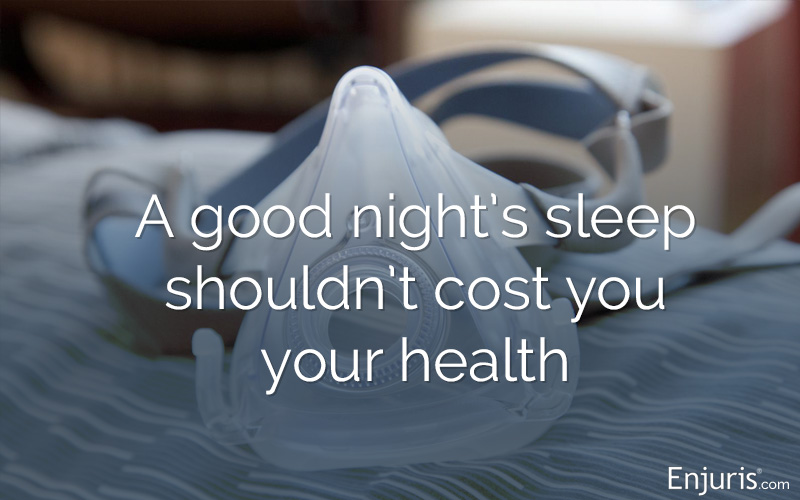
Common sleep apnea treatment is subject to a large lawsuit for cancer risks and other symptoms
People who experience obstructive sleep apnea or similar sleep disturbances might benefit from using what’s called a CPAP machine, which stands for continuous positive airway pressure.
While this is a common and effective treatment for a serious health concern, there have been recent lawsuits and recalls for defective CPAP machines, and you should know if you could be affected.
Obstructive sleep apnea and CPAP treatment
Obstructive sleep apnea is a condition in which a person repeatedly stops and starts breathing while they’re asleep. The person’s throat muscles relax and block the airway intermittently, which is why one of the most common symptoms of obstructive sleep apnea is snoring.
Other symptoms include:
- Excessive fatigue or sleepiness during the day
- Abrupt awakening with gasping or choking
- Dry mouth or sore throat when awakening
- Morning headaches
- Decreased libido
- High blood pressure
- Difficulty concentrating
- Depression, irritability or other mood changes
Even if you don’t experience any of these symptoms, there are long-term effects that obstructive sleep apnea can have on your overall health. The condition could lead to cardiovascular problems, complications with surgeries or medications, glaucoma or other eye conditions and memory problems.
Sleep apnea has also been noted as a possible risk factor for severe COVID-19. People who become ill with COVID-19 who have obstructive sleep apnea are more likely to require hospital treatment.
CPAP therapy
A CPAP machine delivers pressurized air into a person’s mouth while they sleep to keep their breathing passages open and decrease the likelihood of choking or gasping during the night. The machine has a fan that draws in the outside air (that is, the air in your bedroom) and filters and purifies it. The physician who prescribes CPAP therapy will determine each patient’s appropriate pressure level.
A BiPAP machine (bi-level positive airway pressure) is similar to a CPAP. The patient wears a mask or nasal plugs connected to a ventilator in order to push air into the lungs. This type of machine sends positive air pressure when the wearer breathes in and out, but they receive higher air pressure when they breathe in. A CPAP machine, by contrast, delivers the same amount of pressure when the user breathes in and out.
Patients must undergo a sleep study to determine which type of machine or therapy would be best suited to their condition.
CPAP class action lawsuit
CPAP therapy is a well-established treatment for a fairly common condition.
But that’s not the end of the story. The FDA announced a Class I medical device recall in June 2021 for Philips ventilators, CPAP machines and BiPAP machines.
A Class I recall involves a reasonable probability that the use of or exposure to a product will cause serious adverse health consequences or death.
The problem with CPAP and BiPAP machines
The recall of Philips CPAP and BiPAP machines is because the polyester-based polyurethane (PE-PUR) foam that the machines use to reduce noise can break down. When the foam breaks down, there are chemicals that could be breathed in or swallowed by the user.
These chemicals are VOCs, or volatile organic compounds.
VOCs raise the user’s risk for:
- Headaches
- Dizziness
- Exposure to toxins that cause cancer
- Irritation to the eyes, nose, airway or skin
- Nausea or vomiting
- Hypersensitivity, such as an allergic reaction or other immune reaction
There are also tiny pieces of black foam that can break down and travel through the device’s air tubes and be swallowed or inhaled.
Inhaling or swallowing this black foam could cause:
- Toxic or cancer-causing effects on the kidneys, liver or other organs
- Inflammation
- Asthma
- Headaches
- Irritation to eyes, nose, airway or skin
You can view a list of recalled models to see if yours is affected.
Who is eligible for the class action lawsuit for CPAP or BiPAP machines?
Maybe you are.
A class action lawsuit is brought on behalf of a group of people (the “class”) who have suffered common injuries because of the defendant’s negligence.
A class action benefits the plaintiffs because they require only one set of witnesses, experts, issues, documents, etc. If the court finds that the defendant is liable, then they are liable to each plaintiff. That means the plaintiffs don’t need to each bear the expense, time and effort of pursuing separate litigation.
If the defendant owes damages to the plaintiffs, they receive a fair distribution. On the contrary, when plaintiffs file separate claims, the first several plaintiffs might receive the whole “jar” of insurance proceeds or assets, and there would be nothing left for the later plaintiffs.
A multi-district litigation (MDL) lawsuit is similar to a class action because it combines multiple federal lawsuits into a federal case. Like in a class action lawsuit, the court will decide on common questions of fact.
Sometimes an MDL panel will choose to consolidate the claims into a class action. In other situations, plaintiffs might recover different amounts of damages depending on the nature of their individual injuries, but that hinges on the same set of facts, evidence and defendant’s liability.
Here’s a brief summary of CPAP lawsuits and ongoing legal actions:
| Timeline | Legal action |
|---|---|
| June 2021 | FDA issues the first recall for more than 3 million CPAP and BiPAP machines. |
| September 2021 | FDA approves a program for Phillips to repair specific devices. |
| November 2021 | A panel agrees to form a multi-district litigation (MDL) class action lawsuit based in Pennsylvania. The 114 pending CPAP lawsuits are transferred to the Pennsylvania court, as would any further federal CPAP lawsuits. |
| November 2021 | The FDA withdraws its approval of the repair and replace program after new evidence reveals that silicone replacement foam could also present health issues, so the program has to be halted. Evidence emerges that Philips was aware of safety hazards from the PE-PUR foam and ignored the risks for 6 years. |
| January 2022 | There are 11 lawsuits pending against the SoClean CPAP cleaning machine, claiming that it releases unsafe levels of ozone that could cause respiratory problems for users. Each of the 11 lawsuits is a class action that represents thousands of plaintiffs. |
| February 2022 | The MDL panel does not consolidate the SoClean lawsuits, but they are sent to the CPAP class action lawsuit judge because the issues are so closely related. |
| March 2022 | The Philips CPAP MDL approves an agreement allowing a user of a recalled Philips CPAP machine to preserve their right to sue even after the statute of limitations on their claim expires. |
| March 2022 | The FDA scolds Philips for providing inadequate notice to patients about recalls. |
| May 2022 | New evidence suggests that some users of CPAP masks have developed skin cancer on the face where the mask touches. |
| May 2022 | A wrongful death lawsuit is filed for a death related to CPAP use. Plaintiff Doug Shiffler claims that his wife, Joleen, used the CPAP each night. After 2 years of use, she was diagnosed with Stage IV lung cancer, and she subsequently passed away. Shiffler’s lawsuit claims her death was the direct result of toxic foam particles from her CPAP machine. The case will eventually become part of the Pennsylvania CPAP class action. |
| July 2022 | Pretrial discovery is underway, so the class action lawyers and defendant Philips may begin to seek and review documents related to the case for tens of thousands of plaintiffs. It’s likely that the company will eventually offer a settlement. |

How long will my injury claim take?
What’s the settlement process for a lawsuit? A visual guide to the stages of a personal injury lawsuit and how long it takes from start to finish…
What should you do if you use or have used a recalled CPAP machine?
As with any medical concern, the 1st step is always to contact your doctor.
Verify with your doctor that your machine is a recalled model. The doctor will ask you if you’ve suffered any symptoms or been diagnosed with any illness or condition that’s related to the subject of the recall.
If you’re using a recalled CPAP device but haven’t yet suffered illness or harm, you would be entitled to participate in the fix or replace program offered by the manufacturer. You can participate in the class action lawsuit if your CPAP or BiPAP device has caused you to suffer an illness or injury that’s related to the product recall.
Unfortunately, simply using a CPAP device does not necessarily qualify you for a class action lawsuit. You would still need to prove that you suffered an injury or harm from the device to recover damages. However, the court has extended the typical statute of limitations (deadline) in this case. Therefore, if you suffer an injury after the deadline would normally have passed for a product liability lawsuit, you might still be able to recover damages later.
The next step is to contact a medical device liability lawyer. Personal injury law includes product liability claims, which are lawsuits for injuries that are caused by a defective item or device. Your lawyer will guide you through the process of joining a class action lawsuit or pursuing compensation another way if necessary.
You can find a lawyer to help with your CPAP recall class action lawsuit claim by using the Enjuris law firm directory.

Costco Chargers to be Replaced After Recall
Recent recall draws attention to dangerous device charger that has caused fires during use.