

If you’ve been involved in a motor vehicle crash or incident in Pueblo, Colorado, it’s important to obtain the official crash or incident report. You might need it for insurance, legal proceedings, or personal records. The guide below sets forth what you will need and how to request a copy of the relevant reports.
Determine which agency has the report
If you’re going to request a report, you need to make the request to the agency that has the report. The first step in figuring this out is to determine which agency or jurisdiction responded to the crash or scene of the incident.
If the accident was within the Pueblo city limits, it was likely handled by the Pueblo Police Department (PPD). You may request an accident report directly from that agency.
If the accident was in an unincorporated part of Pueblo County or was under the purview of the Pueblo County Sheriff’s Office (PCSO), you would request from that department.
A crash on a state highway that was responded to by a state trooper from the Colorado State Patrol would likely be subject to the state crash records process.
You might not remember or have been aware of which agency responded to an incident or accident. If you received a citation, the information would be included in that document. If not, you could contact PPD or PSCO to inquire about your case number. They should be able to assist you in reaching the correct department.
Understand the Pueblo crash reporting system and recent changes
All minor traffic crash reports in Pueblo must be submitted through the state crash-reporting website; they may not be submitted in person. This policy went into effect in March, 2025.
These minor crashes include those without personal injuries, where vehicles can be removed, the parties have exchanged information, and there could be private property accidents or wildlife involved. The reports are made online through the Colorado Department of Motor Vehicles “Report a Crash” system.
If it’s a serious crash that involved personal injury, incapacitated vehicles, commercial vehicles, and other factors, you will likely need to contact the responding agency directly.
Colorado requires parties to report any accident that involves death, injury, or property damage within ten days.
How to request a report from the Pueblo Police Department
- If your accident can/must be requested online, you can use the PPD Police to Citizens (P2C) portal at no charge. By following prompts at “Get a Crash Report”, you may complete the requested information and receive a printable report.
- There are other types of records, such as traffic accident counter-reports, available by walk-in at the PPD Records Section. These are available at 200 S Main St., Pueblo, CO 81003. You may acquire a police report for $5 for the first 15 pages, and other reports listed here.
How to request a report from the Colorado State Patrol
If the crash occurred on a state highway, or was handled by Colorado State Patrol (CSP), or is a minor crash that parties file online (rather than officer-investigated), the state DMV crash-records system applies.
- Visit “Report a Crash and Obtain a Crash Record” on the DMV site.
- You might be required to complete Form DR2489 (Requestor Release and Affidavit of Intended Use) and pay a fee.
- If no police officer responded to the crash (for instance, it was a minor collision that can be filed online), you may file and retrieve the report online.
It could take up to 90 days for data entry and availability after filing a report.
Steps to take immediately following a crash
Even before a report is requested, you can take a few steps to ensure you’re retrieving the correct document and preserving your legal or insurance options.
- If there’s a responding officer or agency at the scene, ask for the report number.
- Exchange contact and insurance information with each involved party.
- Photograph the scene, including vehicle damage, positions, and weather conditions or other relevant images.
- If there are witnesses, collect contact information. If you’re close to a business or residence, inquire whether there could be video camera footage of the accident.
- Notify your insurance company as soon as possible after the crash. Even if you’re not planning to use your insurance for damage coverage, it’s important to make a report. A report is not the same as a claim. However, if you decide later to make a claim (for instance, if the damages end up to be more costly than you anticipated), you could be prevented from doing so if you did not file a report right away.
- When you receive the report, keep a copy for your records and for insurance or legal action.
FAQ: Obtaining reports and records for a Pueblo accident
Is there a cost?
If you’re acquiring a report from the PPD through P2C, there is no cost. If you need a walk-in copy, there will be a fee. There will also be fees (listed on the website) for PCSO reports.
How soon will a Pueblo accident report be available?
This depends on the agency and whether the crash required investigation. The state system could take up to 90 days.
What if the crash was in Pueblo County but not the city of Pueblo?
In that situation, you’d likely look to PSCO or the state system for the report, but not PPD.
Can I use the report for a personal injury lawsuit or insurance claim?
Yes! Those are the primary reasons to obtain a report. It can be critical evidence in a claim.
What if the crash involves private property, wildlife, or very minor damage?
The PPD directs crashes involving minor injuries, property damage, or wildlife to the state reporting website. It’s important to obtain a report for these types of crashes, as well. They can protect you if someone else decides to make a claim against you.
Why is it important to get a police report after a crash?
- Provide an official, neutral account of the crash. A police report gives an unbiased, third-party description of what happened, which is crucial when drivers disagree about fault.
- Establish a verified record of key details. Officers document the date, time, location, road conditions, weather, vehicle positions, and statements from drivers and witnesses. These details often get forgotten or disputed later.
- Help determine fault and liability. While officers don’t always assign fault, insurers and courts rely heavily on diagrams, witness statements, and officer observations to understand how the crash occurred.
- Strengthen your insurance claim. Most insurance companies request—or even require—a police report, especially when injuries or significant damage are involved.
- Prevent the other driver from changing their story. A report captures statements made at the scene, which reduces the chances of someone later denying responsibility or giving conflicting accounts. Or, if they do, it diminishes their credibility.
- Document the injuries or damage at the scene. Even if injuries seem minor, the report can note complaints of pain, visible injuries, or EMS involvement. This becomes critical if symptoms worsen later.
- Help maintain contact information for all parties. If the other driver provides false information or leaves before exchanging details, the report can include vehicle descriptions, license plates, or officer-gathered contact info.
- Required for legal action or insurance. Some insurance policies and state procedures require crash documentation for claims above certain thresholds or for hit-and-run collisions. Colorado gives parties ten days in which to report any accident that involves death, injury, or property damage.
- Preserve evidence. Skid marks, debris fields, and vehicle positions are temporary. They can be erased when the scene is cleared, or because of weather conditions. Officers document these immediately, which creates a snapshot of the crash scene.
- Protect you from fraud. A report guards against staged accidents, exaggerated claims, or situations where the other driver later blames you. For instance, if you’re involved in a minor fender-bender, this would be noted on the accident report. However, if there’s no report, the other driver could claim far more extensive damage, which could lead to much higher expenses for you.
- Provides heightened documentation if necessary. If the crash involves minors, government vehicles, or commercial trucks, these are considered “special parties” and they require additional documentation. A police report ensures compliance with reporting rules.
- Aid in memory and claim consistency. The legal process isn’t always fast. Memories fade, recollections become fuzzy, and sometimes a person’s memory of an event even changes over time. It’s not intentional deception, but the human brain is imperfect and sometimes it alters perceptions over time.
- Might speed claims process. Insurers often process cases faster when documentation is clear, thorough, and already verified by law enforcement.
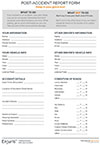 Accident Report Form
Sample post-accident report form to keep in your glove box - fill out at the scene or as soon as you can after a car accident
Download in PDF format
See our guide Choosing a personal injury attorney.