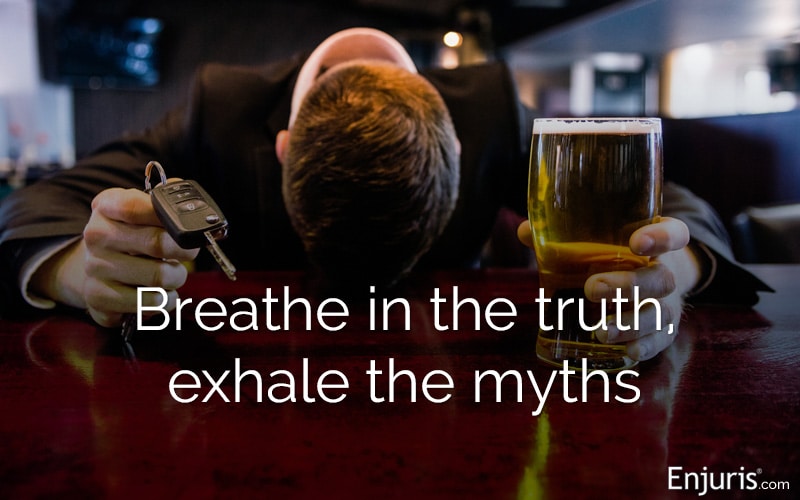
Drunk driving is a reality that, hopefully, most people will never experience first-hand. Nevertheless, the statistics are alarming: according to the National Highway Traffic Safety Administration (NHTSA), one person dies every 52 minutes due to a drunk driving accident in the United States.
Given these sobering facts, it’s important to have a clear understanding of the most common tool used to enforce driving under the influence (DUI) laws. Despite this, myths about breathalyzer tests abound. So, let’s debunk the top seven misconceptions and shine some light on the truth behind these important devices.
Myth 1: You can refuse a breathalyzer test without consequences
The first misconception is that you can refuse a breathalyzer test without legal consequences.
All 50 states have implied consent laws, which require anyone who operates a vehicle in the state to submit to a breathalyzer test if they’re stopped by a law enforcement officer who has reasonable grounds to believe the person has been driving while under the influence of alcohol or drugs.
It’s true that you can technically refuse to take a breathalyzer test, but you’ll face automatic legal consequences if you choose to do so. This could mean a fine, license suspension, or even jail time, depending on the jurisdiction. What’s more, in most cases, evidence of a refusal can be used in court to support a DUI conviction.
Myth 2: Breathalyzers always provide accurate readings
Although breathalyzers are generally reliable, they are not infallible. The accuracy of a reading can be affected by a number of factors, including:
- Operator error
- Poor maintenance
- Software glitches
- Individual variations
According to one investigation, more than 30,000 breathalyzer tests taken over a 12-month period in Massachusetts and New Jersey were invalidated because of human errors and inadequate governmental oversight.
Learn more about the accuracy of breathalyzer tests, including the science behind the tests and the factors that can lead to an inaccurate reading.
Myth 3: Eating certain foods and other tricks can lower your BAC
If you spend just a few minutes searching the Internet, you’ll find dozens of ways to lower your BAC before taking a breathalyzer exam. Here are some of the more common purported ways:
- Eating strong-smelling foods
- Eating gum or a breath mint
- Consuming coffee or water
- Exercise or physical activity
- Vomiting
- Holding your breath or hyperventilation
- Taking a shower
None of these tricks work.
The reality is that your BAC is determined by factors like the amount of alcohol consumed, your weight, and how quickly your body metabolizes alcohol. The only thing that will reliably drop your BAC is time.
On average, your BAC will drop .015 per hour without any additional alcohol consumed. Some factors, such as your gender, medications, and certain illnesses, may cause your BAC to fall more slowly.
Myth 4: Breathalyzer tests are only administered on motor vehicle drivers
Breathalyzers are most commonly used on motor vehicle drivers, but they can also be used on bicyclists, as well as operators of other types of vehicles, such as boats and planes.
The laws surrounding drinking and cycling vary across states. It’s important to familiarize yourself with local regulations to stay informed and safe.
Myth 5: All breathalyzers are created equal
There are many different types of breathalyzers, each with varying levels of accuracy. Basic models used by consumers tend to have a higher margin of error, whereas sophisticated evidential breathing testing devices (EBTs) used by law enforcement tend to be more accurate.
Myth 6: A police officer needs a warrant to administer a breathalyzer test
A breathalyzer can be administered without a warrant because it’s considered minimally invasive. On the other hand, a police officer needs a warrant to administer a blood test, except in some rare situations when there’s not enough time to get a warrant.
Myth 7: Breathalyzer results are the only evidence used in DUI cases
Breathalyzer results carry a lot of weight in DUI prosecutions. However, it’s common for prosecutors to bolster their case with additional evidence, including field sobriety test results, officer testimony, and witness testimony.
Understanding breathalyzer tests and their legal implications is a crucial part of informed decision-making. Unfortunately, misinformation is everywhere. Remember, the best way to avoid a DUI is not to drive if you’ve been drinking.