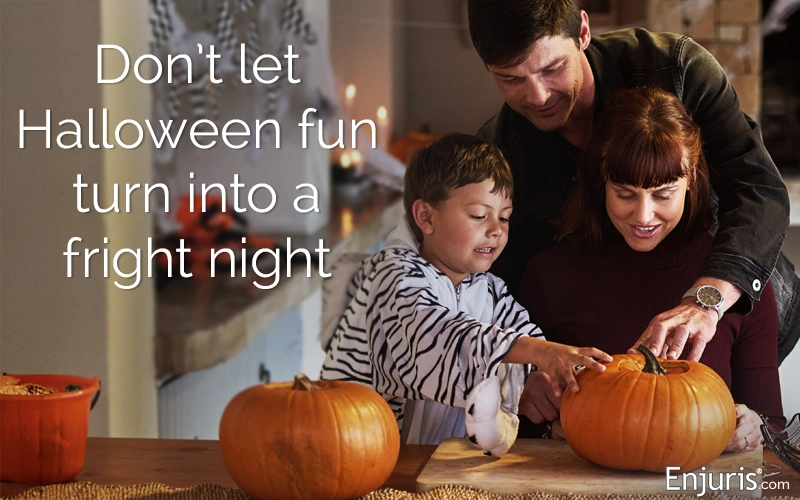
It’s spooky season (if you’re up on your Internet jargon, that would be #SpookySzn)! Some of us are in it for the pranks, jump scares, fake blood, and crazy antics. Others just want their peanut butter cups or chocolate miniatures (which is A-Ok, too!).
But while Halloween and the events leading up to it can be great fun, several types of injuries unfortunately accompany this season of “scaries.”
Halloween drunk driving accidents and fatalities
Did you know that Halloween is one of the most dangerous nights of the year for drunk driving fatalities? We typically think of New Year’s Eve, St. Patrick’s Day, and the other “party” holidays as the nights when the drunk drivers are out on the roads, but Halloween night is right up there, too.
This analysis of Halloween night drunk driving data places it neck-and-neck with St. Patrick’s Day, Fourth of July, and New Year’s holidays. It’s not a perfect comparison—the data aren’t calculated the same way for each—but it illustrates that Halloween has as high a risk for drunk driving fatalities as some of these other days.
Drunk driving deaths per holiday period
| Holiday | Drunk driving deaths |
|---|---|
| St. Patrick’s Day | 290 |
| 4th of July | 188 |
| New Year’s Day | 179 |
| Halloween | 176 |

The fatality figures are gathered over five years for each of these holidays, and for a stretch of five days for the 4th of July, which is considered the “holiday period.” The data for each holiday often uses different time windows and durations.
Halloween data is typically for one night, while July 4th and winter holiday statistics cover multiple days. Thus, raw counts alone don’t reflect risk per hour or fatality rate relative to traffic volume. Nonetheless, the proportion of fatalities in which impairment is involved tends to be higher during holidays, where social drinking is more common.
Spooky Halloween injury statistics
- 3,200 Halloween-related injuries are treated in hospital emergency departments nationwide per year, on average.
- About 55% are from pumpkin-carving cuts and lacerations.
- 25% are from falls.
- 20% are other types of injuries.
- 7,000 Halloween injuries occurred to children and teens between 2007 and 2016. Nearly 1 in 5 involved a head injury.
- 54% of those injured are adults, while about 46% are children.
- Children are 4 times more likely to be hit by a car on Halloween night compared to other nights of the year. On average, there are 4 child pedestrian deaths on Halloween night, versus 1 on other nights.
- The term “Halloween hand” refers to the common hand and finger lacerations that happen from carving pumpkins using sharp or unsteady tools in low light.

Common Halloween injuries
Staying off the roads isn’t the only way to protect yourself from a Halloween injury. Several other types of accidents and injuries are common on Halloween, and it’s wise to be aware because most (if not all) are preventable.
| Type of injury | Estimated % of injuries |
|---|---|
| Cuts and lacerations | 55% |
| Fractures and sprains | 17% |
| Soft tissue injuries | 15% |
| Burns | 5% |
| Allergic reactions/ingestions | 3% |
| Other | 5% |

Allergic reactions
The Canadian Medical Association Journal recently conducted a study that found an increase in allergy-related emergency department visits on Halloween. The biggest culprit was peanut-triggered anaphylaxis, which increased to 85% of allergic reactions on Halloween. Tree nuts accounted for about 60% of the allergic reactions on Halloween.
Nuts and other food allergies aren’t the only culprits, though. Halloween celebrants use decorative chemicals, fog machines, and artificial smoke that could be irritants to sensitive individuals. Some people also suffer reactions from costume materials, face paint, or mask adhesives that cause skin irritations or chemical burns.
Cuts and lacerations
Carving pumpkins isn’t easy! Certainly, it should be a well-supervised activity if children are involved. Knife and sharp-tool injuries from pumpkin carving are seen in emergency departments every year leading up to and on Halloween. There are also injuries from breakable or sharp decorations, props, or broken glass in jack-o-lanterns. Costume malfunctions happen, too, particularly when there are rigid edges, sharp wires, or sharp edges on masks.
Burns, fire, and smoke inhalation
Some people like to use real candles inside their jack-o-lanterns; this gives an appropriately eerie flicker effect, but it can also cause fires. Hay bales and flammable cloth ghosts, particularly when used as indoor decor, can also be dangerous because of their flammable qualities. And, while backyard fire pits, bonfires, and pyrotechnics certainly aren’t limited to Halloween parties and gatherings, they are common. In some parts of the country, the ground is covered in dry leaves in late October, and this is akin to placing kindling around your otherwise controlled fire. Be very careful and have plenty of water ready to extinguish a fire if you’re doing anything involving fire, sparks, or other incendiaries, in order to prevent a fire from getting out of control.
Choking or ingestion injuries
Choking is one of the primary dangers to toddlers. Particularly on a night when there’s a lot of hubbub and children might be permitted to consume novelty treats or candies that they don’t normally, or if parents are distracted or unaware that their little one is putting something in their mouth while trick-or-treating, choking can be a big problem. Small toy parts or candy can be a choking hazard to little ones on Halloween.
Even non-food items like glow sticks or small decorative items can be dangerous. Masks or small parts to costumes can have components that obstruct a child’s breathing or airway.
Facial and eye injuries
Anyone—child or adult—could be injured by tree branches that overhang the street or sidewalk, tree limbs, or low wires while trick-or-treating or decorating. Halloween celebrants also suffer eye irritation from spray paints, fog machines, dry ice, or smoke machines. Eye or facial trauma can also be caused by costume prop failure, such as snapping parts or splintering plastic.
Trick-or-treat pedestrian accidents
We know pedestrian accidents can happen any day of the year. However, Halloween is the night when children are outside walking the streets after dark, which is unusual on the other 364 nights. It’s almost a recipe for disaster—small children, already “high” on sugary sweets, excited for a much-hyped evening of fun and frolic, wearing costumes that might have long extensions, masks that might obstruct vision, shoes that might be unusual or ill-fitting (“it’s just for one night!”), and drivers who are eager to get to their own festivities—what could go wrong? Well, a lot, actually.
Children… bolt. Well, they might, anyway. With all the excitement of Halloween, little ones are more likely to run between parked cars, cross a street without looking both ways, or do other haphazard things that could put them at risk of becoming injured in a pedestrian accident. Particularly if a child is wearing a dark costume, a driver might not see them if they cross mid-block or step off a curb unexpectedly.
Children could also experience trip-and-fall accidents on uneven sidewalks, broken curbs, or cracks in the ground if it’s dark and they are carrying heavy bags of candy. Of course, adults can also fall because of a hazardous condition, particularly in poorly lit areas.
Falls from heights or elevated areas
Children might want to be involved in decorating—it’s half the fun of the season, after all!—but injuries happen from climbing ladders to hang decorations or lights, people fall from rooftops, and children and adults climb on unstable surfaces to decorate. Children should be supervised while decorating, and adults should use best practices when using ladders or on elevated surfaces like a roof.
Emergency department visits on Halloween
- 55% of all emergency department visits on Halloween are due to pumpkin carving injuries.
- The risk of pedestrian accidents is 43% higher on Halloween than on non-Halloween days or nights, with the risk spiking between 6-7 PM.
- To prevent injuries, it’s recommended to increase visibility and use safe walking routes while trick-or-treating.
- When carving pumpkins, it’s important to use hand protection and choose the right tools to prevent injuries.

Halloween injuries by age group
Under
age 6
This group accounts for 10% of Halloween injuries. Common injuries include candy choking hazards, allergic reactions, burns, and minor falls while trick-or-treating.
Ages
6-17
This group accounts for 36% of Halloween injuries. Common injuries include pedestrian injuries, costume-related trips, bicycle or scooter crashes, and carving accidents while helping adults.
Ages
18-54
This group accounts for 42% of Halloween injuries. Common injuries include hand and wrist lacerations from pumpkin carving, falls from ladders or porches, and party-related injuries.
Ages
55+
This group accounts for 12% of Halloween injuries. Common injuries are fall-related fractures (hips, wrists, ankles) that occur while decorating or supervising children outdoors.

8 tips for staying safe on Halloween 🎃
1. Pumpkin carving safety
- Use safer carving tools instead of kitchen knives (pumpkin carving kits with serrated, controlled blades).
- Cut pumpkins on a stable surface using a non-slip base.
- Illuminate with battery-powered LED candles rather than open flames.
- Keep hands and carving tools dry to prevent slipping.
2. Costume visibility
- Choose costumes that fit properly (not too long) to avoid tripping.
- Opt for light or reflective materials (tape, sashes) or add LED lights to make children visible.
- Avoid masks that restrict peripheral or downward vision; consider face paint instead.
- Use tread-safe shoes, not costume shoes, for walking or trick-or-treating.
3. Safe trick-or-treating
- Walk on sidewalks, not in the street; cross at corners and crosswalks.
- Go out in groups and bring flashlights or glow sticks.
- Supervise young children; older kids should travel planned routes in known neighborhoods.
- Stay on well-lit paths; avoid shortcuts through dark alleys or overgrown yards.
4. Decorate safely
- Use stable ladders on even ground when hanging decorations or lights.
- Avoid using extension cords because they can be foot traffic hazards; secure or tape down cables.
- Ensure walkways, steps, and driveways are clear of cords, debris, leaves, or props.
- Place decorations so they don’t obstruct walking paths and use lights rated for outdoor use.
5. Use fire or candles with caution
- Keep flammable decorations away from heat sources (candles, open flames, jack-o-lanterns).
- Use flameless candles or LED lights inside pumpkins.
- Place jack-o-lanterns where they won’t be knocked over by costumes or gusts of wind.
- If using a fire pit or bonfire, maintain a safe perimeter, keep water nearby, and supervise at all times.
6. Avoid allergic reactions and choking
- Inspect candy and discard unwrapped or open treats.
- Be aware of allergens (nuts, dyes, etc.).
- Avoid giving candy with choking risks (for instance, small hard parts for toddlers).
7. Avoid intoxication hazards
- If drinking alcohol at Halloween parties, always designate a sober driver or use a rideshare service.
- Know that impaired walking, decoration hanging, or navigating streets at night increases risk.
8. Be prepared for an emergency
- Carry a small first-aid kit—bandages, antiseptic wipes, tweezers.
- Educate children and household members about basic steps for what to do if separated, traffic safety, how to remove a costume safely.
- Keep mobile phones charged and have a meeting point if someone gets lost.

Halloween can be the most fun night of the year—whether you’re age one or 100—there’s no limit to merriment of the holiday. If you love your annual fix of spooky spirit, never lose that energy! But do be aware of your surroundings and take a few extra precautions on Halloween.
Sources
US DOT Traffic Safety Marketing
Mothers Against Drunk Driving
NSC Injury Facts
American Academy of Orthopaedic Surgeons
SCP Health
US Consumer Product Safety Commission
US Centers for Disease Control and Prevention
National Library of Medicine