
When tragedy strikes in a school environment, the question of liability often follows, as families and communities seek answers and accountability.
Recent cases involving student suicides in Rhode Island and Utah have highlighted how complicated these issues of liability can be for school districts, administrators, and staff.
How common is suicide among high school students?
Suicide is the second-leading cause of death for teens and young adults ages 10-34, at a rate of 11 per 100,000. According to the Centers for Disease Control and Prevention (CDC), this accounted for 7,126 deaths in 2022 (the most recent year for which complete data is available).
Nearly 1 in 4 high school students (22 percent) reported seriously considering suicide within the past year, with certain groups facing significantly higher risks:
- 30 percent of female students
- 27 percent of American Indian/Alaska Native students
- 45 percent of LGBTQ+ students
What’s more, 10 percent of high school students reported attempting suicide in the past year, with the highest attempt rates among females (13 percent), American Indian/Alaska Native students (16 percent), Black teens (14 percent), and lesbian, gay, or bisexual teens (22 percent).

Nathan Bruno’s death and lawsuit
A Rhode Island jury awarded $5.4 million to the family of 15-year-old Nathan Bruno, who took his own life in 2018. The jury found that Portsmouth High School’s former football coach, Ryan Moniz, and certain school administrators were negligent in their handling of Bruno’s situation, contributing to the teenager’s suicide.
According to the lawsuit, Moniz pressured Bruno to reveal the names of other students involved in sending him harassing messages. This pressure reportedly extended beyond the coach to include Bruno’s football teammates, which the family argued created a toxic environment and contributed to his emotional distress.
Moniz and other school staff allegedly failed to communicate with Bruno’s parents about a police investigation involving him and reassigned him to another class without notifying his family. Ultimately, the jury found Moniz’s actions directly caused Bruno’s death, resulting in an award against the school district.
“It was just an utter failure, pressuring a boy,” said Peter Cerilli, who represented the parents with John Foley. “There was basically bullying by the coach.”
Isabella Tichenor’s death and lawsuit
Isabella “Izzy” Tichenor, a 10-year-old autistic Black girl, died by suicide in 2021 after facing severe racial and disability-related bullying at Foxboro Elementary School. According to her family, despite repeated complaints, school officials failed to intervene effectively, creating an environment in which Izzy felt isolated and unsafe.
Following the tragedy, the Davis School District agreed to a $2 million settlement with Tichenor’s family.
Although the district did not admit fault, it acknowledged the family’s grievances and agreed to take steps to prevent future cases. This included introducing policies to monitor and document bullying and improving support for students who face harassment.
The settlement came shortly after the U.S. Department of Justice reprimanded the district for failing to address racial discrimination.
Legal considerations for school liability in student suicide cases
Both the Bruno and Tichenor cases highlight key legal elements required to establish liability in cases where school environments may have contributed to a student’s death. To hold a school district or its employees liable in cases of student suicide, plaintiffs typically must establish:
- Duty of care: Schools have a duty to ensure students’ safety and well-being, including mental health support and protections from bullying.
- Breach of duty: Plaintiffs must demonstrate that school staff or administration breached this duty by failing to intervene, notify parents, or take other reasonable actions.
- Causation: The plaintiff must prove that the school’s negligence was a substantial contributing factor leading to the student’s death.
- Damages: Finally, plaintiffs must show that the family suffered financial or emotional damages as a result of the loss.
Causation is often the most challenging element to prove in student suicide cases because it requires establishing a direct link between the school’s actions (or inactions) and the student’s decision to take their own life. Unlike physical injuries, where cause and effect can often be observed directly, emotional and psychological impacts are complex and subjective.
Proving that a school’s failure to protect or support a student was a “substantial contributing factor” in their suicide demands extensive evidence, often including expert testimony, documentation of the student’s mental state, and an analysis of any other contributing influences.
For example, in a case where a student was bullied at school but also had a history of mental health issues, it can be difficult to demonstrate that the school’s inaction alone was a significant factor in their decision. The defense may argue that personal or external factors unrelated to the school environment were the primary causes.
How to document and report concerns to the school
If you’re concerned about your child’s well-being or suspect bullying, it’s essential that you document and report these concerns to school administrators. Having a record of communications with the school may not only help in protecting the student but also strengthen any potential legal claims if the situation escalates. Here are some steps you can take:
- Keep a written record: Document all instances of bullying or signs of distress your child reports, including dates, details, and any witnesses. Keep copies of emails, texts, or letters sent to school staff about your concerns.
- Notify school officials in writing: Whenever possible, address concerns formally in writing to ensure a documented trail. Be sure to send the documents via certified mail with a return receipt requested (this way, you’ll have proof the document was received). Include specific requests for interventions and ask for written responses from the school.
- Request meetings and follow-ups: Request regular meetings with school staff to discuss progress and measures taken. If interventions aren’t working, ask the school for adjustments and document any new recommendations.
- Consult school policies: Review the school’s policies on bullying, harassment, and mental health support to understand what resources and protections should be available to your child.
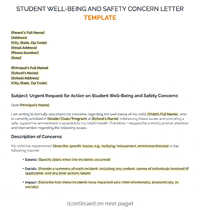 Student Well-Being Letter
Learn how to report concerns to your school, document issues, and request support for your child’s well-being.
Download in PDF format
Legislative and policy changes
In both Rhode Island and Utah, these tragic cases spurred legislative responses. Rhode Island enacted the Nathan Bruno and Jason Flatt Act, which mandates suicide prevention policies and requires suicide prevention training for all public school district personnel. Similarly, following Izzy Tichenor’s death, Utah passed Izzy’s Bill, which requires schools to track and document reports of bullying and discrimination, with the goal of improving responses to harassment and providing greater accountability in school environments.
These legislative changes reflect a growing recognition that schools bear significant responsibility in protecting students’ mental well-being. Schools are increasingly aware they may face liability if they fail to provide comprehensive mental health support, enforce effective anti-bullying and cyberbullying policies, and follow timely parental notification protocols. By learning from these cases, districts across the country can work toward fulfilling their duty of care, reducing liability, and creating safer, more supportive environments for all students.
If you or someone you know needs help, call or text the National Suicide & Crisis Lifeline at 988. You can also reach the Crisis Text Line by texting CRISIS to 741741.
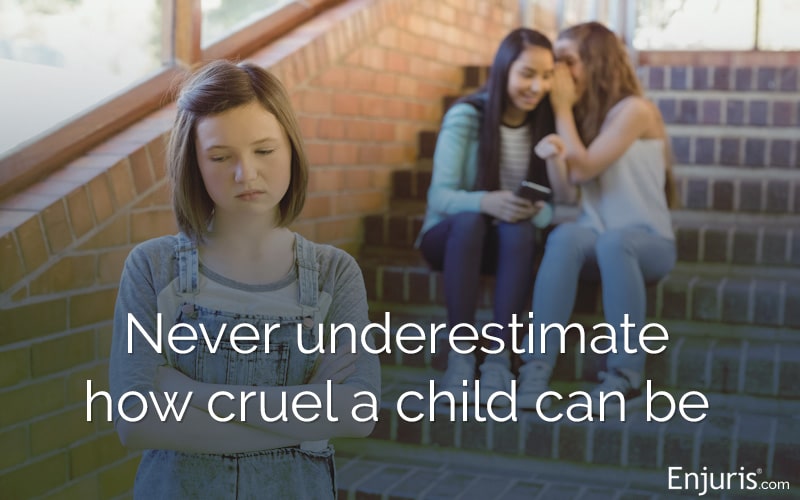
Parents win $9m from school district after daughter’s suicide
A 12-year-old was bullied relentlessly. She died by suicide. Now her parents have recovered a $9.1m settlement from her school for failing to protect her.